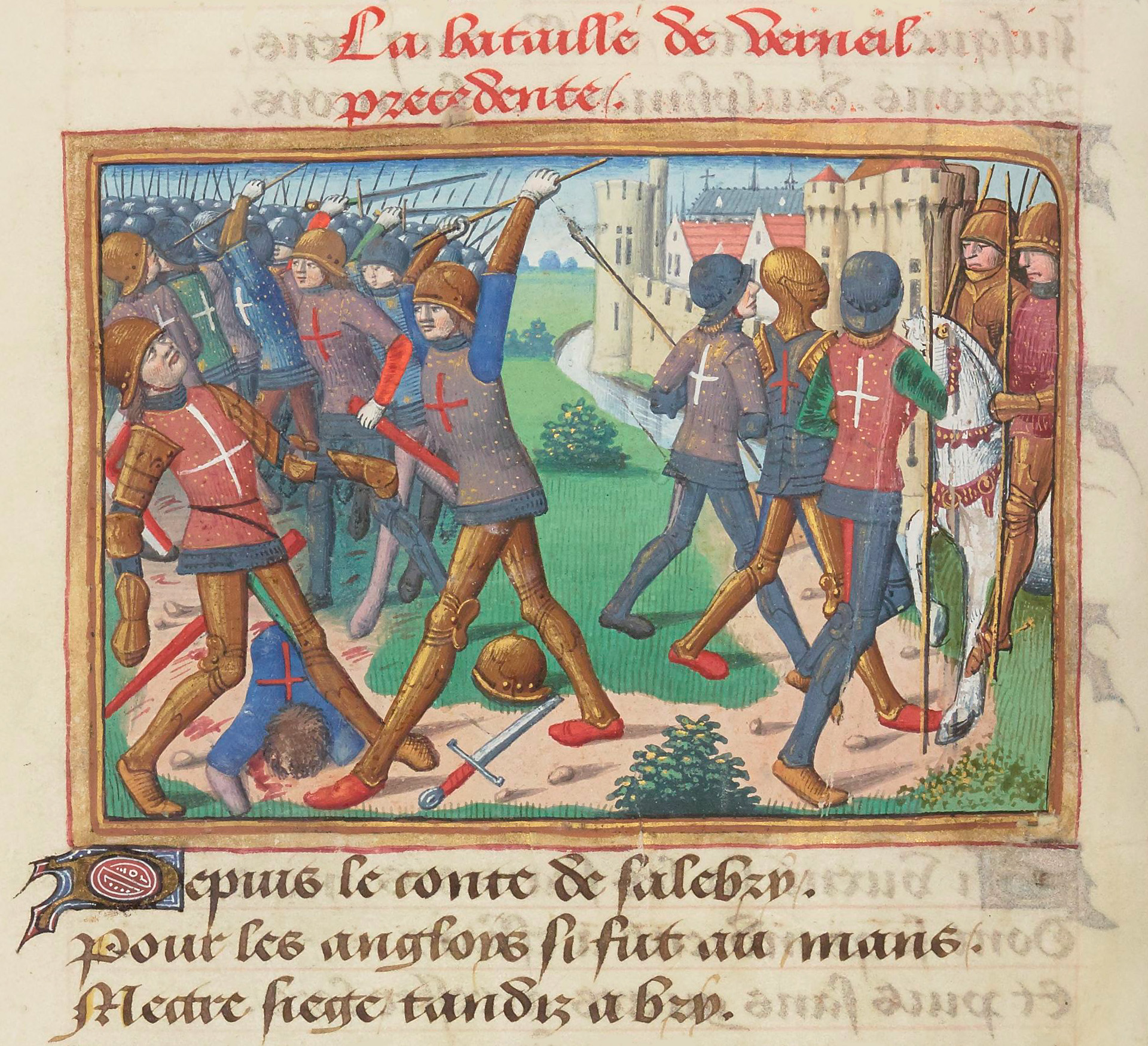
Battle of Verneuil
The Earl of Douglas, one of Scotland's most powerful noblemen, had traveled to France to find the Duke of Bedford and fight him. According to the chronicles, Bedford sent word that he had come to drink with Douglas and prayed for an early meeting. Douglas replied that, having failed to find the duke in England, he had come to seek him in France. They found each other on 17 August 1424, on a sun-baked plain a mile north of Verneuil-sur-Avre. What followed was, in the words of medievalist Desmond Seward, "a hand-to-hand combat whose ferocity astounded even contemporaries" -- one of the bloodiest battles of the Hundred Years' War.
Scotland's Army Crosses the Channel
By 1424, France was fracturing. The disaster at Agincourt nine years earlier had gutted the French nobility, and England's Henry V had conquered Normandy before his death in 1422. The Dauphin Charles, disinherited by the Treaty of Troyes, controlled only the south of France and desperately needed soldiers. He turned to Scotland, France's ally under the ancient Auld Alliance. The first large Scottish contingent -- 6,000 men under John Stewart, Earl of Buchan -- had arrived in 1419 and proved their worth at the Battle of Bauge in 1421, the first serious English setback of the war. In early 1424, Buchan returned with 6,500 more men, accompanied by the formidable Earl of Douglas. The Dauphin also hired 2,000 Milanese heavy cavalry from Filippo Maria Visconti, Duke of Milan -- armored mercenaries clad in full tempered steel plate, riding barded horses. The Franco-Scottish army was confident it could crush the English in open battle.
A Ruse Opens the Gates
The English, commanded by Bedford and the Earl of Salisbury, had been besieging the fortress at Ivry when the Franco-Scottish army assembled to relieve it. Before they could arrive, Ivry surrendered. Uncertain what to do, the allied commanders debated. The Scots pushed for battle; the senior French nobility, haunted by the memory of Agincourt, counseled caution. A compromise emerged: they would attack English-held border towns instead, starting with Verneuil. A group of Scots took the town through a clever deception, marching some of their own countrymen in as prisoners while pretending to be English, claiming Bedford had won a great victory. The gates swung open. When Bedford learned Verneuil had fallen, he marched to retake it. Both armies deployed on an open plain north of the town and stood facing each other from dawn until about four in the afternoon, each waiting for the other to move first under a blazing August sun.
Steel Hooves Across Hard Ground
Bedford ordered the advance. His soldiers shouted "St. George! Bedford!" as they crossed the field. After a brief and inconclusive archery exchange between English and Scottish bowmen, the 2,000 Milanese cavalry charged. The summer sun had baked the ground so hard that the English could not drive their protective wooden stakes firmly into the earth. Arrows bounced off the Italians' superior plate armor. The Milanese smashed through the English formation, scattering longbowmen on the right wing and riding clear through to loot the English baggage train. Panic rippled through the English army. A Captain Young fled with 500 men, convinced the battle was lost; he was later hanged, drawn, and quartered for cowardice. Retreating English soldiers spread false news of Bedford's defeat across Normandy, sparking local uprisings at Pont-Audemer and in the countryside.
Forty-Five Minutes of Slaughter
But Bedford rallied his men-at-arms, who showed extraordinary discipline in reforming their ranks. The dismounted English and Franco-Scottish men-at-arms crashed together on foot in what contemporaries described as the most ferocious melee of the entire war. The chronicler Wavrin, who fought in the battle, recalled how "the blood of the dead spread on the field and that of the wounded ran in great streams all over the earth." Bedford himself waded into the fighting with a two-handed poleaxe that, according to Seward, "smashed open an expensive armour like a modern tin can." For three-quarters of an hour, no side gained advantage. Then the scattered English longbowmen reformed and re-entered the fight with a great shout. The French line broke. Many, including the Count of Aumale, were driven into the moat at Verneuil and drowned.
No Quarter Given
With the French routed, Bedford turned on the Scots, who stood alone. Surrounded on multiple sides, they made a ferocious last stand. The English cried "A Clarence! A Clarence!" invoking Bedford's brother Thomas, killed by Scots at Bauge three years earlier. No quarter was offered. Nearly the entire Scottish force fell on the field, including both Douglas and Buchan. When the Milanese cavalry finally returned from looting the baggage train, they discovered the slaughter and fled. Altogether, some 6,000 to 8,000 men on the Franco-Scottish side died, with Bedford claiming 7,262 killed in a letter written two days later. The Army of Scotland as a distinct fighting force was effectively destroyed. Bedford returned to Paris in triumph, received, one chronicler wrote, "as if he had been God." The Dauphin's planned coronation at Reims would have to wait five more years, until a teenage peasant girl from Lorraine arrived to change the course of the war.
From the Air
Located at 48.76°N, 0.94°E near Verneuil-sur-Avre in the Eure department of Normandy, France. The battlefield lies on open plains north of the town, still largely agricultural land. Nearest airports include Evreux-Fauville (LFOE) approximately 45 km northeast and Paris-Orly (LFPO) approximately 120 km east. Best viewed from 3,000-5,000 feet AGL. The town of Verneuil-sur-Avre is visible along the Avre river valley.