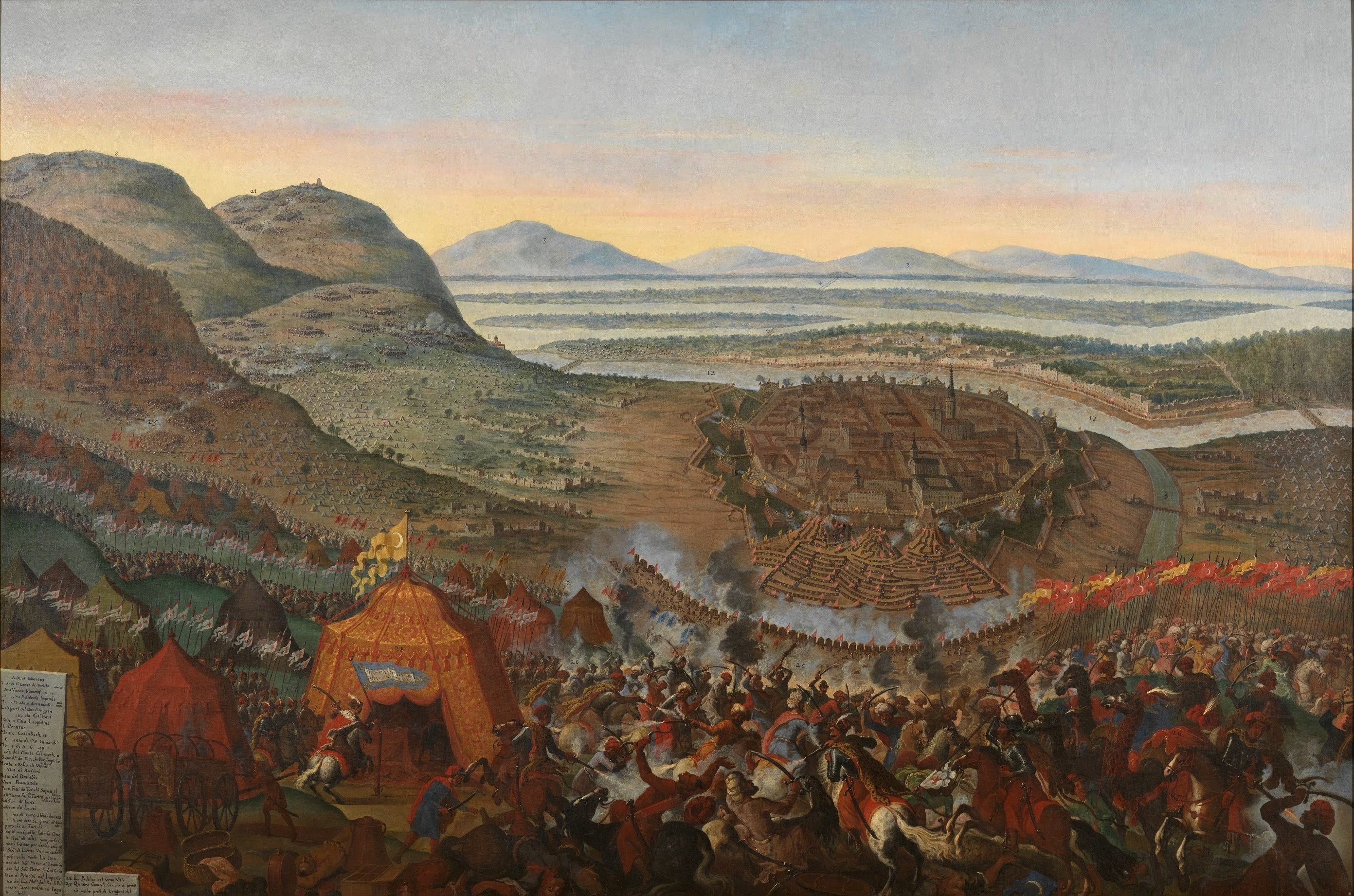
The Battle of Vienna: The Cavalry Charge That Saved a Continent
By early September 1683, Vienna was dying. Ottoman sappers had been tunneling beneath the city walls for two months, detonating mine after mine to collapse the fortifications. Disease and starvation were thinning the garrison. The defenders had located and disarmed ten mines set for a final, catastrophic detonation under the Lobelbastei, but they knew they could not hold much longer. Then, on the morning of September 12, the watching Ottoman sentries saw something that changed the shape of European history: an army of 70,000 soldiers pouring out of the Vienna Woods onto the slopes of Kahlenberg Mountain, with 20,000 Polish cavalry - including 3,000 of the legendary Winged Hussars - preparing to charge.
The Sultan's Grand Design
Grand Vizier Kara Mustafa Pasha had arrived before Vienna in July 1683 with an army that Ottoman sources number at approximately 120,000 soldiers and 156 guns, though tens of thousands more provided logistical support. The force included Janissaries, Sipahi heavy cavalry, Tatar horsemen from the Crimean Khanate, and contingents from Wallachia and Moldavia. The goal was not merely to take a city but to shatter the Habsburg heartland and open Central Europe to Ottoman control. For two months, Mustafa's sappers dug tunnels and detonated mines while his troops gradually demolished Vienna's outer defenses. By mid-August, Austrian Ambassador Kunitz estimated the besieging army had already suffered some 20,000 casualties, yet the pressure on the walls only intensified. An Ottoman account captured after the battle would record total casualties of 48,544 by September 10 - a staggering toll that speaks to the ferocity of the siege and the determination of both sides.
An Alliance Assembled in Six Days
While Vienna bled, a relief force was assembling with extraordinary speed. Pope Innocent XI had helped broker the Holy League, bankrolling the campaign with papal funds supplemented by loans from bankers and noblemen across Europe. King Jan III Sobieski of Poland marched south with the largest contingent, including his prized Winged Hussars - heavy cavalry who wore wooden frames mounted with eagle or ostrich feathers that roared in the wind during a charge. Imperial forces from the Habsburg lands, Saxony, Bavaria, and Franconia joined them. Despite the multinational composition and the fact that the commanders had only six days to organize, an effective command structure emerged with Sobieski at its head. The speed of assembly was itself remarkable. Sobieski's forces crossed the Danube on pontoon bridges and pushed through the dense Vienna Woods to reach Kahlenberg Mountain - all while the Crimean Khan, tasked by Mustafa with blocking their advance, inexplicably refused to attack.
Twelve Hours on Kahlenberg
The battle began at dawn on September 12 and built through the day in phases. German and Austrian infantry engaged Ottoman positions on the left flank while Polish infantry advanced on the right, capturing the village of Gersthof by four in the afternoon. At 5:00 PM, with the German forces closing in on the central Ottoman position at the Turkenschanze, Sobieski launched the decisive blow: the largest cavalry charge in recorded history. Twenty thousand horsemen, led by 3,000 Winged Hussars, swept down the slopes directly toward Kara Mustafa's headquarters. The exhausted, demoralized Ottoman lines broke almost immediately. Soldiers who had fought for months fled toward the southeast. The Viennese garrison, hearing the thunder of the charge, sallied out from behind its battered walls to join the assault. By nightfall, the Ottoman camp - with its tents, supplies, and war chest - had fallen. Mustafa himself barely escaped, though his escape only delayed the inevitable: on Christmas Day 1683, he was executed in Belgrade by strangulation with a silk cord, the Ottoman Empire's traditional punishment for commanders who failed.
The Human Cost Beyond the Walls
The siege was not only a military contest. In the countryside surrounding Vienna, Ottoman forces conducted systematic raids that devastated the civilian population. The villagers of Perchtoldsdorf barricaded themselves in a church fortress and resisted until the Ottomans offered terms: surrender your weapons, and your lives and property will be spared. When the villagers capitulated, the men were gathered in the market square and massacred. Women and children were taken into slavery. Across the Austrian and Hungarian border zone in 1683, an estimated 57,220 people were enslaved - 6,000 men, 11,215 married women, 14,922 unmarried women under twenty-six, and 26,093 children. These numbers, meticulously recorded, represent not abstract statistics but families torn apart, communities destroyed, and individual lives of immeasurable suffering. The victory at Vienna ended the Ottoman threat to Central Europe, but for those who had already been taken, liberation came too late or not at all.
An Echo Across Centuries
Ottoman historian Silahdar Findiklili Mehmed Agha called it the most disastrous defeat since the founding of Ottoman statehood in 1299. Vienna was never besieged by the Ottomans again. The battle triggered the Great Turkish War, which over the next sixteen years pushed Ottoman borders far to the southeast. In gratitude, the Austrians erected a church atop Kahlenberg Mountain in Sobieski's honor. The constellation Scutum was named in 1684 to commemorate the shield Sobieski carried. Yet the battle's legacy remains contested. In 2024, the city of Vienna declined a proposed monument to Sobieski, citing concerns about its appropriation by anti-Muslim and anti-Turkish political movements. History rarely stays in the past. The Battle of Vienna shaped the borders of modern Europe, ended Ottoman expansion westward, and created a narrative of civilizational conflict that people still invoke - and argue about - more than three centuries later.
From the Air
The battle took place on and around Kahlenberg Mountain (48.26N, 16.33E), located on the northern edge of Vienna along the Danube. The hill rises to 484 meters and is clearly visible from the air, with a church on its summit commemorating the battle. The Turkenschanzpark in Vienna's 18th district marks the former central Ottoman position. Vienna International Airport (LOWW) is 23 km southeast. Bratislava Airport (LZIB) is 60 km east. At 3,000-5,000 feet, the Danube curves around the Kahlenberg and Leopoldsberg hills, with the Vienna Woods stretching to the west - the same forested terrain through which Sobieski's relief army emerged on September 12, 1683.