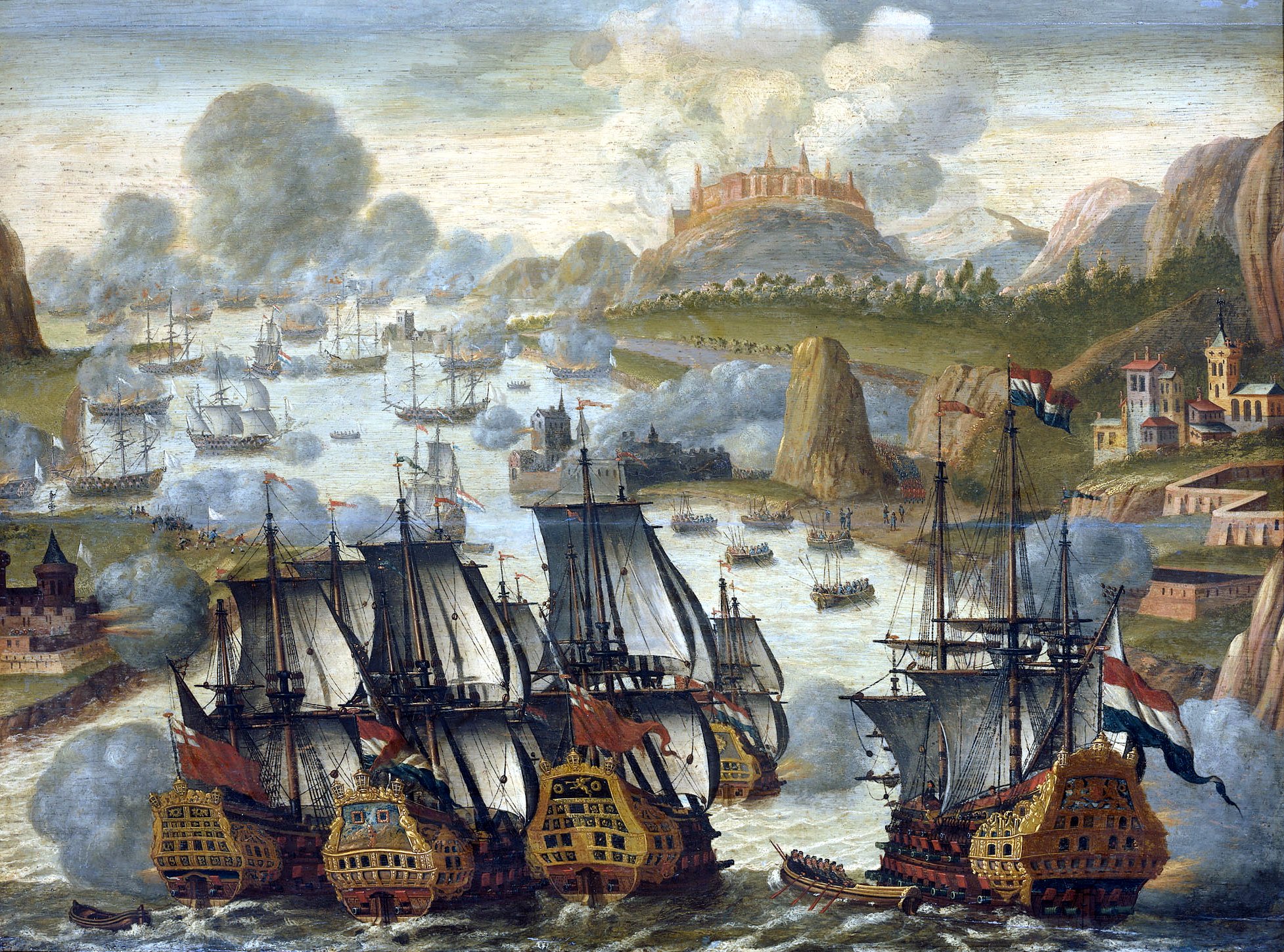
Battle of Vigo Bay
The intelligence came from a boastful French consul. In October 1702, Captain Thomas Hardy's chaplain, a Jersey man named Beauvoir, was watering in the Portuguese port of Lagos when the consul let slip that the Spanish treasure fleet, laden with silver from the Americas, had entered Vigo Bay in northern Spain. Beauvoir confirmed the report through a messenger from the Imperial Embassy in Lisbon. Hardy raced after Admiral George Rooke, catching him on October 17 just in time to prevent the fleet from crossing the Bay of Biscay for home. Rooke's recent attempt to capture Cadiz had been a humiliating failure. Now, word of a treasure fleet changed everything.
Silver, Suspicion, and a Sheltered Bay
The treasure fleet had crossed the Atlantic from Havana: 56 vessels, 22 Spanish and the rest French, carrying silver, pepper, cochineal, cocoa, snuff, indigo, and hides. Under normal circumstances, the cargo would have been landed at Cadiz, but the Anglo-Dutch fleet's recent attack on that port made the route too dangerous. Instead, the convoy diverted to Vigo Bay, a deep inlet on the Galician coast. The French admiral Chateaurenault, commanding the escort fleet, positioned his ships behind a boom stretched across the Rande Strait, anchored between twin shore batteries. Within the boom he moored his largest men-of-war with their broadsides covering the entrance. It was a strong defensive position. But the Spanish had been suspicious of French intentions from the start, and much of the silver had been quietly unloaded and sent inland before the battle began.
Breaking the Boom
Early on October 23, Vice Admiral Thomas Hopsonn led the attack on the boom, followed by English ships and Dutch vessels under Philips van der Goes. Simultaneously, the Duke of Ormonde landed 2,000 marines near Teis and marched on Fort Rande. Lord Shannon's grenadiers stormed the outer wall and silenced the seaward battery just as the ships reached the boom. The 90-gun Association attacked and silenced the northern battery on the opposite shore. Hopsonn's ship struck the boom and initially became entangled, drowning 53 men according to Rooke's journal. But as the breeze picked up, the other Allied ships broke through and engaged the trapped Franco-Spanish fleet. With the boom broken and the forts taken, Chateaurenault's men set fire to their own ships rather than let them be captured. Allied sailors worked through the night to save prizes, and by morning not a single French or Spanish vessel remained afloat that had not been taken or burned.
The Treasure That Got Away
The destruction was total. Of the French escort's 15 ships of the line, 2 frigates, and 1 fireship, none escaped. Five were captured by the English, one by the Dutch, and the rest burned. All three Spanish galleons and 13 trading vessels were destroyed or taken. Yet the silver that had motivated the attack was largely gone. Isaac Newton, then Master of the Mint, reported that the total metal delivered to him by June 1703 amounted to roughly 2,043 kilograms of silver and 3.4 kilograms of gold, valued at just 14,000 pounds. Coins struck from this metal bore the word VIGO below Queen Anne's bust and remain rare collector's pieces. Philip V, meanwhile, confiscated all treasure-fleet silver belonging to English and Dutch merchants and borrowed further from Spanish traders, keeping nearly seven million pesos, the largest sum any Spanish king had ever extracted from the American trade.
Ripples Across an Empire
The battle's strategic consequences far outweighed the captured treasure. The demonstration of Anglo-Dutch naval dominance persuaded Peter II of Portugal to abandon his treaty with France and join the Grand Alliance. This alliance gave the Maritime Powers a base in Lisbon and opened new theaters of war in Spain and the western Mediterranean. The commercial treaties that followed became an essential component of Britain's 18th-century prosperity. Treasure hunters have returned to Vigo Bay repeatedly over the centuries, from Alexandre Goubert's failed 1728 attempt to raise a ship to William Evans's 1825 diving-bell expedition. Jules Verne immortalized the sunken fleet in his 1870 novel Twenty Thousand Leagues Under the Seas, where Captain Nemo funds his submarine Nautilus from the treasure on the bay floor, depicted as never having been offloaded. The real treasure had long since traveled by mule to the castle of Segovia, but the legend of Vigo Bay's sunken silver endures.
From the Air
Located at 42.25N, 8.74W in the Ria de Vigo, Galicia, northwest Spain. Vigo Bay is a large sheltered inlet clearly visible from altitude, with the Rande Strait narrows where the boom was placed now spanned by the modern Rande Bridge. The city of Vigo lies on the southern shore. Nearest airport is LEVX (Vigo-Peinador) approximately 10 km from the bay. The Cies Islands mark the mouth of the bay to the west. Best viewed from 3,000-5,000 ft AGL.