Battle of Villalar
Every April 23, tens of thousands of people gather in a small town on the Castilian plateau to lay flowers at a stone monument. The town renamed itself Villalar de los Comuneros to honor what happened here in 1521, and the date is now the official holiday of the autonomous community of Castile and Leon. What draws the crowds is not a victory. It is a defeat -- one that ended the most serious challenge to royal power in early modern Spain and turned three executed rebel leaders into martyrs for democratic self-governance centuries before the concept had a proper name.
The Comuneros Rise
The Revolt of the Comuneros erupted in 1520 when Castilian cities rebelled against King Charles I, a Habsburg who had arrived from Flanders speaking no Spanish and surrounded by foreign advisors. The comuneros -- urban citizens demanding a voice in governance -- formed a junta, seized towns, and fielded armies. At stake was the question of whether Castile's traditional liberties, embodied in its Cortes and municipal councils, would survive under an ambitious foreign king bent on consolidating power. By early 1521, the rebellion held substantial territory, anchored by the fortress at Torrelobaton. But the comunero forces were plagued by indecision, desertions, and a fatal lack of cavalry -- the arm that would decide the coming battle.
Rain and Ruin on the Meseta
On the morning of April 23, 1521, the rebel commander Juan de Padilla finally ordered a withdrawal toward Toro, where he hoped to find reinforcements. He had delayed too long. The royalists, having united the armies of the Constable and the Admiral of Castile at Penaflor, now fielded 6,000 infantry and 2,400 cavalry against the comuneros' 7,000 foot soldiers and just 400 horsemen. Then the rain came. Heavy downpours turned the open meseta into a bog, slowing Padilla's infantry to a crawl while doing far less to impede the royalist cavalry. Worse, the rebels' 1,000 arquebusiers found their primitive firearms rendered useless by the wet. The royalist horsemen swept into the struggling column, and the comunero army disintegrated. Some fled toward Toledo, others toward Portugal. The battle was less a fight than a collapse.
Three Men at Dawn
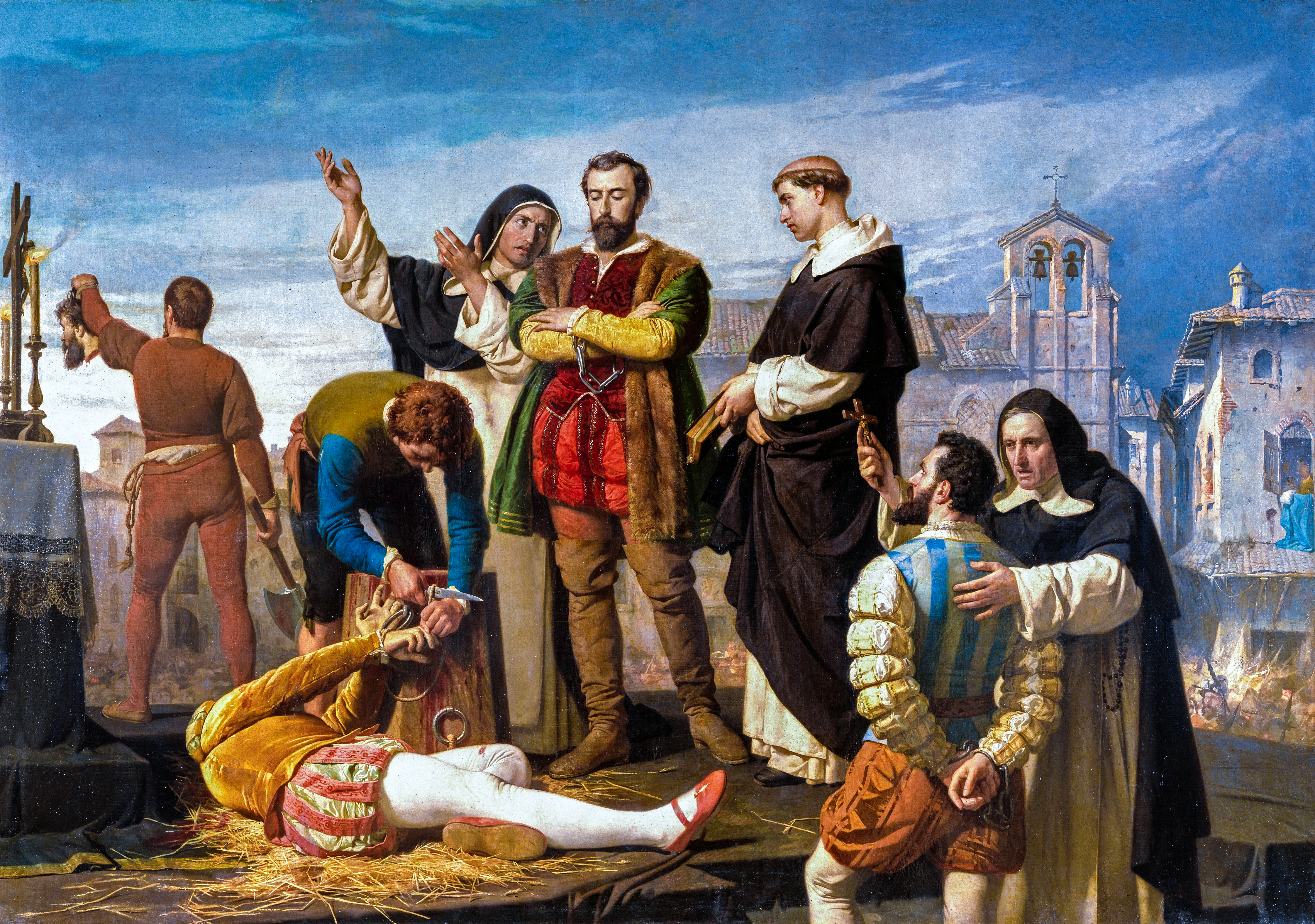
The royalists captured three of the rebellion's most prominent leaders: Juan de Padilla of Toledo, Juan Bravo of Segovia, and Francisco Maldonado of Salamanca. There would be no protracted trial. The following morning, all three were beheaded in the town square. With its leaders dead and its army scattered, the revolt in Old Castile crumbled. City after city surrendered to the Constable's forces. Toledo held out until October, partly because a French invasion of Navarre diverted the royalist army northward, but the military resistance was effectively finished. Charles I's grip on Spain was secured, and with it came a shift toward the centralized, autocratic monarchy that would define the Habsburg era.
Martyrs Rediscovered
For three centuries, Villalar was a quiet footnote. Then, in the 1820s, the liberal military hero Juan Martin Diez -- known as El Empecinado -- organized an expedition to find and exhume the remains of the three executed leaders, recasting them as champions of constitutional liberty against despotism. The parallel to his own era's struggle between liberals and absolutists was unmistakable. By the 1920s, city councils were calling for commemorations at Villalar. After Franco's dictatorship ended, the symbolism intensified. Popular celebrations began at Villalar in 1976, and in 1986 the autonomous community of Castile and Leon made April 23 its official regional holiday. Today the field where the comuneros fell is Spain's most potent reminder that the tension between central authority and local self-determination runs deep in Castilian soil.
From the Air
Located at 41.55N, 5.13W on the flat Castilian meseta northwest of Valladolid. The town of Villalar de los Comuneros is small but identifiable from the air. Nearest significant airport is Valladolid (LEVD), approximately 40 km southeast. The terrain is open agricultural flatland at roughly 700 m elevation. Best viewed at 3,000-5,000 ft AGL for the broad landscape context of the battlefield.