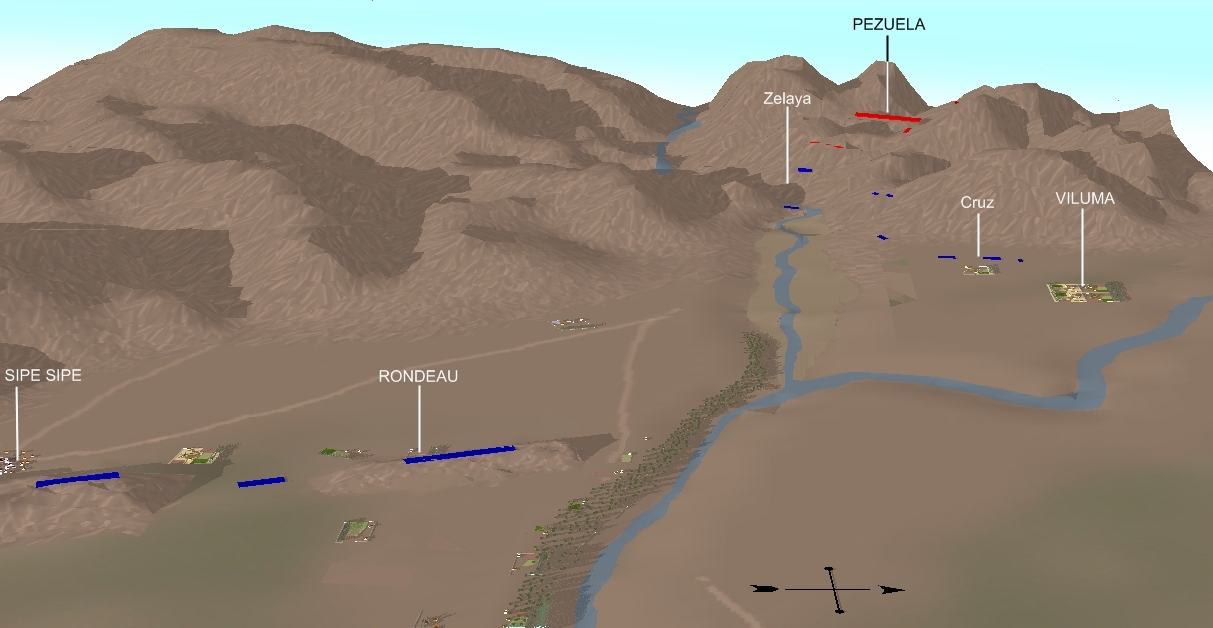
Battle of Viluma
The commander who led the Army of the North into Upper Peru in 1815 was not supposed to be in charge. Jose Rondeau held his position through mutiny — his officers had refused to accept the replacement sent by Buenos Aires, and Rondeau, rather than insist on lawful succession, accepted their defiance and marched on. It was a pattern that would define the entire campaign: a sequence of insubordination, improvisation, and ultimately catastrophe. On November 29, 1815, on the plateau of Sipe-Sipe west of Cochabamba, Rondeau's undermanned and outgunned force collided with Brigadier Joaquin de la Pezuela's royalist army. The result was the worst defeat the independence movements had suffered since the Battle of Huaqui four years earlier, and it ended Buenos Aires's ambitions in Upper Peru for good.
A Command Built on Defiance
The Army of the North had already seen better days and better commanders. Jose de San Martin, who would later become the liberator of Argentina, Chile, and Peru, had led the force before health problems forced him to step down. His replacement, Rondeau, inherited a difficult situation: two prior campaigns into Upper Peru had both been repulsed by royalist forces. When Supreme Director Ignacio Alvarez Thomas dispatched General Carlos Maria de Alvear to take command, Rondeau's officers refused the transfer. Their loyalty was personal, not institutional, and Rondeau chose to honor it. The decision had consequences beyond the chain of command. General Martin Miguel de Guemes, whose gaucho cavalry had been essential to defending the northern frontier, withdrew his forces to Salta in disgust. Rondeau marched into Upper Peru with a diminished army and a fractured command structure.
The Long March to Sipe-Sipe
Despite these problems, the campaign began with promise. In April 1815, Rondeau won a skirmish at Puesto del Marquez, near the modern border between Bolivia and Argentina. His army pressed north, reaching Potosi by June and Chayanta by September. But an attempt to overrun a small royalist garrison at Venta y Media in October ended in failure, a warning that the campaign's momentum was fading. Undeterred, Rondeau occupied Cochabamba and established his camp on the plateau of Sipe-Sipe, near the town of the same name. He had between 3,000 and 3,500 men and nine field guns. Across the plain, Pezuela was assembling a force larger than his: 4,100 soldiers supported by twenty artillery pieces. The numerical disparity was stark, but Rondeau had positioned himself on open ground where numbers and firepower would matter most.
Catastrophe on the Plateau
The battle on November 29, 1815, was devastating. Pezuela's larger force, with more than double the artillery, overwhelmed Rondeau's positions. The independence army lost an estimated 1,000 men — killed, wounded, or captured — along with every piece of artillery they had brought into the field. The scale of the disaster surpassed even the Battle of Huaqui in 1811, which had ended the first Argentine campaign into Upper Peru. What made Viluma different was its finality. After Huaqui, Buenos Aires had tried again. After Vilcapugio and Ayohuma in 1813, they had tried again. After Sipe-Sipe, they stopped trying. The highlands of Upper Peru were simply too far, too high, and too well defended by royalist forces operating from their base in Peru.
Aftermath and the Marquis of Viluma
The consequences fell unevenly. Rondeau was relieved of command in 1816 and returned to Buenos Aires, though his career in Argentine politics was far from over — he would eventually serve as Supreme Director. Pezuela's reward was grander and more immediate: he was named interim Viceroy of Peru by royal order, promoted to lieutenant general, and given the title Marquis of Viluma, forever linking his name to the plateau where he had broken the independence army. Upper Peru itself returned to firm Spanish control, folded back into the Viceroyalty of Peru. It would take another decade — and the armies of Bolivar and Sucre approaching from the north rather than the south — before the region would finally break free of Spain. When it did, it became not an Argentine province but an independent nation: Bolivia.
From the Air
The battlefield of Sipe-Sipe lies west of Cochabamba at approximately 17.46°S, 66.35°W, on the Bolivian Altiplano at roughly 2,600 meters (8,500 feet) elevation. The terrain is an open plateau surrounded by Andean foothills. Cochabamba (SLCB) is the nearest major airport, located approximately 25 km to the east. The area offers relatively flat terrain by Andean standards but remains at significant elevation. Expect density altitude effects and variable mountain weather. The Tunari range is visible to the north.