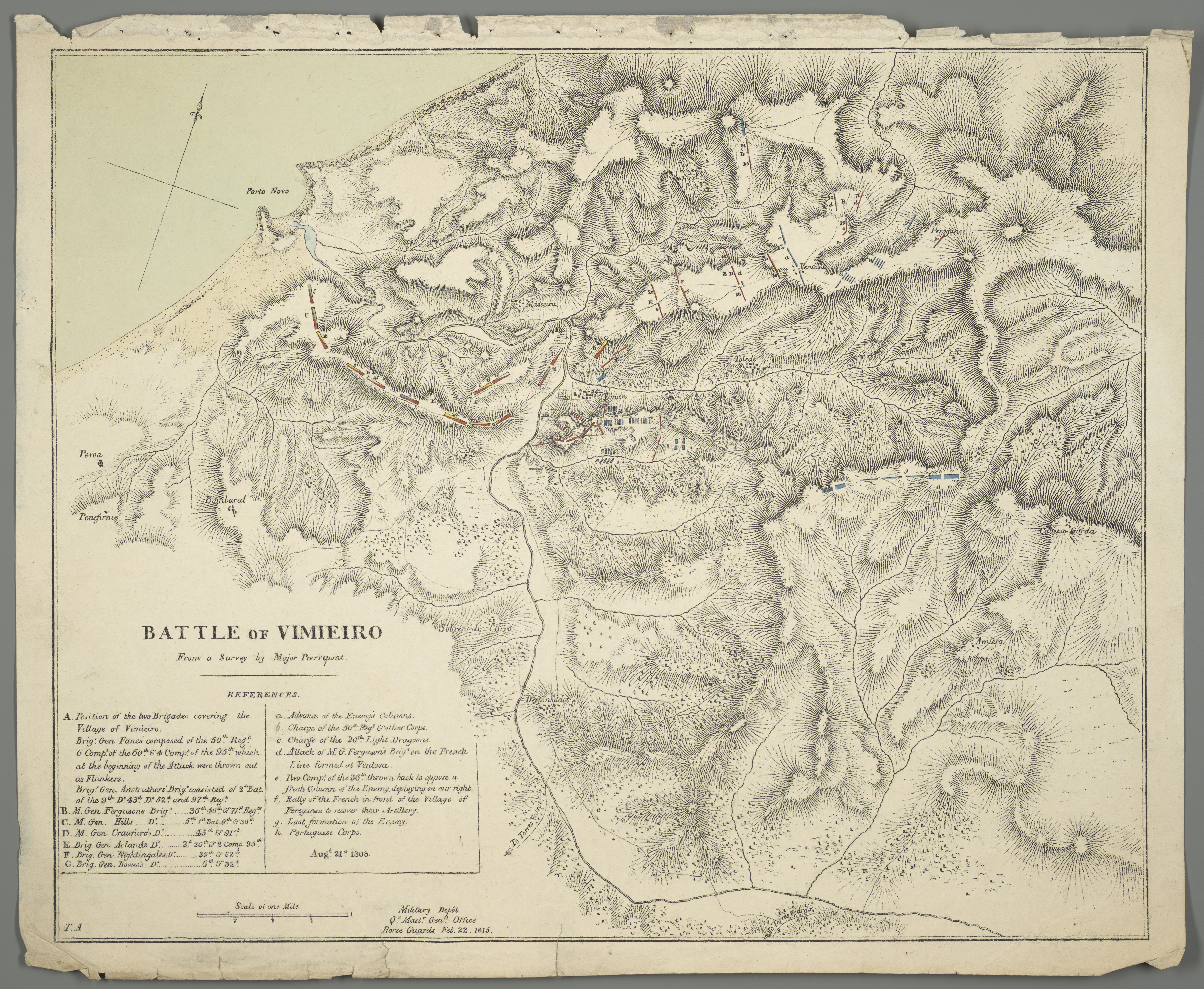
Battle of Vimeiro
Arthur Wellesley won the Battle of Vimeiro on 21 August 1808. Then he was told to stop winning. The future Duke of Wellington had deployed his 20,000 troops across the ridges near the village of Vimeiro, northwest of Lisbon, and methodically destroyed every French attack that General Jean-Andoche Junot threw at them. But just as Wellesley prepared to pursue the retreating French, two senior officers arrived in sequence — Sir Harry Burrard during the battle, Sir Hew Dalrymple soon after — and assumed command. Neither had been on the field. Both declined to pursue. The French escaped, and the war's first clear British victory was turned into a diplomatic scandal that would echo back to London.
The Line Against the Column
Vimeiro was a textbook demonstration of the tactical advantage that British infantry would exploit throughout the Peninsular War. Junot organized his 14,000 men into columns — formations 40 files wide and 48 ranks deep, designed to deliver shock but dependent on skirmishers and artillery for fire support. Wellesley's troops waited in two-deep lines behind ridge crests, invisible until the French were close. When Thomières' 2,100-man brigade advanced on Vimeiro, Fane detached riflemen from the 60th Regiment and 95th Rifles who outfought the French skirmishers. Stripped of their screen, the French column blundered into the 50th Regiment at 100 yards. The British line opened fire, companies wheeling inward to enfilade both flanks. Unable to deploy, the French broke and ran, abandoning three cannons.
Five Attacks, Five Failures
Junot's battle plan depended on coordination: three brigades to assault Vimeiro while Brenier's brigade swung wide to seize a ridge to the northeast. But Wellesley detected the flanking move and redeployed three brigades to block it, forcing Junot to attack prematurely. Each subsequent assault followed the same grim pattern. Charlot's brigade, advancing in a narrow column, struck Anstruther's hidden battalion and was taken in the flank. Kellermann's grenadier reserve managed to break into Vimeiro before being counterattacked and routed — the 20th Light Dragoons pouncing on the retreating grenadiers before charging out of control into Margaron's cavalry and suffering 25 percent casualties. Colonel Taylor was killed in the over-enthusiastic pursuit. Solignac attacked the northeast ridge with battalions abreast but marched into volley fire before deploying. Brenier's late-arriving brigade initially drove back two British battalions that had relaxed after beating Solignac, but rallied British troops and the 29th Regiment stopped them. Brenier was wounded and captured.
Victory Denied
The butcher's bill told a clear story: 2,000 French casualties and 13 cannons lost against 700 Anglo-Portuguese losses. Wellesley urged an immediate pursuit to cut off Junot's retreat toward Torres Vedras. Burrard refused. Dalrymple, arriving next, compounded the error by negotiating the Convention of Cintra — terms so generous that the defeated French army was transported home by the British navy, complete with its loot, guns, and equipment. The convention caused an outcry in Britain, where the public had expected a decisive victory to be followed by decisive consequences. An official inquiry exonerated all three commanders, but public opinion and the military establishment blamed Dalrymple and Burrard. Both received administrative posts and never commanded in the field again.
Wellesley Returns
For Wellesley, Vimeiro was a beginning, not an end. He had bitterly opposed the Convention of Cintra, and his tactical performance at Vimeiro demonstrated the principles he would perfect over the next seven years: the use of reverse-slope positions, the disciplined two-deep line against the French column, the aggressive deployment of light infantry as skirmishers. The battle ended the first French invasion of Portugal and established the Peninsular War's central dynamic — French numerical superiority countered by British tactical discipline and Portuguese determination. Wellesley was returned to active command in Spain and Portugal, where he would fight his way from Lisbon to Toulouse, earning his dukedom along the way. The village of Vimeiro, unremarkable before August 1808, carries the memory of the day when the future Iron Duke first proved what a British line could do to a French column.
From the Air
Located at 39.175°N, 9.317°W near the village of Vimeiro, approximately 60 km north-northwest of Lisbon. The battlefield occupies rolling hills and ridges typical of central Portugal's coastal terrain. Look for the village in a valley with ridgelines to the west and northeast. The Atlantic coast and Maceira Bay (the British landing point) are visible a few kilometers to the west. Recommended viewing altitude: 3,000-5,000 ft for terrain appreciation. Nearest airport: Lisbon/Humberto Delgado (LPPT) approximately 65 km south-southeast. The Torres Vedras area, where the French retreated, lies approximately 20 km to the south.