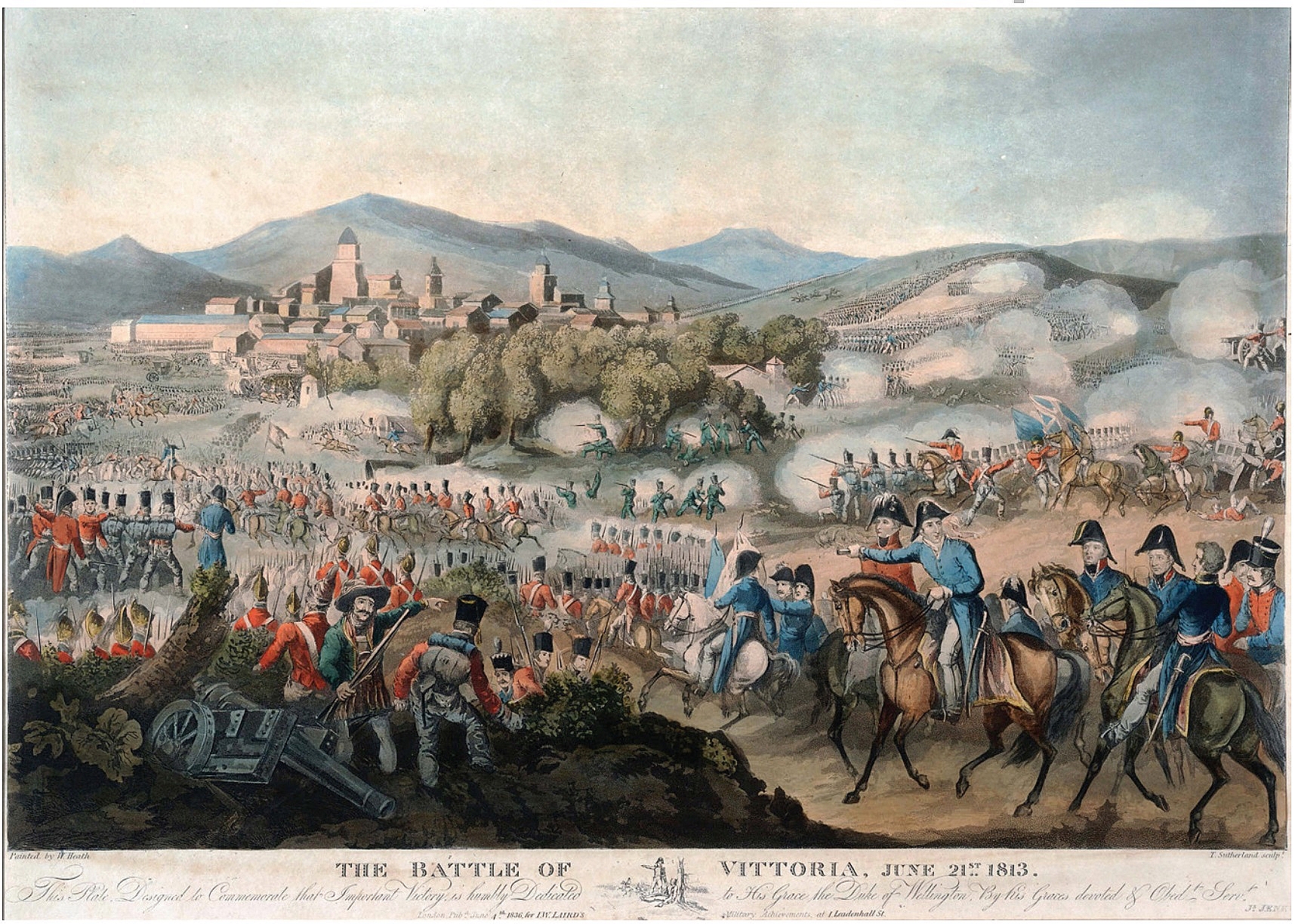
Battle of Vitoria
Wellington's soldiers were supposed to pursue the fleeing French army. Instead, they stopped to loot. The abandoned wagons contained, as one account put it, "the loot of a kingdom" -- over one million pounds in treasure, art, and plunder accumulated during years of French occupation. The breakdown in discipline so enraged Wellington that he fired off one of his most quoted lines: "We have in the service the scum of the earth as common soldiers." The Battle of Vitoria, fought on 21 June 1813, had just shattered French power in Spain. And the victors were too busy pillaging to finish the job.
Napoleon's Crumbling Grip
By the spring of 1813, Napoleon's position in Spain was deteriorating. His disastrous invasion of Russia had forced the recall of thousands of soldiers to rebuild the Grande Armee, leaving King Joseph Bonaparte and Marshal Jean-Baptiste Jourdan with a diminished force of 68,000 to hold the peninsula. Wellington, who had spent the winter reorganizing after his failed siege of Burgos, now commanded 121,000 troops: 53,749 British, 39,608 Spanish, and 27,569 Portuguese. In May he launched a bold flanking march from northern Portugal across the mountains, sending Sir Thomas Graham with the bulk of the army over terrain the French considered impassable. Wellington himself commanded a smaller central force as a feint, drawing French attention while the real blow swung wide around their right flank.
Four Columns Against the Zadorra
The battlefield centered on the Zadorra River, which runs east to west before looping into a sharp hairpin bend. The French had deployed in three defensive lines south of the river, their positions anchored by the Heights of La Puebla to the south and Monte Arrato to the northwest. Vitoria lay two miles to the east, its streets clogged with an enormous wagon train of accumulated plunder. Jourdan, who had been ill with fever the day before, had issued few orders. Wellington attacked from four directions simultaneously. Hill's 20,000-man column drove up the Burgos road toward the heights. Wellington's center crossed the Zadorra at the hairpin bend. Dalhousie's column cut across Monte Arrato. And Graham's 20,000-man column swung around to the north to cut the road to France.
Collapse at Arinez
The fighting was fierce and costly. On the Heights of La Puebla, Colonel Henry Cadogan was killed leading his brigade against French counterattacks. Picton's 3rd Division, crossing the river under withering artillery fire of 40 to 50 cannon, lost 1,800 men -- more than a third of all Allied casualties in the entire battle. But the French command structure was fractured. Jourdan, fixated on his left flank, refused to send reinforcements when his right began to crumble. Gazan refused to cooperate with d'Erlon. When Graham's column appeared on the Bilbao road and Longa's Spanish troops cut the road to Bayonne, the French position became untenable. The army attempted a stand at the village of Arinez, but four Allied divisions swept the position. French morale collapsed. Artillerists abandoned their guns and fled on the trace horses.
The Plunder of a Kingdom
The French left behind 151 cannon, 2,800 prisoners, and a fortune in looted treasure. Allied casualties totaled about 5,000: 3,675 British, 921 Portuguese, and 562 Spanish. French losses were at least 8,000 killed, wounded, and captured. Tens of thousands more escaped through a narrow valley on the Salvatierra road, covered by the rearguard action of Reille's two divisions. The French losses would have been far worse had Wellington's soldiers not broken ranks to plunder the abandoned wagons. The 18th Hussars earned Wellington's particular fury, and he threatened to send them home in disgrace. They later redeemed themselves in a gallant charge at Croix d'Orade the following April.
Beethoven's Battle
By December 1813, Wellington's army had seized San Sebastian and Pamplona and was encamped in France. The Peninsular War was effectively over. The battle's resonance traveled far beyond the battlefield. Ludwig van Beethoven composed his Opus 91, known as "Wellington's Victory" or the "Battle Symphony," to celebrate the engagement. George IV later commissioned the painter George Jones to depict the scene. Bernard Cornwell placed the battle at the climax of his novel Sharpe's Honour. At Vitoria-Gasteiz today, the Armory Museum displays captured Imperial militaria and model recreations of the fighting, and a monument marks the French withdrawal from the valley where an empire's grip on Spain was finally broken.
From the Air
Located at 42.85N, 2.68W in the Zadorra River valley near Vitoria-Gasteiz, capital of the Basque Country. The battlefield terrain is visible as a broad valley with the river's distinctive hairpin bend, flanked by the Heights of La Puebla to the south and Monte Arrato to the northwest. Nearest airport is Vitoria (LEVT). Best viewed at 3,000-5,000 feet AGL. The city of Vitoria-Gasteiz lies to the east of the historical battlefield.