Battle of Vittorio Veneto
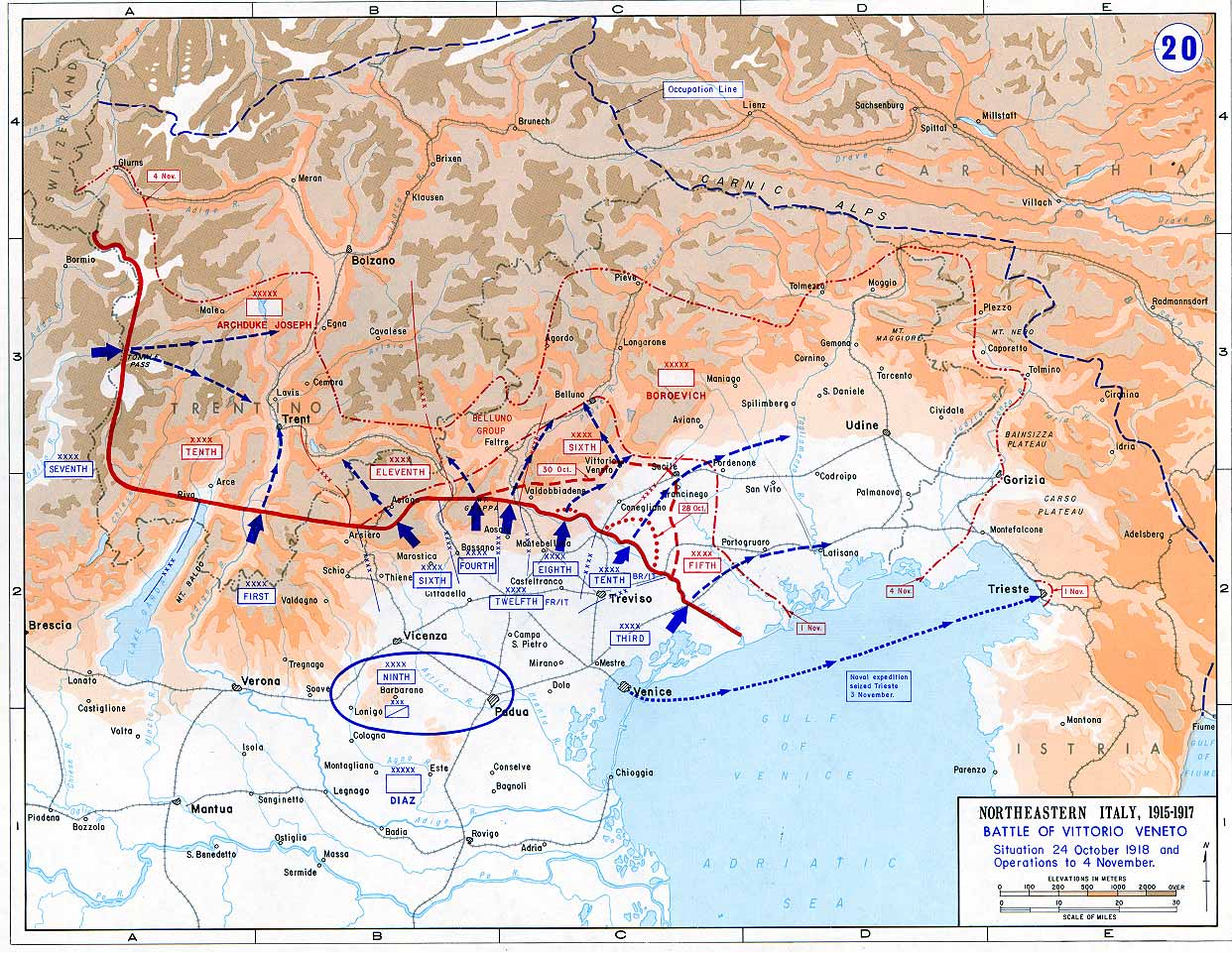
The city was simply called Vittorio when the battle was fought there in late October 1918, named for the king who had unified Italy half a century earlier. By the time the government renamed it Vittorio Veneto in 1923, the name had become synonymous with something larger than the modest town in the Venetian foothills: the destruction of the Austro-Hungarian Empire and the end of the First World War. Between October 24 and November 3, 1918, Italian forces and their allies drove across the Piave River, broke through the Austrian lines, and watched as the 600-year Habsburg state dissolved in real time beneath their advance.
The Night Crossing
The battle began with an act of quiet audacity. On the night of October 23, Italian engineers from the 18th Pontieri rowed British soldiers across the Piave River to seize the Grave di Papadopoli, a cluster of islands in the middle of the swollen river. The British troops -- battalions of the Honourable Artillery Company and the Royal Welch Fusiliers -- were more frightened of drowning in the torrent than of the Austrians waiting on the other side. For the sake of silence, the HAC used only bayonets until the alarm was raised. By dawn they held half the island, and the full-scale assault could begin. The date chosen for the main attack was October 24 -- exactly one year after Caporetto, the catastrophic defeat that had nearly knocked Italy out of the war. General Armando Diaz, who had rebuilt the Italian army from that disaster, intended the anniversary to carry a different meaning.
An Empire Unravels
Diaz's plan was elegant in its ambition: three armies would drive across the Piave toward Vittorio Veneto, cutting communications between the two Austrian army groups opposing them. The Fourth Army would attack Monte Grappa to draw in Austrian reserves, while the Eighth and Tenth armies forced the river crossings. Allied forces totaled 57 divisions -- 52 Italian, three British, two French -- along with the American 332nd Infantry Regiment. The Austro-Hungarians had 46 infantry and six cavalry divisions, but both sides were ravaged by influenza and malaria. The Italians possessed 7,700 guns to the Austrians' 6,030. From October 24 to 31 alone, Italian artillery fired 2,446,000 shells. But the real disintegration was political. On October 28, Czechoslovakia declared independence. The next day, the South Slavs followed. On October 31, Hungary proclaimed its withdrawal from the union, officially dissolving the Austro-Hungarian state. Austrian commander Svetozar Boroevic ordered a counterattack, but his troops refused to obey.
The Caimans of the Piave
Among the most extraordinary participants were the Caimani del Piave, 82 elite Arditi swimmers recruited by Captain Remo Pontecorvo Bacci. Created after the military analyzed its failures at Caporetto, these soldiers were trained to survive in the icy, powerful currents of the Piave for up to 16 hours. Armed only with a resolza knife and two hand grenades, they served as the sole communication link between Italian troops who had crossed to the west bank and those still on the east bank when all other means failed. Fifty of the 82 died in the river during the campaign -- a casualty rate exceeding 60 percent. Their sacrifice embodied the desperate intensity of the final push. On October 29, the Italian Eighth Army broke through toward Vittorio Veneto. Lancers and Bersaglieri cyclists entered the town on the morning of the 30th. By November 3, Trieste had fallen to an amphibious expedition, and the entire Austrian position was collapsing.
The Last Day of an Empire
The Armistice of Villa Giusti was signed on November 3 at 3:20 p.m., to take effect 24 hours later. Austrian General Weber asked the Italians to stop fighting immediately, arguing that his army had already laid down its weapons. Italian General Badoglio refused, threatening to break off negotiations and continue the war. Italian troops advanced until 3:00 p.m. on November 4, occupying all of Tyrol including Innsbruck by month's end. The toll for the ten-day battle was 37,461 Italian casualties -- 24,507 of them on Monte Grappa alone -- plus 2,139 British and 778 French. Ludendorff later argued that Vittorio Veneto prompted the collapse of the Austro-Hungarian monarchy, dragging Germany into its fall. The Wilhelmshaven mutiny erupted the same week, the German Revolution spread from Kiel, and less than a week after the Austrians, the Germans requested their own armistice. The war ended on November 11, 1918.
From the Air
Vittorio Veneto lies at 45.96N, 12.35E in the foothills of the Venetian Prealps, where the mountains meet the northern edge of the Po plain. The town sits in a valley between low ridges and is visible from altitude as a linear settlement along the main north-south road. The Piave River, the battle's central obstacle, runs roughly 15 km to the south and east. Monte Grappa (1,775m) rises prominently to the southwest. Venice Marco Polo (LIPZ) is approximately 70 km to the south; Treviso (LIPH) is closer at about 45 km. The Grave di Papadopoli island complex is visible in the river below. Best viewed from 4,000-6,000 feet AGL.