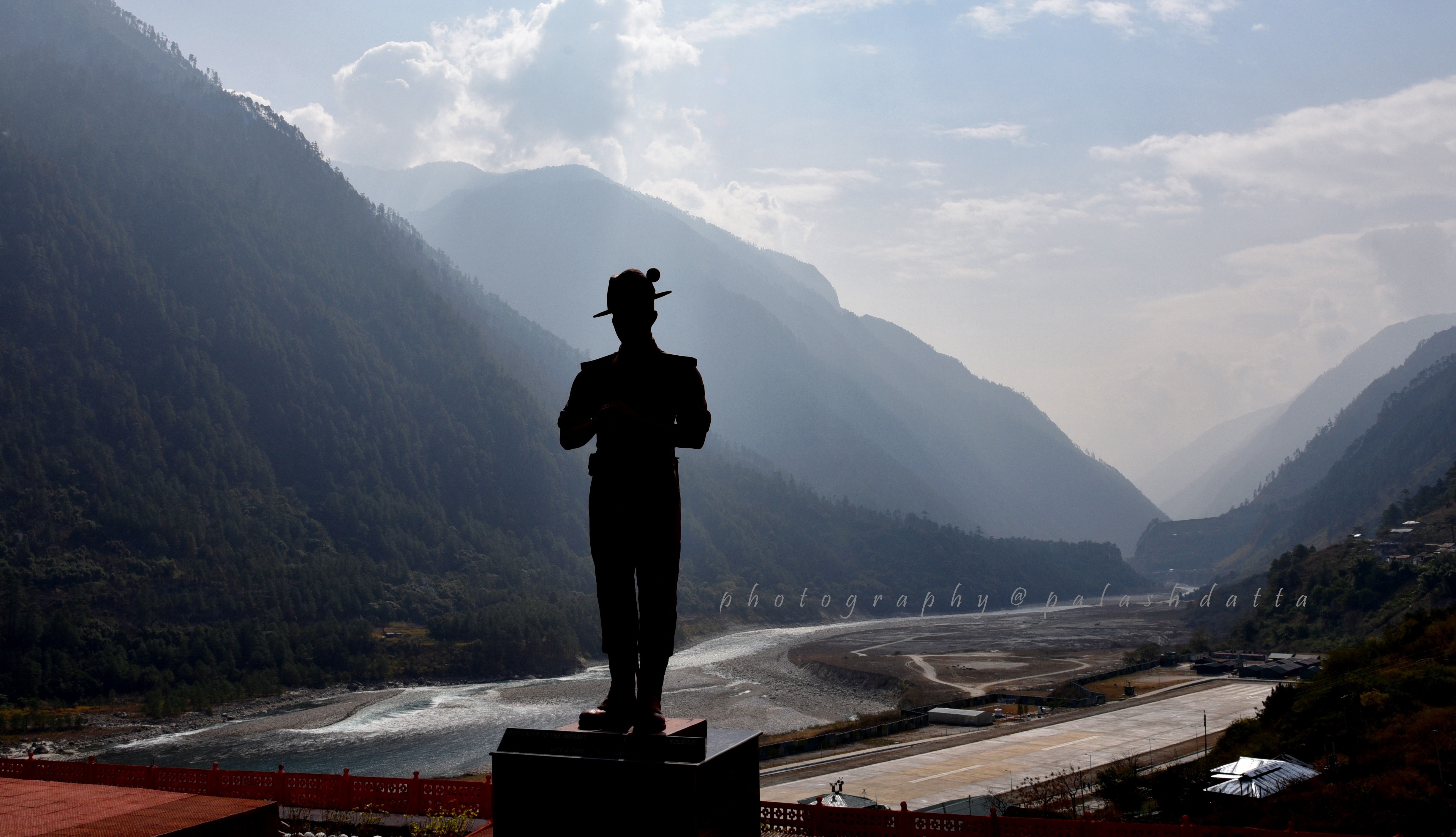
Battle of Walong
At three in the morning on October 23, 1962, Lieutenant Bikram Singh Rathore of the 6th Kumaon Regiment fired a Very Light flare into the darkness above a hanging bridge over Namti Nullah, five kilometers from the town of Walong. He had removed the last planks of the bridge. Below, the first Chinese soldier had already stepped onto the gap and fallen into the ravine. Behind him, the soldiers of the PLA's 153rd Regiment milled in confusion on a narrow path, exposed. Indian machine guns and mortars, sighted precisely on that chokepoint, opened fire. About 200 Chinese troops were killed or wounded. Nine Indians died. It was a textbook ambush, and it was only the opening act.
A Line Drawn in 1914
The Sino-Indian War of 1962 grew from a border dispute with roots in the colonial era. The McMahon Line, drawn in 1914 during the Simla Convention, established the boundary between British India and Tibet. China never recognized it. When Chinese forces began advancing into Indian-held territory in October 1962, the Walong sector in what is now Arunachal Pradesh became a critical battleground. The Indian 11th Infantry Brigade, led by Brigadier N.C. Rawlley, was tasked with defending the ridges and valleys around the small frontier town. His forces were outnumbered and under-equipped, facing a Chinese army that had already demonstrated its willingness to push deep into disputed territory.
Four Weeks of Fighting
The battle began on October 21, when the Chinese 153rd Infantry Regiment attacked India's Kibithu Post, 40 kilometers north of Walong. Midnight machine gun fire and mortar bombardment preceded infantry assaults by over 3,000 soldiers. Naik Bahadur Singh took over a light machine gun after its crew was killed and kept firing until a bullet struck his chest. He was later awarded the Vir Chakra posthumously. After the Kibithu position proved untenable, the 6th Kumaon withdrew to Walong, where Lieutenant Bikram Singh's ambush at Namti Nullah bought critical time. For the next three weeks, Indian troops from the 4th Sikh Regiment and 6th Kumaon engaged the Chinese in continuous skirmishes, using the brutal terrain to create bottlenecks that slowed a numerically superior force.
The Last Stand on West Ridge
On November 14, the 6th Kumaon did something no other Indian unit managed in the entire war: they attacked. Without artillery or air support, they captured Chinese positions in the Walong sector. But ammunition was running low and casualties mounting. Two days later, the PLA's 130th Division, brought in as reinforcement, launched a massive assault on the roughly 100 soldiers of Delta Company holding West Ridge. Lieutenant Bikram Singh had promised Brigadier Rawlley he would hold until 1100 hours and never withdraw. Waves of Chinese soldiers attacked from three sides, the fourth being a sheer cliff. The Kumaonis repulsed the first assaults, then fought on well past the promised time. When their ammunition was exhausted, they fought hand to hand. Of Delta Company, only 17 soldiers returned. The rest died on the ridge.
Helmets on the Mountain
In 1986, twenty-four years after the battle, a patrol from the 6th Assam Regiment climbed to West Ridge and found skeletal remains still lying among helmets, LMG magazines, water bottles, spent ammunition, and a pair of binoculars that likely belonged to Lieutenant Bikram Singh. They cremated the bodies of at least 37 soldiers and built a makeshift memorial displaying the helmets and battle relics. This site, known as Helmet Top Post, stands on a cliff between Walong and Tilam. Overall, the battle produced 642 Indian and 752 Chinese casualties. The Walong War Memorial next to the airstrip carries the names of 32 soldiers from the 4th Sikh Regiment and 17 from the 4th Dogra Regiment, along with verses composed by a veteran: "The sentinel hills that round us stand / bear witness that we loved our land."
What the Mountain Remembers
China declared a unilateral ceasefire on November 21, 1962, five days after the fall of West Ridge. Even PLA researchers from the Academy of Military Science later acknowledged that the Indian forces at Walong displayed "significantly and notably higher morale and will to resist" compared to other sectors. The 6th Kumaon battalion celebrates November 14 as Walong Day. Military historians continue to study the battle for its lessons in mountain warfare, particularly the decisive importance of terrain and the catastrophic consequences of inadequate logistics. Five Vir Chakras were awarded to soldiers of the 6th Kumaon. The battle remains a symbol of resistance against overwhelming odds, a story etched into the ridgelines of a remote Himalayan valley where the evidence of sacrifice lay undiscovered for a generation.
From the Air
Located at 28.13N, 97.02E in extreme eastern Arunachal Pradesh, India, near the Chinese border. The town of Walong sits in a valley along the Lohit River, surrounded by steep ridges including the West Ridge battle site. The Walong Advanced Landing Ground (airstrip) is visible from altitude adjacent to the war memorial. Nearest ICAO airport is Tezu (VETX), roughly 150 km to the south. The terrain is extremely mountainous with limited visibility due to cloud cover. The McMahon Line border runs just north of the town.