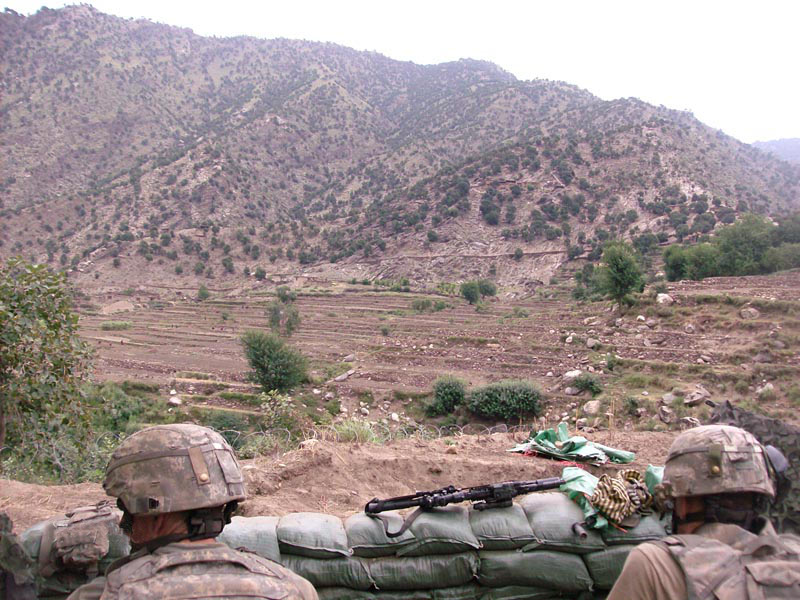
Battle of Wanat
The militants began flooding an irrigation ditch the day before. The background noise of rushing water masked the sound of fighters moving into position around the tiny American patrol base at Wanat, a village in Afghanistan's far eastern Nuristan Province. At dawn on July 13, 2008, an estimated 200 Taliban insurgents opened fire simultaneously from the mountains, the farmland, and the village itself. Vehicle Patrol Base Kahler had been under construction for only five days. Its defenses were incomplete. What followed was among the most devastating coordinated attacks on American forces in the entire Afghan war.
Five Days to Build, Five Minutes to Breach
The platoon had arrived after dark on July 8 -- 48 American soldiers and 24 Afghans from 2nd Platoon, Chosen Company, 2nd Battalion, 503rd Infantry Regiment, 173rd Airborne Brigade. They drove from Camp Blessing in five armored Humvees, a 90-minute convoy through hostile terrain. The patrol base sat in an open field about 300 meters by 100 meters, hemmed on two sides by village buildings set at higher elevation. A six-man engineer squad arrived by Chinook with a Bobcat loader and began filling HESCO barriers, but much of the perimeter remained protected by nothing more than concertina wire stretched flat on the ground. The soldiers noticed groups of men watching the construction from the village. At a dinner meeting, a local told the Americans they should shoot any men seen in the mountains. The day before the attack, tribal elders held a council without inviting the American officer in charge. Every warning sign was there. The base was two weeks from being relieved by a fresh unit.
The Fight for Topside
A small observation post called Topside sat 50 to 70 meters outside the main base, nestled among rocks under a tree. Seven soldiers manned it under Forward Observer Sergeant Ryan Pitts. The first rounds hit with terrible accuracy, wounding or stunning every soldier at the position. Specialist Matthew Phillips was mortally wounded while throwing grenades at attackers closing in. Corporal Jason Bogar fired hundreds of rounds from his automatic weapon until it jammed, applied a tourniquet to Pitts's leg after an RPG struck, then manned two other machine guns before leaping from the bunker to engage insurgents firing from the village hotel. He was shot through the chest and killed. First Lieutenant Jonathan Brostrom and Corporal Jason Hovater rushed from the main base to reinforce Topside; both were killed. When the surviving defenders fell back, Pitts -- seriously wounded -- held the position alone, fighting off Taliban attempts to overrun it until reinforcements reached him two hours later.
Ninety-Six Rounds of 155mm
At the main base, the situation was nearly as desperate. The Taliban had destroyed much of the Americans' heavy weaponry in the opening minutes and breached the eastern barriers. Fighters threw rocks that soldiers initially mistook for grenades, flushing them from cover. Medic PFC William Hewitt was shot in the arm; Specialist Jeff Scantlin, trained as a combat lifesaver, took over treating the wounded. Three times, teams of soldiers sprinted through Taliban fire to resupply Topside and carry back the dead and wounded. Artillery batteries at Camp Blessing, roughly five miles away, fired 96 rounds of 155mm ammunition into the surrounding positions. Close air support followed. After roughly four hours, the Taliban withdrew. Nine American soldiers lay dead: Specialist Sergio Abad, Corporal Jonathan Ayers, Corporal Jason Bogar, Sergeant Israel Garcia, Corporal Jason Hovater, Corporal Matthew Phillips, Corporal Pruitt Rainey, Corporal Gunnar Zwilling, and First Lieutenant Jonathan Brostrom. Twenty-seven others were wounded.
Investigations and Recriminations
The aftermath generated as much controversy as the battle itself. An Army investigation completed in August 2008 found that local Afghan police had assisted the Taliban -- large weapons caches were discovered in the police barracks, far more than a 20-man force could use. A civilian helicopter strike on July 4 that killed 17 people had inflamed local sentiment against the Americans. The Army historian's report concluded that ten months of negotiations over the outpost's location had given the Taliban ample time to plan and coordinate. Lieutenant Jonathan Brostrom's father, a retired Army colonel, became a vocal critic after reading the report. Senator James Webb pushed for a formal investigation. Lieutenant General Richard Natonski's review led to reprimands for the chain of command, but in June 2010, the Army revoked them, concluding that no negligence was involved. Three days after the battle, American and Afghan forces withdrew from Wanat entirely.
What Remains at Wanat
In July 2014, Sergeant Ryan Pitts received the Medal of Honor for his actions that morning -- holding Topside alone, wounded and bleeding, until help arrived. He was 22 years old during the battle. The Army's official praise for the soldiers who fought at Wanat acknowledged what the investigations could not resolve: "By their valor and their skill, they successfully defended their positions and defeated a determined, skillful, and adaptable enemy." The village of Wanat still sits at the junction of mountain valleys in Nuristan, a district center that briefly hosted an American patrol base for five days in 2008. The open field where VPB Kahler stood has long since returned to local use. The battle endures in military study -- the Combat Studies Institute published a full historical account in 2010 -- and in the memory of nine families who lost someone in a place most Americans have never heard of.
From the Air
Located at 35.05°N, 70.91°E in Nuristan Province, eastern Afghanistan. The village of Wanat sits in the Waygal district at the convergence of mountain valleys, roughly 5 miles from the former Camp Blessing along the Pech River. Terrain is extremely rugged with steep mountain slopes on all sides. Best viewed from 10,000-15,000 feet AGL. The nearest significant airfield is Jalalabad Airport (OAJL), approximately 70 nm south. Visibility can be limited by mountain shadows in early morning hours.