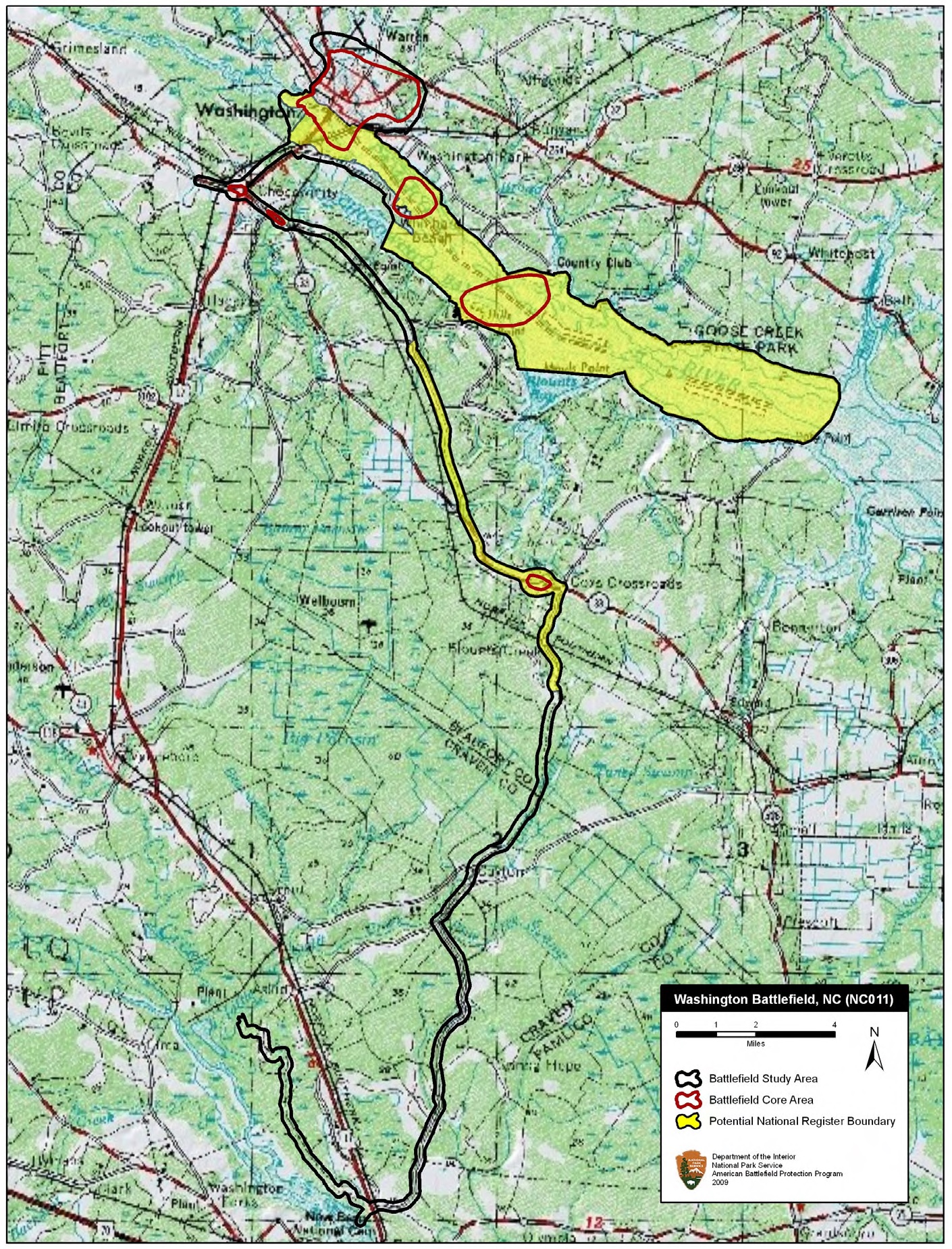
Battle of Washington
"If the Confederates want Washington, come and get it." Major General John G. Foster's reply to the surrender demand was pure bravado. His garrison at Washington, North Carolina -- a town so modest it was often called Little Washington -- was outnumbered and encircled. Confederate batteries blocked the Tar River, earthworks ringed the town, and two rebel brigades guarded the overland routes from New Bern. For twenty-one days in the spring of 1863, Foster and his soldiers held on, enduring artillery barrages, dwindling supplies, and miserable rain while waiting for help that kept failing to arrive.
Lee Turns His Attention South
The siege grew from a shift in Confederate strategy. After Burnside's North Carolina Expedition in 1862, the state's coastal garrisons had been a secondary concern for the South. But in December 1862, a Union raid from New Bern destroyed the railroad bridge at Goldsborough along the vital Wilmington and Weldon Railroad, the main supply artery connecting the Deep South to Virginia. The damage was temporary, but it alarmed Confederate leadership. After the victory at Fredericksburg gave Robert E. Lee breathing room, he dispatched Lieutenant General James Longstreet with a substantial force to deal with the Federal presence along the coast. Longstreet personally targeted Suffolk, Virginia, while Major General D. H. Hill led a column against the Union garrisons at New Bern and Washington, North Carolina.
A West Point Engineer Digs In
Foster was no ordinary garrison commander. A West Point-trained Army engineer, he put his skills to work reinforcing Washington's defenses and deploying three gunboats along the waterfront. By March 30, 1863, when Brigadier General Richard B. Garnett's brigade began the investment of the town, Foster had turned Little Washington into a hard target. Hill set up batteries and river obstructions along the Tar River to block reinforcements, and posted two brigades south of town to cut the overland route from New Bern. But Hill had orders to avoid a costly direct assault. The engagement settled into an artillery duel, with both sides conserving ammunition. Rain turned the trenches to mud, supplies ran low on both sides, and the siege became a grim test of endurance. While Hill could not take the town, he was accomplishing a secondary objective: his foraging parties were stripping the surrounding countryside of food and supplies while the Federals remained pinned down.
Relief That Never Came
Two Federal attempts to break the siege failed spectacularly. Brigadier General Henry Prince sailed a relief column up the Tar River, took one look at the Confederate batteries lining the banks, and turned his transports around without firing a shot. A second effort under Brigadier General Francis Barretto Spinola advanced overland from New Bern but was defeated along Blount's Creek and forced to retreat. With no rescue in sight, Foster made a bold decision. He would escape Washington himself to organize a proper relief force, leaving his chief of staff, Brigadier General Edward E. Potter, in command of the garrison. On April 13, the USS Escort ran the gauntlet of Confederate batteries and fought its way upriver into Washington, delivering desperately needed supplies and a Rhode Island regiment. Two days later, Foster boarded the battered vessel for the return trip. The ship took heavy fire, the pilot was mortally wounded, but Foster made it through.
The Siege Dissolves
Hill's withdrawal began even before Foster's escape bore fruit. By mid-April, the Confederate general faced converging pressures: his foraging mission was complete, Union supplies had reached the garrison aboard the Escort, and Longstreet urgently requested reinforcements for his own assault on Suffolk. Hill broke off the siege on April 15 and began pulling Garnett's brigade away from Washington's fortifications. Foster, back in New Bern, wasted no time. He launched a multi-pronged relief operation, sending Prince toward Kinston to pin down Confederates near Goldsborough while personally leading a second column north toward Blount's Creek. On April 18, Spinola drove Confederate forces from their roadblock at Swift Creek. The next day, Brigadier General Henry M. Naglee attacked the Confederate rear guard near Washington, capturing prisoners and a regimental battle flag. By April 20, the Confederates had completely withdrawn from the area.
A Quiet Aftermath
The Battle of Washington ended without a decisive victor. The Confederates failed to take the town, but Hill's foraging parties had gathered supplies critical to sustaining Southern forces in the region. The Union held Little Washington, but its garrison had been pinned down for three weeks and two relief expeditions had been repulsed. During the siege, Union commanders armed African Americans to participate in the town's defense, an early instance in North Carolina of the shift toward recruiting Black soldiers for military service. Apart from raids conducted by Foster and Potter, North Carolina's coast remained relatively quiet until 1864, when Lee again spared troops for operations against Federal outposts. The siege of Little Washington never became one of the war's famous engagements, but for the soldiers who endured those twenty-one days of mud, shells, and shrinking rations, the memory was vivid enough.
From the Air
Washington, NC sits at 35.54N, 77.06W along the Tar River in Beaufort County. From the air, the town is visible at the bend of the Tar River where it widens before flowing into the Pamlico River. The nearest airport is Washington-Warren Field (KOCW), located just northeast of town. Pitt-Greenville Airport (KPGV) is approximately 20 nm to the west. At 2,000-3,000 feet AGL, the Tar River's path and the surrounding flat coastal plain are clearly visible. The historic town center sits on the north bank of the river.