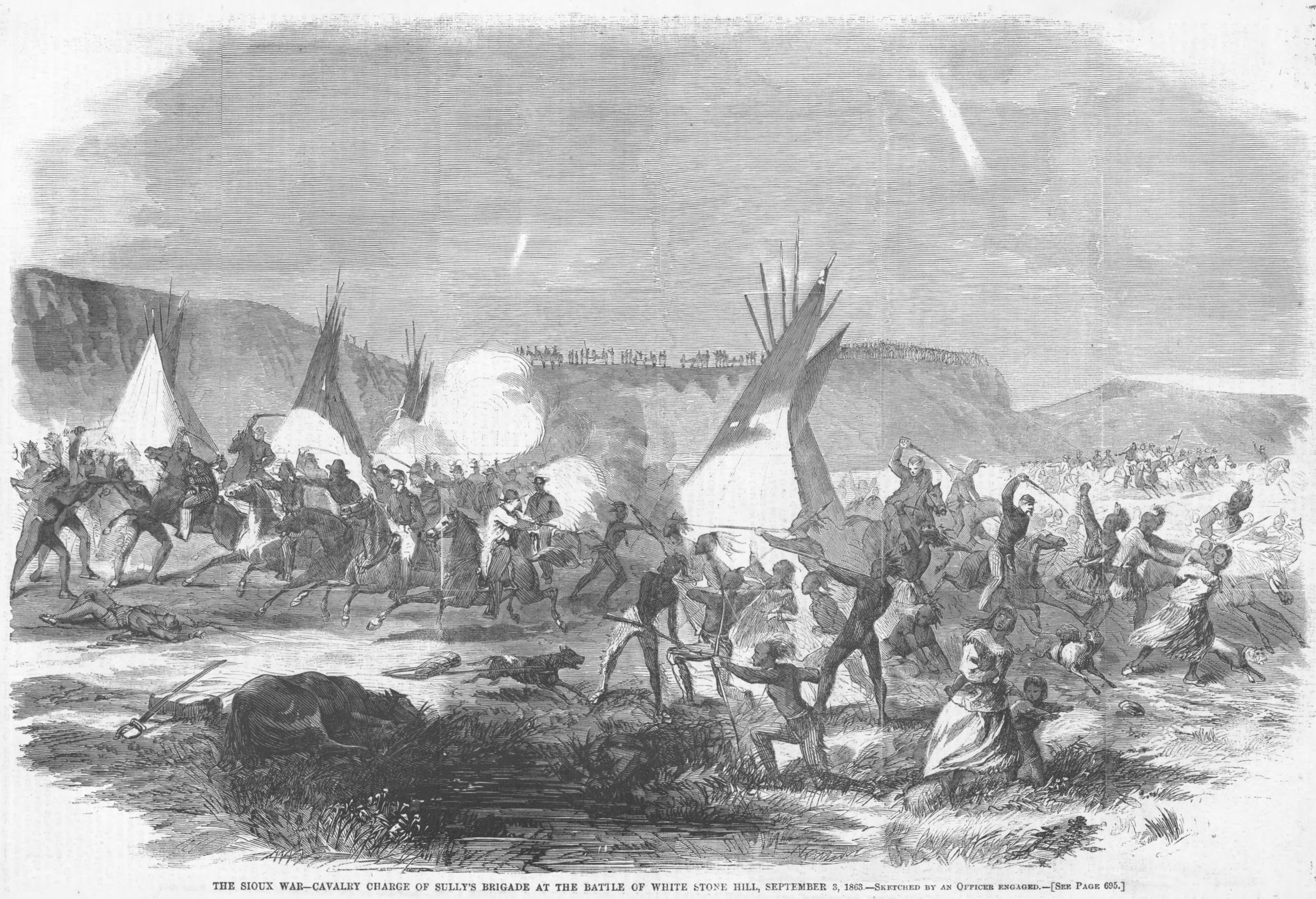
Battle of Whitestone Hill
A delegation walked forward under a white flag made from a flour sack. The Sioux representatives told Major A. E. House they were peaceful, interested only in hunting, and offered to surrender several chiefs. House demanded unconditional surrender of the entire camp. Both sides were stalling - the Sioux to give women time to pack, House to wait for reinforcements galloping ten miles across the prairie. It was September 3, 1863, on the rolling grasslands of what is now Dickey County, North Dakota, and the fragile negotiation was about to collapse into one of the most devastating attacks on Native people in the northern Great Plains.
Roots in the Minnesota Uprising
The violence at Whitestone Hill grew from the Dakota War of 1862, when a faction of Santee Dakota in Minnesota rose up against the United States over the government's failure to deliver promised food and payments. The rebellion killed more than 600 white settlers, mostly unarmed civilians. The army crushed the uprising, executed its leaders, and in April 1863 expelled virtually all Sioux from Minnesota - whether they had participated in the war or not. Sioux lands were confiscated. Roughly 4,000 Santee fled west into Dakota Territory, joining Yanktonai, Yankton, and Lakota bands. General John Pope then ordered two military expeditions into the eastern Dakotas: one led by Brigadier General Henry Hastings Sibley overland from Minnesota, and a second by Brigadier General Alfred Sully up the Missouri River by steamboat. Sibley fought the Sioux at Big Mound, Dead Buffalo Lake, and Stony Lake in July, pushing them west across the Missouri and destroying their winter supplies. Sully, delayed by low water on the river, arrived near present-day Bismarck in mid-August to find Sibley already gone.
Four Hundred Lodges on the Prairie
Sully's force of 1,200 men - the 6th Iowa Cavalry, the 2nd Nebraska Cavalry, eight mountain howitzers, scouts, and a wagon train - searched southeast for the Sioux who had recrossed the Missouri to hunt buffalo for winter provisions. On September 3, his scout Frank LaFramboise, a mixed-blood Santee, reported a village of 400 lodges ten miles ahead. LaFramboise had been briefly captured by Sioux warriors but released, a signal the encampment was not looking for a fight. The village held Yanktonai (including the Cuthead band), Santee, Hunkpapa - possibly including a young leader named Sitting Bull - and Sihasapa Sioux. Estimates of the inhabitants ranged from 2,000 to 4,000 people, with the Sioux themselves claiming about 950 fighting men. Sully's soldiers carried long-range rifles rather than the usual cavalry carbines, giving them a decisive edge over warriors armed mostly with muskets, shotguns, and bows.
Chaos at Dusk
Sully reached the ridge overlooking the encampment around 6 p.m. with only 600 to 700 of his men. Below, Sioux families were already packing tipis to leave. He deployed the 6th Iowa to the right flank and the 2nd Nebraska to the left, cutting off escape routes through the ravines, then advanced into the camp with three companies and artillery. Two chiefs, Little Head and Big Head, surrendered with about 150 followers. But the close quarters made artillery useless, and much of the fighting devolved into chaotic exchanges at sixty yards. Colonel Wilson of the 6th Iowa ordered a mounted charge, but in his haste some of his men had unloaded weapons. Sioux fire caused the cavalry horses to bolt and the charge collapsed. As darkness fell, both sides pulled back to defensive positions. The soldiers spent a harrowing night listening to the sounds of the Sioux moving through the battlefield - the dead were scalped, and a wounded soldier's cries for help went unanswered because his comrades feared a trap. He was found alive the next morning, dying from his wounds.
Ashes and Aftermath
Dawn revealed an empty camp. The Sioux had escaped under cover of darkness. Sully sent patrols but found few. He then ordered everything left behind to be burned: 300 tipis and between 400,000 and 500,000 pounds of dried buffalo meat - an entire winter's food supply, the product of a thousand butchered buffalo. Casualties tell conflicting stories. The army reported 22 soldiers killed and 38 wounded. Sioux losses ranged from 100 to 300 killed, including women and children, with 156 captured. Samuel J. Brown, one of Sully's own interpreters and himself part Sioux, called it "a perfect massacre" and said it was "lamentable to hear how those women and children was massacred." Sully, his horses and mules exhausted, marched to Fort Pierre in present-day South Dakota and built Fort Sully for winter quarters. The following year he returned, fighting the Sioux again at the Battle of Killdeer Mountain.
The Hill Remembers
Today the State Historical Society of North Dakota maintains a portion of the battlefield as Whitestone Hill State Historic Site. Two monuments stand on the prairie grass: one honoring the Sioux dead, the other commemorating the fallen soldiers. A small museum tells both versions of the story. Standing Rock Sioux tribal historian LaDonna Brave Bull Allard has described how U.S. forces continued pursuing and killing Sioux for days after the initial attack. The Dakota call this place a massacre site, not a battlefield. The distinction matters. Whitestone Hill was not the end of the conflict but an escalation that hardened both sides and led to decades more bloodshed across the Great Plains. The open prairie where it happened looks much the same as it did in 1863 - rolling grass, unbroken sky, and a silence that holds the weight of what occurred here.
From the Air
Located at 46.17N, 98.86W in Dickey County, North Dakota. The terrain is flat to gently rolling prairie with no significant obstructions. The nearest airport is Ellendale Municipal Airport (KELN), approximately 20 miles to the southeast. Aberdeen Regional Airport (KABR) in South Dakota is about 50 miles to the south. The battlefield is marked by a small state historic site visible as a cleared area amid agricultural fields. Approach from any direction at low altitude for the full sense of the vast, open landscape. Visibility typically excellent over the northern Great Plains.