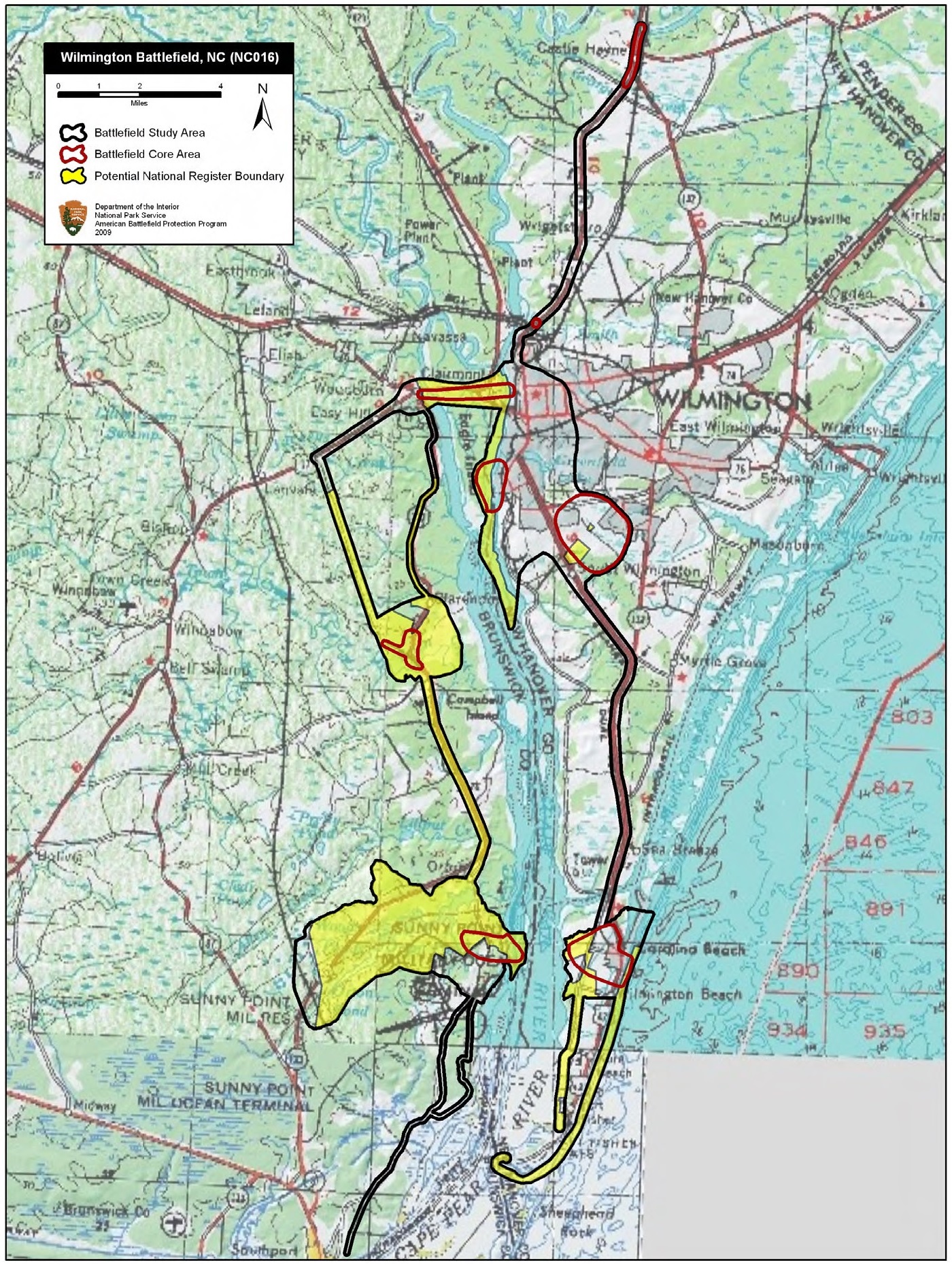
Battle of Wilmington
Lt. Commander William B. Cushing built a fake warship out of old barrels and canvas, floated it up the Cape Fear River, and watched the Confederates panic. They detonated their own water mines trying to destroy the decoy, clearing the way for Rear Admiral David D. Porter's real gunboats. It was that kind of fight -- improvised, relentless, and fought as much in waist-deep swamp water as on solid ground. The Battle of Wilmington, waged from February 11 to 22, 1865, was the Confederacy's last stand on the Atlantic seaboard, a twelve-day campaign to defend the only major port still feeding supplies to Robert E. Lee's army. When it ended, the Union blockade was finally complete, and the war had weeks left to run.
The Last Open Door
By early 1865, Wilmington was the Confederacy's final functioning Atlantic port. Blockade runners still slipped through the Cape Fear River inlet carrying tobacco, cotton, and military supplies to trading partners in Great Britain, the Bahamas, and Bermuda. Much of what kept the Army of Northern Virginia fighting came through this single chokepoint. When Fort Fisher fell to a Union assault in January, the port itself was sealed to runners, but the city thirty miles upriver remained in Confederate hands. General Braxton Bragg commanded the defense with Robert F. Hoke's veteran division from Lee's army, supplemented by heavy artillerists and home guard troops. Hoke held three brigades along the Sugar Loaf Line on the east bank of the Cape Fear River and stationed a fourth brigade at Fort Anderson on the west bank. Union general in chief Ulysses S. Grant saw Wilmington not just as a port to close but as a staging base -- rail lines ran from the coast to Goldsboro, where they could resupply William T. Sherman's armies marching north through the Carolinas.
Three Fights Along the River
Major General John M. Schofield commanded the combined Union force: Alfred H. Terry's Fort Fisher Expeditionary Corps reinforced by the newly arrived XXIII Corps. On February 11, Schofield struck Hoke's Sugar Loaf Line with Terry's troops while Porter's gunboats bombarded the fortifications from the ocean side. By late afternoon, the Union had overrun the Confederate skirmish line but found the main works too strong for a frontal assault. Schofield pivoted, ferrying Jacob D. Cox's division to the west bank to attack Fort Anderson instead. Porter's fleet sailed upriver and hammered the fort's twelve guns into silence. Then came Cushing's ingenious Quaker monitor -- a dummy warship designed to trick the defenders into wasting their mines. Cox sent two brigades directly at the fort while John S. Casement's men slogged through the swamps to flank it. When General Johnson Hagood sensed the encirclement and began pulling out, the attackers stormed in and took the fort with minimal resistance.
The Flat-Bottom Boat
Hagood fell back to Town Creek and burned the bridge behind him. Cox needed to cross, but the creek was too deep to ford. His troops found a single flat-bottom boat in the river and used it to ferry three full brigades across while a fourth brigade kept Hagood distracted with a diversionary skirmish. When Hagood realized he was being flanked again, he left two regiments as a rear guard and retreated toward Wilmington. The Union forces waded through the swamp and struck the Confederate flank, routing both regiments and capturing 375 prisoners along with two artillery pieces. The next day Cox rebuilt the bridge, brought Schofield's artillery across, and combined with Porter's gunboats to put the city itself within range. On the east bank, Hoke continued to hold Terry at bay, but the situation was now hopeless. Bragg recognized it and ordered Wilmington abandoned.
Fire on the Waterfront
Bragg used February 21 to evacuate everything he could. Union prisoners held in the city were moved out. Anything of military value that could not be transported was put to the torch -- bales of cotton and tobacco, storehouses, foundries, shipyards, and ships at anchor. The fires lit the night sky along the Cape Fear River as the Confederate garrison prepared to march. At one in the morning on February 22, Bragg withdrew his forces northward. Cox's corps entered the city after eight that morning. Terry's command followed an hour later. The last major Confederate port on the Atlantic coast had fallen.
A Blockade Complete
Wilmington's capture completed the Union naval blockade that had been strangling the Confederacy since 1861. No Atlantic port remained to replace what had been lost. The press savaged Bragg for the defeat, and members of the Confederate Congress demanded President Jefferson Davis resign. Bragg's forces retreated to Goldsboro, where they merged with Joseph E. Johnston's army for a final stand that would never succeed. For the Union, Wilmington became exactly what Grant intended -- a supply base. Schofield spent weeks repairing rail lines the Confederates had torn up, then reorganized his troops into the Army of the Ohio and marched inland to join Sherman near Fayetteville. The campaign had cost both sides relatively modest casualties compared to the war's great battles, but its strategic impact was decisive. With Wilmington gone, the Confederacy was sealed inside its own borders, fighting on momentum alone.
From the Air
The Battle of Wilmington extended along the Cape Fear River from Fort Fisher at the coast (33.97N, 77.92W) northward through Fort Anderson (34.06N, 77.93W) and Town Creek to Wilmington itself at 34.18N, 77.95W. From the air, the river's winding course through coastal lowlands is clearly visible, with the narrow peninsula of Confederate Point to the south. Key battlefield sites include Sugar Loaf (east bank south of Wilmington), Fort Anderson (west bank near Brunswick Town), and Town Creek. Best viewed at 3,000-5,000 feet AGL for the full campaign extent. Nearest airports: Wilmington International (KILM) on the northeast side of the city, and Cape Fear Regional Jetport (KSUT) in Southport to the south.