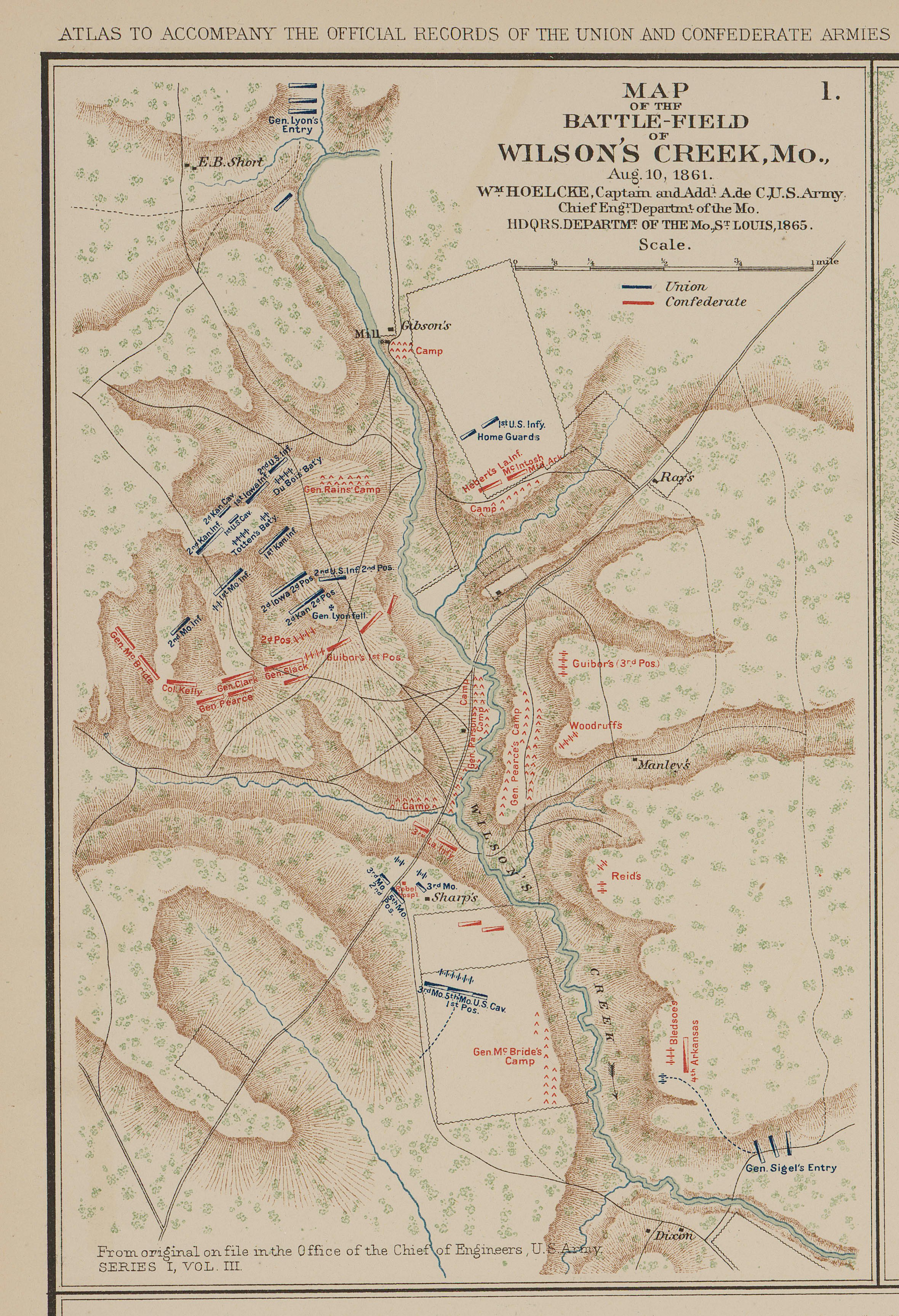
Battle of Wilson's Creek
Nathaniel Lyon once scouted an enemy camp disguised as a blind old woman in a carriage. That story, whether legend or fact, captures the aggressive temperament of the Union general who refused to retreat from Springfield, Missouri, in August 1861. Outnumbered more than two to one, with his men's enlistments expiring and no reinforcements coming from St. Louis, Lyon's only rational option was withdrawal. Instead, on August 10, he split his 5,431 men into two columns and attacked a combined Confederate and Missouri State Guard force of over 12,000 encamped along Wilson Creek. The gamble cost him his life -- he became the first Union general killed in battle during the Civil War -- and earned the engagement its lasting nickname: the Bull Run of the West.
A State at War with Itself
Missouri in 1861 was a border state tearing at its own seams. Governor Claiborne Fox Jackson harbored Confederate sympathies, while Lyon commanded the Federal arsenal in St. Louis. The confrontation escalated rapidly. Lyon captured a pro-Confederate militia camp in the Camp Jackson affair on May 10, triggering a street riot that killed three prisoners, two soldiers, and twenty-eight civilians. The state legislature responded by creating the Missouri State Guard under Sterling Price. At a last-ditch peace conference at the Planter's House Hotel on June 11, Lyon ended negotiations with words that rang like a declaration: "This means war." Lyon then seized Jefferson City, routed the Missouri State Guard at Boonville, and drove the rebels south. But at the Battle of Carthage on July 5, Confederate forces defeated Franz Sigel's column. By August, Price had joined forces with Confederate General Benjamin McCulloch and Arkansas militia general N. Bart Pearce. Their combined army, over 12,000 strong, encamped along Wilson Creek southwest of Springfield.
The Pincer That Failed
On the afternoon of August 9, Sigel proposed splitting the outnumbered Union force into a pincer attack. He would take 1,200 men around the Confederate camp to strike from the south while Lyon hit from the north. Other officers opposed the plan, but Lyon -- who had already rejected one of Sigel's proposals for divided attacks -- agreed. The Union army marched out that rainy evening. McCulloch had actually planned his own attack for August 10 but called it off when rain threatened to dampen his soldiers' gunpowder. He also withdrew his pickets that night, a decision that handed Lyon the element of surprise. At around 5:00 a.m., Lyon's artillery opened fire. Confederate cavalry was driven from the ridge that would become known as Bloody Hill. Three times during the morning, Southern forces assaulted the hill and three times they were repulsed.
Gray Uniforms and Friendly Fire
Sigel's southern column initially wreaked havoc, his artillery scattering 1,500 cavalry and nearly 2,000 unarmed Missouri State Guardsmen in the Sharp farm fields. But Sigel was poorly deployed. When McCulloch sent the 3rd Louisiana Infantry toward Sigel's position, the uniform confusion that plagued the early war proved devastating. The Louisiana regiment wore gray, and Sigel's men mistook them for the gray-clad 1st Iowa, a friendly unit. Union officers ordered their men to hold fire. A private sent down the road to identify the approaching force was shot after realizing the truth. The 3rd Louisiana charged, supported by Rosser's Missouri troops and Pearce's Arkansas battalion. Four Union guns were overrun. Sigel's brigade routed, fleeing to Springfield in scattered groups. Historians believe Sigel was likely the first unwounded Union soldier to reach the city from the battlefield.
Death on Bloody Hill
With Sigel destroyed, the Confederates consolidated against Lyon on Bloody Hill. Lyon's horse had been killed. He had been wounded in the head and right leg. Still, he personally led a counterattack by the 2nd Kansas Infantry. During this charge, Lyon was killed. Command passed to Major Samuel D. Sturgis. A third Southern assault, the largest of the day with about 3,000 men, struck around 10:30 a.m. but was repulsed, with Union artillery playing a decisive role. By 11:30, with ammunition running low and no word from Sigel, Sturgis ordered a retreat to Springfield. The exhausted Union column arrived at 5:00 p.m. Casualties were roughly equal -- 1,317 Union and an estimated 1,222 for the combined Southern forces -- but the percentages were devastating: nearly a quarter of Lyon's men were killed, wounded, or captured. The 1st Kansas suffered the seventh-highest killed-and-mortally-wounded rate of any Union regiment in the entire war.
Bloody Hill Preserved
The Confederates won the field but were too exhausted and low on ammunition to pursue. Price led the Missouri State Guard north to capture Lexington in September, but a Union concentration soon forced him back. Wilson's Creek gave the Confederates temporary control of southwestern Missouri, but the Union retook Springfield by late October. The battle site is preserved today as Wilson's Creek National Battlefield, operated by the National Park Service. The Ray family home, used as a Confederate field hospital, is one of only two structures from 1861 still standing on the battlefield. The National Park Service has restored much of the land to vegetation patterns resembling those of the battle. In the 1890s, five Union veterans of Wilson's Creek received the Medal of Honor for their actions that August morning: Lorenzo Immell, John Schofield, Henry Clay Wood, William M. Wherry, and Nicholas Bouquet.
From the Air
Located at 37.100N, 93.408W approximately 10 nm southwest of Springfield, Missouri, at roughly 1,200 feet MSL. Springfield-Branson National Airport (KSGF) lies approximately 12 nm to the northeast. The battlefield encompasses open, rolling terrain along Wilson Creek. Bloody Hill is the prominent ridge feature. The Ray House and a springhouse are the only surviving 1861 structures. The National Park Service visitor center and tour road are visible from low altitude. The terrain is restored tallgrass prairie and woodland. Best viewed at 2,000-4,000 feet AGL to appreciate the tactical layout of the battle -- Lyon's approach from the north, Sigel's flanking movement from the south, and the creek running through the center.