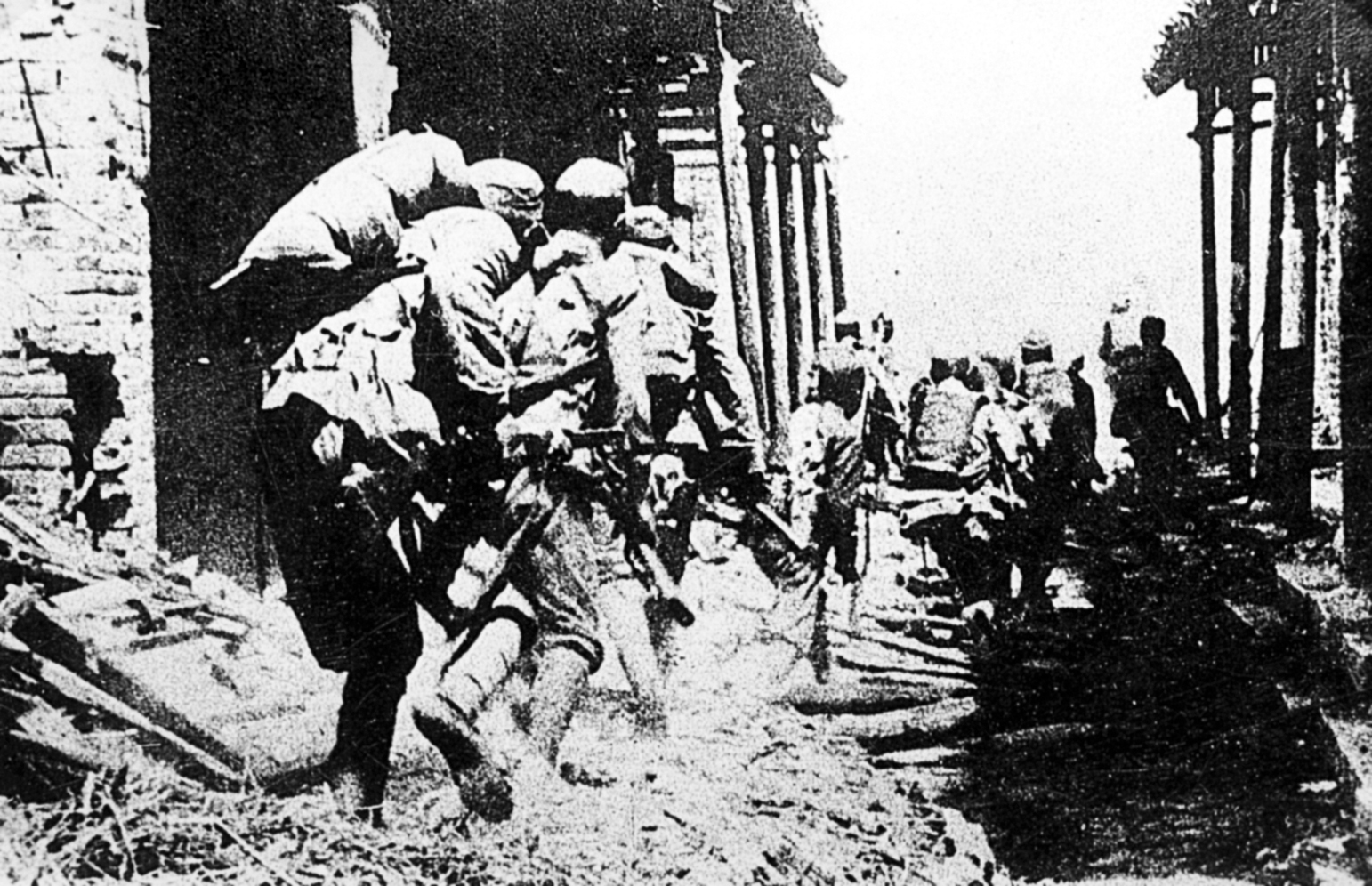
Battle of Xuzhou
In early 1938, Xuzhou was the most important railway junction in eastern China. Two lines crossed here -- the north-south Jinpu Railway connecting Beijing to Nanjing, and the east-west Longhai Railway running from Lanzhou to the coast. Whoever controlled Xuzhou controlled the movement of troops and supplies across the entire central plain. For more than three months, Chinese and Japanese armies fought a sprawling, brutal campaign across the farmland, cities, and rail lines radiating from this junction. The result was an eventual Japanese victory that failed in its primary objective: the Chinese army escaped.
Rails and Ruin
The Japanese strategy was straightforward: two armies would advance along the Jinpu Railway from the north and south, meet at Xuzhou, and then push west into the Yangtze valley toward Wuhan. Chiang Kai-shek recognized the threat. At a military conference in Wuchang in late January 1938, he declared the defense of Xuzhou his top strategic priority. Chinese preparations swelled from 80,000 to 300,000 troops positioned along both rail lines. But the defenders were at a severe disadvantage -- most mechanized forces and aircraft in eastern China had been destroyed in the Battle of Shanghai three months earlier, and replacement equipment had not yet arrived.
Stalemate and Sacrifice
The campaign opened in early February with Japanese armored units attacking along the railway under heavy air support. At Bengbu, the Japanese seized control of areas north of the Huai River. At Linyi, Chinese forces under Generals Pang Bingxun and Zhang Zizhong fought the Japanese to a standstill in three weeks of entrenched combat, enduring devastating losses to prevent a breakthrough. Along the eastern Longhai Railway near Lianyungang, fighting devolved into bloody stalemates where neither side could push the other back. The 60th Corps of the Yunnan Army held Yuwang Mountain against the Japanese 10th Division for nearly a month, losing more than half its strength before being relieved.
Taierzhuang: The Stone-Walled Victory
The campaign's defining moment came in late March at the walled city of Taierzhuang, positioned along the Grand Canal at a critical intersection of the rail lines. Chiang Kai-shek telegraphed his generals: "The enemy at Taierzhuang must be destroyed." The cramped conditions of urban combat neutralized Japanese advantages in armor and artillery, allowing Chinese soldiers to fight on more equal terms. The Chinese severed Japanese supply lines while resupplying their own forces, bleeding the attackers dry of ammunition and reinforcements. The resulting Chinese victory was the first major defeat of Japanese forces in the war. Both sides lost at least 20,000 soldiers in two weeks, and Taierzhuang itself was nearly leveled, but the morale effect across China was profound.
Escape and Flood
After Taierzhuang, the Japanese assembled 400,000 troops for a massive pincer movement to encircle the Chinese at Xuzhou. Divisions drawn from the Kwantung Army reinforced the attack, supported by tank battalions and motorized units. The encirclement tightened through April and May. Then, on May 18, a sandstorm and dense fog rolled across the plain. Under this natural cover, the Chinese forces broke out and withdrew, preserving the majority of their army to fight again at Wuhan. Xuzhou fell, but the escape denied the Japanese their strategic objective. In a desperate final measure, the Chinese breached the dikes of the Yellow River, flooding vast areas to block the Japanese advance. The floods killed hundreds of thousands of Chinese civilians and displaced millions more -- a catastrophic decision whose necessity remains debated by historians.
From the Air
Located at 34.267N, 117.167E at Xuzhou, Jiangsu Province. Major railway junction city on the North China Plain. Nearest major airport: Xuzhou Guanyin Airport (ZSXZ). The Jinpu (north-south) and Longhai (east-west) railway lines intersect here. The Yellow River lies to the northwest. Recommended viewing altitude: 5,000-10,000 feet AGL.