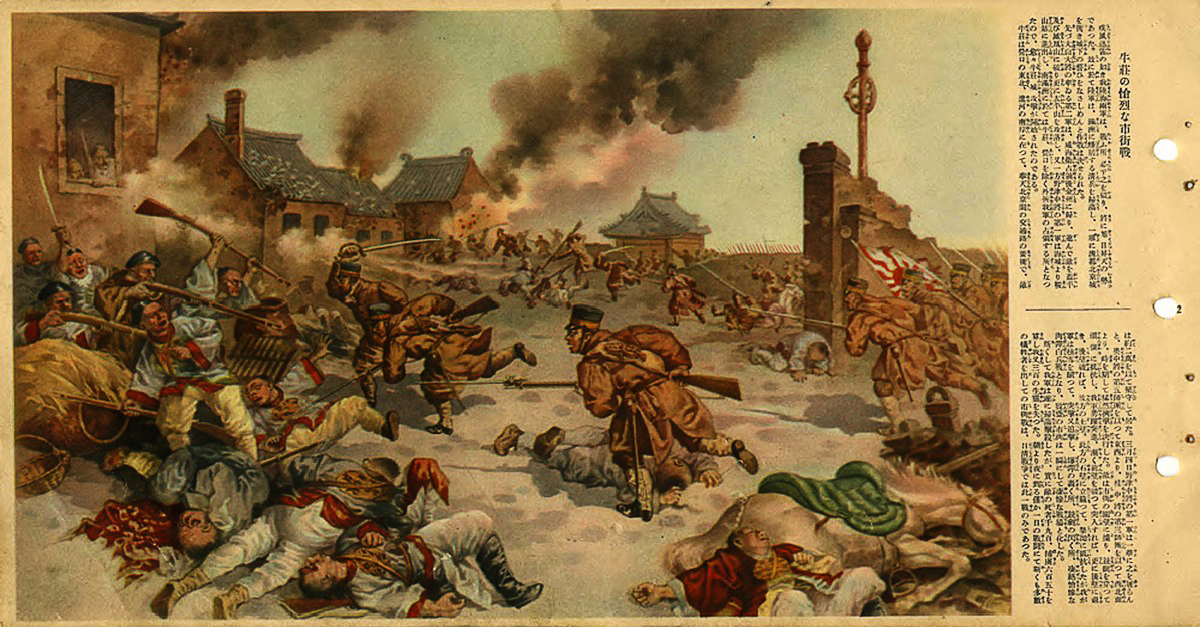
Battle of Yingkou
By the winter of 1895, the Qing Empire was running out of armies. General Song Qing's force in Manchuria -- the last organized Chinese army in the theater -- had been battered by months of fighting around Haicheng and Kaiping, launching counteroffensive after counteroffensive against entrenched Japanese positions, each one repulsed with mounting casualties. When the Japanese finally turned from defense to attack and marched on the treaty port of Yingkou, the battle that followed effectively ended the First Sino-Japanese War on the Asian mainland. The army of Song Qing ceased to exist as a fighting force, and the road to the Treaty of Shimonoseki was opened.
A Cascade of Defeats
The Japanese entry into Manchuria began after victories at Pyongyang and Jiuliancheng in the autumn of 1894. Marshal Yamagata Aritomo pursued the retreating Qing forces aggressively, and General Katsura Taro's 5th Brigade captured Haicheng on December 13, unraveling General Song Qing's defensive plans along the Liao River. The fall of Kaiping in January 1895 inflicted 1,200 Chinese casualties against just 307 Japanese losses. The Qing government, alarmed by the disasters, reorganized its command: the Guangxu Emperor relieved Li Hongzhang and installed a six-man defense committee headed by Prince Chun, which assembled 50,000 troops at Shanhaiguan and 55,000 in Beijing under the overall command of Liu Kunyi. But these massive reserves were held back to defend the capital and Zhili Province, leaving Song Qing with just 35,000 men in Manchuria to face 30,000 battle-hardened Japanese soldiers.
Offensives That Broke the Army
Song Qing was nothing if not tenacious. Between January 17 and February 21, 1895, he launched three separate offensives to retake Haicheng and Kaiping, attacking with up to 20,000 men at a time. Each assault was repulsed. In one engagement, 20,000 Chinese troops suffered 300 casualties against just 41 Japanese. The lopsided figures reflected not just Japanese tactical superiority but the devastating effectiveness of entrenched defenders armed with modern artillery against attackers advancing across open ground. General Nozu, the Japanese commander, watched these costly Chinese offensives exhaust themselves, then decided to exploit the exhaustion with a counterattack of his own.
The Fall of Yingkou and Niuzhuang
The fighting at Niuzhuang was fierce. When conventional attacks yielded little, the Japanese methodically destroyed houses in the town, bringing their guns to bear directly on Chinese positions. The bombardment continued until 11 PM, when the surviving defenders surrendered. Casualties were severe: 389 Japanese against an estimated 3,000 Chinese, including 2,000 dead and 633 prisoners. But Song Qing managed to reassemble 11,000 men at Tianzhuangtai the following day. Nozu, unwilling to give the Chinese time to regroup, pressed on immediately. At Tianzhuangtai, Chinese resistance crumbled: 2,000 casualties, the entire Chinese artillery force captured, against just 16 Japanese killed and 144 wounded. Song Qing's army had been destroyed as an organized fighting force.
The Road to Shimonoseki
The capture of Yingkou marked the effective end of major land combat in the First Sino-Japanese War. The Japanese army continued to push for permission to advance on Beijing or Mukden, and in late March landed marines near the Grand Canal, placing them within 50 miles of the strategic waterway connecting Beijing to Nanjing. Combined with the capture of the Pescadores Islands near Taiwan, this pressure drove the Qing government to finalize negotiations. The Treaty of Shimonoseki, signed on April 17, 1895, ended the war on terms devastating to China: the cession of Taiwan, the Pescadores, and the Liaodong Peninsula, plus an indemnity of 200 million taels of silver. The battle at Yingkou had proven what the preceding months of combat had suggested -- that the Qing military system, for all its numerical strength, could not match the modernized Japanese army in the field.
From the Air
Located at 40.67°N, 122.23°E near the treaty port of Yingkou, at the mouth of the Liao River on the Liaodong Bay, Liaoning Province. The city and surrounding flat terrain where the battle was fought are visible from the air. Nearest major airport: Shenyang Taoxian International Airport (ZYTX). Recommended viewing altitude: 10,000-15,000 ft. The Liao River and its delta are prominent navigation features.