Battle of Yu Oc
Three rifle shots echoed through the forest at 7:00 a.m. on 19 November 1884 -- Chinese scouts signaling that the French were coming. Along the Clear River in northern Tonkin, Lieutenant-Colonel Jacques Duchesne's column of five infantry companies had been marching in single file since dawn, heading for the village of Yu Oc. Weeks earlier, Liu Yongfu's Black Flag Army had seized this stretch of the river, severing the only supply route to the French garrison at Tuyen Quang, 100 kilometers upstream. The isolated post was slowly being strangled. Duchesne's mission was to break the blockade, push a food convoy through, and put the garrison on a footing to survive the winter. He would have four hours to do it.
Strangled on the Clear River
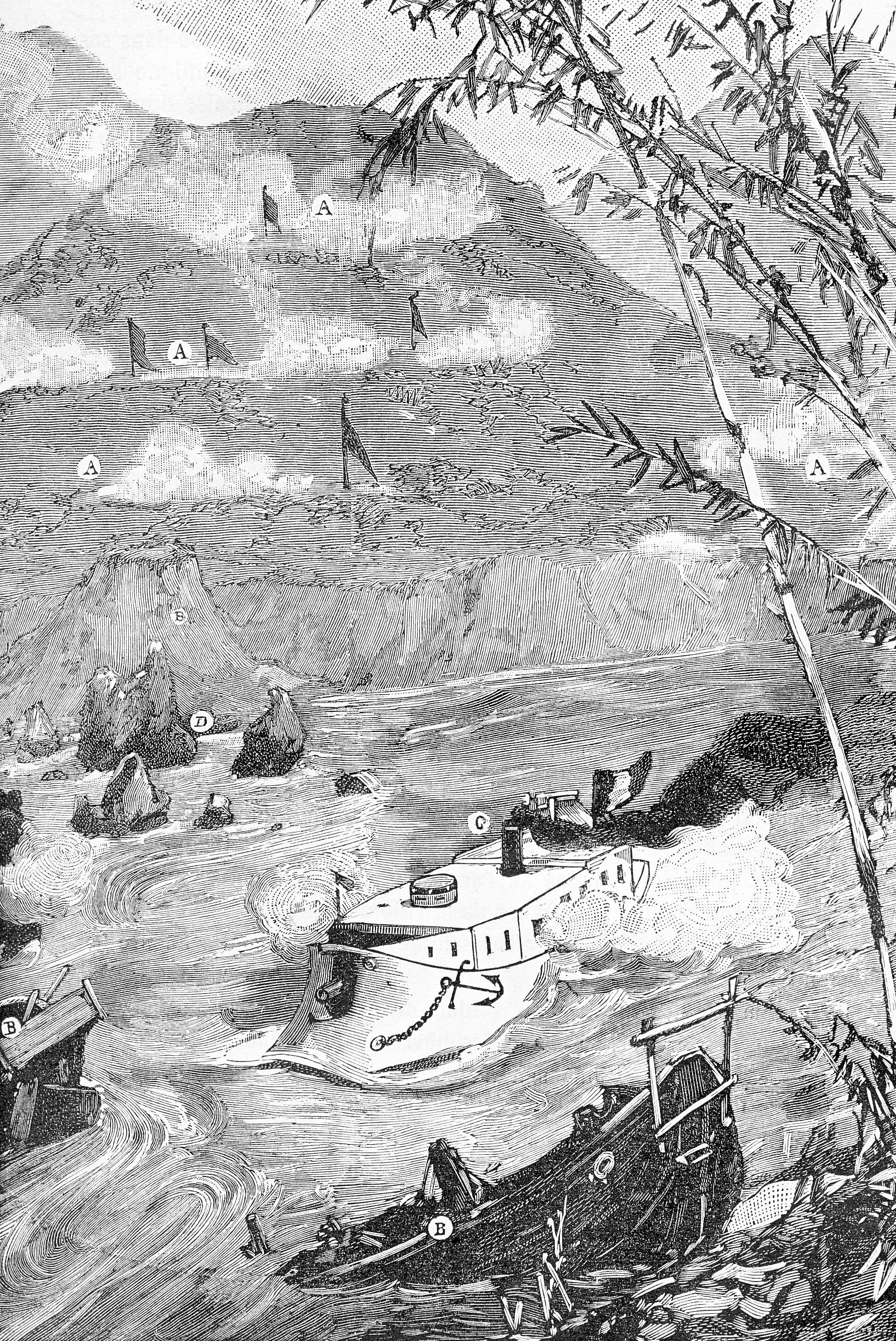
Tuyen Quang was the most westerly French outpost in Tonkin, planted on the Clear River in June 1884 after the French captured Hung Hoa and Thai Nguyen. Two companies of the 1st Foreign Legion Regiment garrisoned it, over 100 kilometers from the nearest friendly post. When the Sino-French War erupted on 23 August 1884, the isolation became lethal. Tang Jingsong's Yunnan Army and Liu Yongfu's Black Flags began probing the defenses in October, launching nuisance attacks between the 13th and the 19th. Malaria compounded the pressure -- by month's end, 170 of the garrison's 550 men were unfit for duty. French gunboats attempted supply runs along the Clear River, threading between harassing fire from both banks. When the Black Flags fortified Yu Oc in late October, they commanded both the land route and the river passage to Tuyen Quang. The gunboat Trombe lost one dead and seven wounded running the gauntlet on 12 November. Four days later, Revolver took two dead and three wounded, including her commander, Ensign de Balincourt.
Approach Through Silence
General Briere de l'Isle, commanding the Tonkin Expeditionary Corps, responded to the attack on Revolver within hours. He assembled a column under Duchesne: five infantry companies with artillery support, drawn from the garrison at Hung Hoa. On 18 November, the troops boarded a flotilla of junks escorted by four gunboats and moved upstream to a point seven kilometers above Yu Oc. They went ashore on the right bank of the Clear River that afternoon and began their approach on foot, moving slowly through the riverside forest in single file. By evening they were within a few hours' march of the Black Flag positions. The jungle was quiet. No scouts, no pickets, no signs of the enemy. The silence was deliberate -- the Black Flags knew the French were coming and chose to wait. Duchesne's marine infantry led the column at dawn the next morning, with the artillery behind and two Foreign Legion companies guarding the rear. The marsouins advanced without speaking, alert to every shadow in the tree line.
The Flank Through the Forest
When the firing erupted, it came from three directions at once: across the path ahead, from the woods to the west, and from the opposite bank of the Clear River. Chanu and Herbin's marine infantry companies engaged the enemy head-on, absorbing the initial onslaught while the battle's decisive maneuver unfolded unseen. Captain de Borelli's Foreign Legion company had peeled away from the column and was working through the forest around the Chinese flank. By 10:00 a.m., the marines were nearly out of ammunition. At that moment, de Borelli's legionnaires emerged from the western tree line, threatening the Black Flags' retreat. The effect was immediate -- the defenders abandoned their forward positions, leaving flags and ammunition behind. Duchesne pressed the advantage. Ten minutes later, the column reached a deep ravine with a Chinese fort on the far side. De Borelli ordered fixed bayonets. His exhausted legionnaires scrambled down one side and up the other without firing a shot. The Chinese fled before contact. At the Yu Oc pagoda, de Borelli and Chanu established a defensive perimeter while the rest of the column burned the Black Flag barracks and dismantled their fortifications.
The Convoy Gets Through
French casualties totaled 10 dead and 37 wounded, concentrated among the marine infantry who bore the brunt of the frontal engagement. Chinese and Black Flag losses went unrecorded but were believed to be considerably higher. The next day, under the protective guns of the Eclair, the food convoy reached Tuyen Quang. Duchesne spent three days clearing Black Flag positions around the post -- burning the camp at Dong Dien, pushing defenders back from Truong Mu toward Phu An Binh, and destroying Chinese earthworks on the left bank. The enemy withdrew without contesting any of these advances. On 23 November, Duchesne departed for Son Tay, establishing a new post at Phu Doan on the Clear River to anchor the supply line. He left behind a reorganized garrison under Chef de Bataillon Marc-Edmond Domine: just over 630 men with 120 days of provisions but only 200 artillery shells. The gunboat Mitrailleuse remained on the river as their sole naval support.
Prelude to a Siege
The day after Duchesne's departure, Domine declared Tuyen Quang in a state of siege. The Battle of Yu Oc had broken the blockade and bought the garrison time, but it had not broken the enemy's will. The Black Flags and the Yunnan Army were regrouping, and the four-month siege that followed -- from 24 November 1884 to 3 March 1885 -- would become one of the most celebrated episodes of the entire Sino-French War. Duchesne, for his part, would go on to command the French expedition that conquered Madagascar in 1895. General Briere de l'Isle commemorated the victory with a characteristically florid order of the day, praising Duchesne for routing the enemy 'after a stubborn action lasting four hours' and noting that 'the enemy was pursued with the bayonet in his guts.' The order slightly understated French casualties -- a common enough occurrence in colonial war dispatches, where the gap between what was written for Paris and what was endured in the field tended to be measured in blood.
From the Air
Located at 21.82N, 105.22E on the Clear River (Song Lo) in Tuyen Quang Province, northern Vietnam. The Yu Oc gorge is a narrow river passage flanked by forested hills. From the air, the Clear River is clearly visible winding through the terrain. Nearest airport: Noi Bai International (VVNB), Hanoi, approximately 130 km southeast. Recommended altitude: 3,000-5,000 feet for gorge terrain appreciation. The area is densely vegetated, with the river serving as the primary navigation reference.