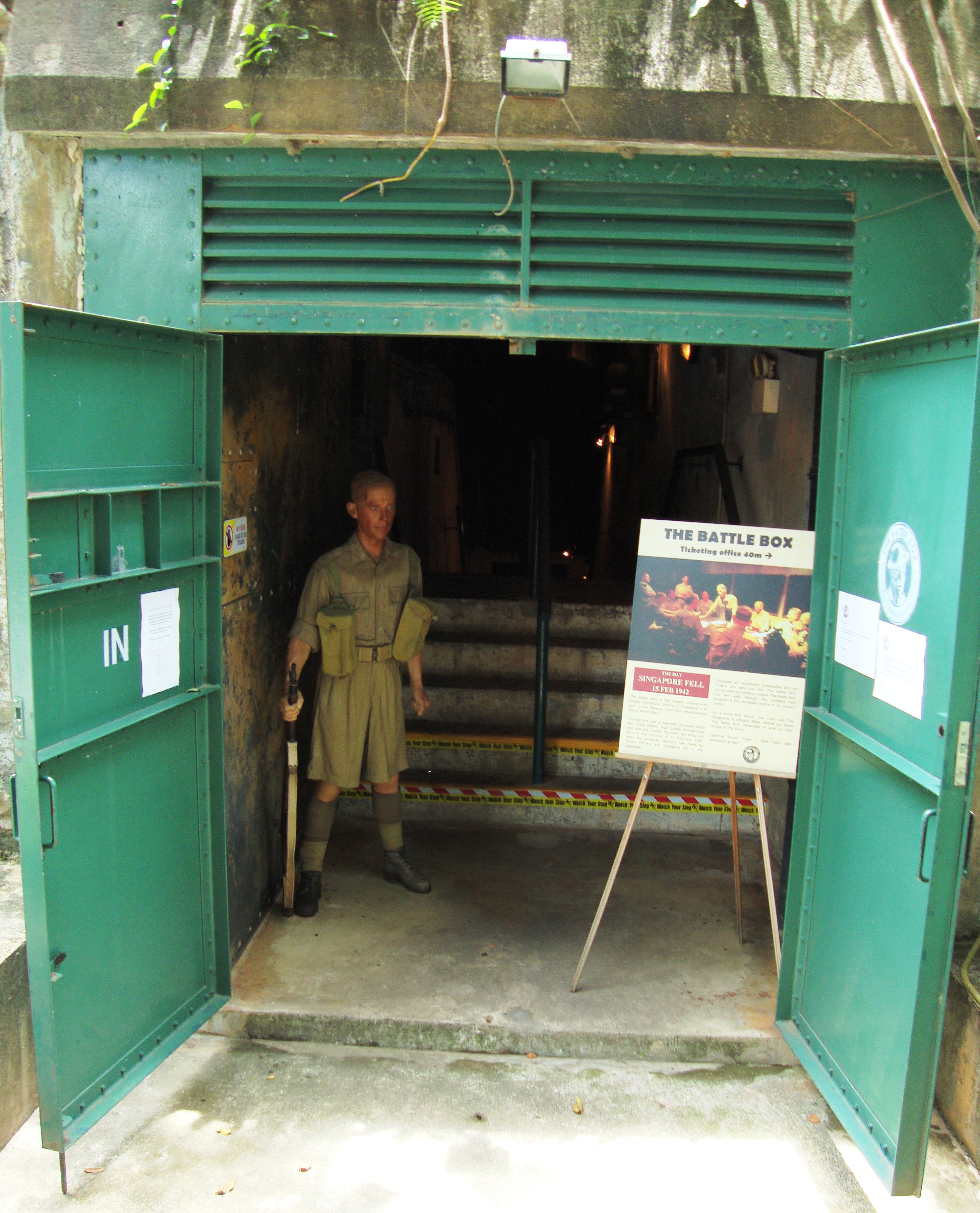
Battlebox
On the morning of 15 February 1942, Lieutenant-General Arthur Percival sat in a windowless concrete room thirty feet beneath Fort Canning Hill and made the decision that would define his legacy. Singapore's water supply was failing. Japanese artillery could reach every corner of the city. There were no viable options for counterattack. In a meeting attended by Generals Bennett, Heath, and Simmons, Percival authorized the surrender of Singapore -- the largest capitulation of British-led forces in history. The room where it happened still exists, sealed in reinforced concrete under one of Singapore's most pleasant public parks, and for decades after the war, nobody could even find it.
The Fortress That Wasn't
Singapore's strategic value was obvious long before the bunker was built. Positioned in the western Pacific at the crossroads of vital shipping lanes, the island was essential to Britain's ability to project naval power against Japan. The Admiralty's Singapore strategy demanded a fully equipped base, and the Singapore Naval Base rose on the island's north shore. Fort Canning Hill, a modest rise in Singapore's Central Area where Stamford Raffles had built a residence in 1823, became the British Army's headquarters in the 1920s. But Colonel Arthur Percival -- then Chief of Staff to General Dobbie -- recognized in 1936 that the Army, Royal Navy, and Royal Air Force each maintained separate headquarters, a dangerous fragmentation. He proposed a Combined Operations Headquarters beneath Fort Canning, and construction began that year on a bomb-proof bunker completed by 1941.
Thirty Feet Down
The bunker was built to withstand direct hits. Its reinforced concrete walls measured one metre thick, enclosing somewhere between 22 and 29 rooms -- sources disagree on the exact number. Inside were a telephone exchange connected to every military and most civilian switchboard in Malaya, signals rooms, operations rooms, sleeping quarters, latrines, and a cipher room for encoding and decoding messages. Brigadier Curtis, Commander of Fixed Defences, coordinated coastal artillery strikes from within. By 1941, however, the bunker was already considered too small for its intended role as a combined headquarters, and Percival -- now returned to Malaya as a lieutenant general -- authorized a new facility at the RAF headquarters on Sime Road. That new building was finished in December 1941. The Fort Canning Bunker became the headquarters of Major General Frank Keith Simmons, the Fortress Commander responsible for Singapore Island's defence.
Nine Days in February
The Japanese invaded Malaya on 8 December 1941, pushing south through Thailand and landing at Kota Bahru on the northeast coast. By 31 January 1942, Allied forces had been driven back to Singapore Island. On 8 February, Japanese troops crossed the Straits of Johor at the Battle of Sarimbun Beach, followed by a second landing near the Kranji River. The new Sime Road headquarters had to be abandoned during the Battle of Kranji, and on 11 February, Percival moved Combined Operations back to the Fort Canning Bunker. Around 500 officers and men crowded into the underground complex as Japanese bombing and artillery pounded the Central Area overhead. Four days later, with water supplies dwindling and no path to a counterattack, Percival convened his fateful meeting in the Commander, Anti-Aircraft Defence Room. The decision was unanimous. British forces would seek terms with the Japanese.
Lost and Found
The Japanese occupied the bunker throughout their three-and-a-half-year hold on Singapore, using it for communications until their own surrender. After the war, the British returned to Fort Canning Hill and used it as the Singapore Base District Headquarters. They handed it over to the Singapore Armed Forces in 1968-69, and the hill briefly housed the Singapore Command and Staff College. But the bunker itself, empty since the war, was sealed off in the late 1960s due to safety concerns. Its exact location was forgotten. It reentered public awareness only in 1988, when a journalist following leads about a hidden underground complex rediscovered the entrance. The bunker was developed into a museum depicting the final days of the Battle of Singapore, opening as the Battle Box on 15 February 1997 -- the 55th anniversary of the surrender.
Below the Park, Above the Past
Today, Fort Canning Hill is a lush urban park where Singaporeans jog, picnic, and attend open-air concerts. The Battlebox reopened to the public on 15 February 2024, operated by non-profit Global Cultural Alliance and offering free admission. An advisory team led by independent curator Tan Teng Teng -- who helped establish the original museum in 1997 -- ensures historical accuracy. Descending the concrete stairs into the bunker, the contrast with the tropical green overhead is immediate and jarring. The air cools, the light flattens, and the walls close in. The rooms are furnished to evoke their wartime configuration, and the telephone exchange, the signals boards, the map tables all carry a weight that no plaque can fully explain. This is where an empire's grip on Southeast Asia came undone -- not in a dramatic last stand, but in a quiet meeting in a room designed to withstand everything except the reality of defeat.
From the Air
Located at 1.296°N, 103.846°E beneath Fort Canning Hill in Singapore's Central Area. The hill is a green mound visible between the Singapore River and Orchard Road corridors. From low altitude, Fort Canning Park's tree canopy contrasts with the surrounding urban grid. Singapore Changi Airport (WSSS) is approximately 16 km to the east. Seletar Airport (WSSL) is 13 km to the north. The Marina Bay waterfront and its distinctive skyline are visible immediately to the south.