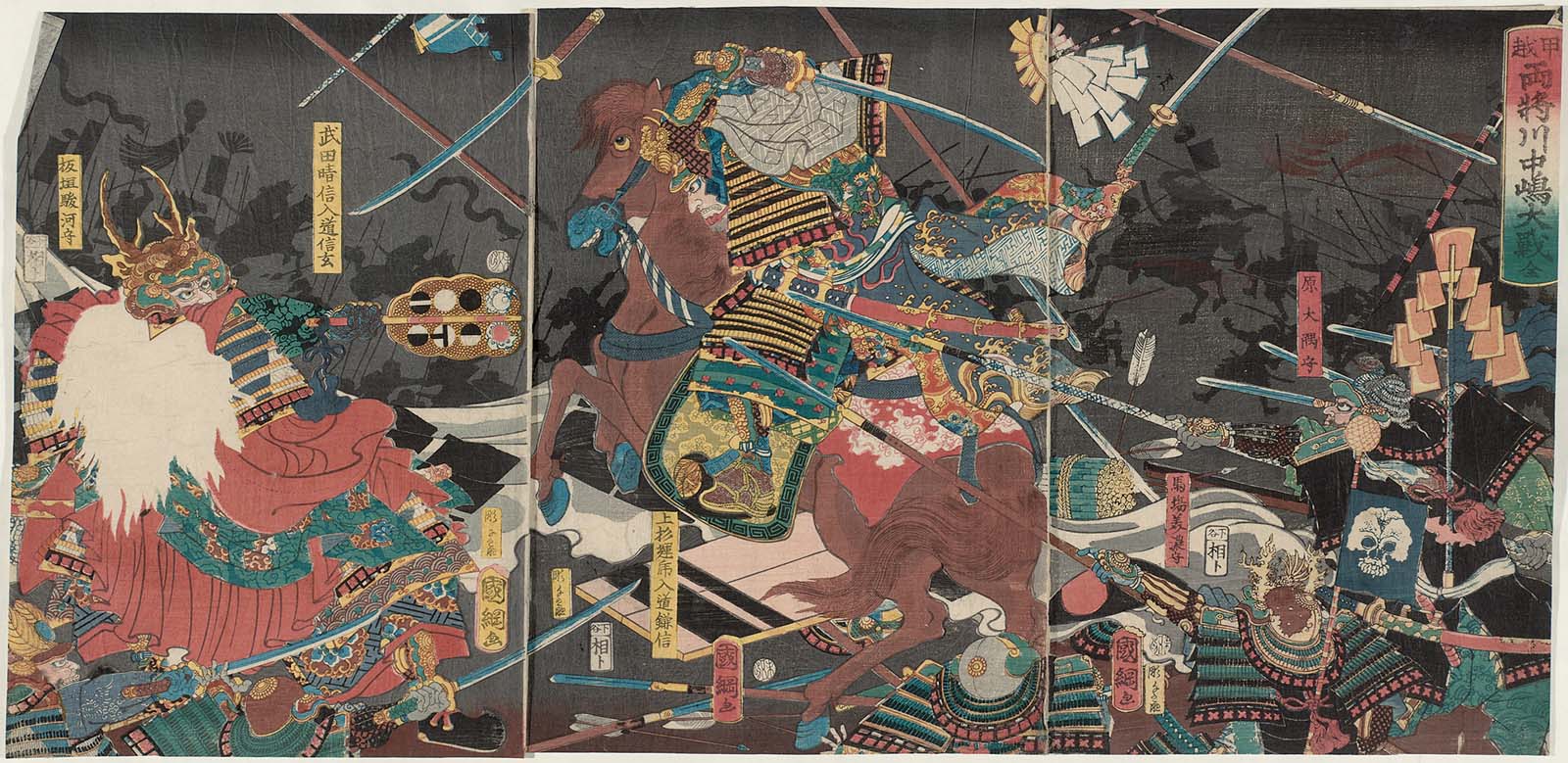
Battles of Kawanakajima: Eleven Years Between Two Rivers
According to legend, Uesugi Kenshin rode alone into Takeda Shingen's command post. Shingen, caught without his sword, parried the horseman's blade with his iron war fan. Bodyguards rushed in, Kenshin wheeled his horse and vanished into the chaos. Whether the duel actually happened is debated by historians, but the image -- two warlords meeting face-to-face on a battlefield littered with dead -- became the defining scene of Japan's Sengoku period. It was October 18, 1561, the fourth and bloodiest of the Battles of Kawanakajima. The plain where it happened, wedged between the Sai River and the Chikuma River near modern Nagano, looks peaceful now. But for eleven years, it was the most contested ground in Japan.
The Warring States Collision
The Sengoku period -- Japan's century of civil war -- created a landscape of ambitious warlords carving out territory wherever the shogunate's grip weakened. By the 1540s, Takeda Shingen of Kai Province had begun swallowing neighboring Shinano Province, seizing castles at Hayashi, Fukashi, and others by siege. The lords he displaced, particularly Ogasawara Nagatoki and Murakami Yoshikiyo, fled north and appealed for help to the one man strong enough to stop Shingen: Uesugi Kenshin, lord of Echigo Province. Kenshin answered. Their battleground became the plain of Kawanakajima, a flat expanse where the Sai and Chikuma Rivers converge just south of the ancient Zenkoji temple. Five times between 1553 and 1564, the two armies met there. Neither man ever broke the other.
The Early Clashes
The first battle, the Battle of Fuse in 1553, erupted just twelve days after Shingen captured Katsurao Castle. He pushed into the Kawanakajima plain along the Chikuma's eastern bank while Kenshin marched up the western bank. They skirmished at a Hachiman shrine, and Shingen withdrew. Kenshin pursued, winning again at Hachiman and taking Arato Castle before winter forced both sides to disengage. The second battle, Saigawa in 1555, saw Shingen camp south of the Sai River while Kenshin positioned himself near Zenkoji temple, using its elevated ground for a commanding view. The standoff lasted from August to November without decisive result. The third encounter in 1557 followed Shingen's capture of Katsurayama fortress, which overlooked Zenkoji from the northwest. He pushed toward Iiyama Castle but withdrew when Kenshin advanced from the temple. Each battle tested strategies and resolve, but neither general committed fully.
The Day of the War Fan
The fourth battle, on October 18, 1561, was different. Shingen's strategist Yamamoto Kansuke devised Operation Woodpecker: split the army and send 8,000 men to attack Kenshin's camp on Mount Saijo from behind, driving his forces downhill onto the plain where Shingen's main body waited in a crane's wing formation designed to surround the enemy. But Kenshin anticipated the trap. Under cover of night, he marched his entire army off the mountain and across the Chikuma River. At dawn, when Shingen's main force expected fleeing soldiers, they found the full Uesugi army bearing down in a rotating wheel formation that kept fresh troops cycling to the front. The fighting was savage. Kansuke, realizing his plan had failed, charged into the Uesugi lines and died. Shingen's younger brother Takeda Nobushige was killed. Both armies suffered staggering casualties -- roughly 3,000 to 5,000 dead on each side, the highest percentage losses of any Sengoku battle.
A Rivalry Without Resolution
The fifth and final battle at Shiozaki in 1564 produced no decisive outcome either. Neither Shingen nor Kenshin ever established lasting control over the Kawanakajima plain. Yet the rivalry endured in Japanese culture long after both men died -- Shingen in 1573, Kenshin in 1578. During the Edo period, the battles became a favorite subject for woodblock print artists, partly because both the Takeda and Uesugi clans had died out, making glorification of their deeds politically safe under the Tokugawa shogunate. The image of Kenshin's mounted assault and Shingen's war fan defense was carved, painted, and retold until it became the defining emblem of samurai valor. The 1969 film Furin Kazan dramatized the fourth battle's climax. A shogi variant was named after the battles. Today, a bronze statue of the two warriors' legendary duel stands in Kawanakajima Battlefield Park in Nagano, forever frozen in the moment before the war fan meets the sword.
From the Air
Located at 36.649N, 138.195E on the Kawanakajima plain, present-day Nagano, Japan. The plain is clearly visible from altitude as the flat confluence area between the Sai River (flowing from the south) and the Chikuma River (from the east). Zenkoji temple lies to the north on slightly elevated ground -- the strategic observation point Kenshin used during the second battle. Mount Saijo, where Kenshin camped before the fourth battle, rises to the west. Kawanakajima Battlefield Park marks the approximate center of the 1561 engagement. Nearest major airport is Matsumoto Airport (RJAF), approximately 77 km south. Best viewed at 5,000-8,000 feet AGL to see the river convergence and understand the terrain that shaped the battles.