Battles of Latrun (1948)
David Ben-Gurion called the decision not to launch a sixth assault on Latrun 'bechiya ledorot' -- a cause for lamentation for generations. The prime minister's anguish was not merely strategic. Between May 25 and July 18, 1948, Israeli forces attacked the fortified police station at Latrun five separate times and failed five separate times, losing 168 soldiers while the Jordanian Arab Legion held the position that controlled the only road between Tel Aviv and Jerusalem. The defeat forced a desperate improvisation: a bypass road carved through the hills in darkness, named the 'Burma Road' after the World War II supply route between Burma and China. That improvised track saved the 100,000 Jewish residents of besieged West Jerusalem from starvation. Latrun itself remained under Jordanian control for nineteen more years, until the Six-Day War of 1967.
The Road to Jerusalem
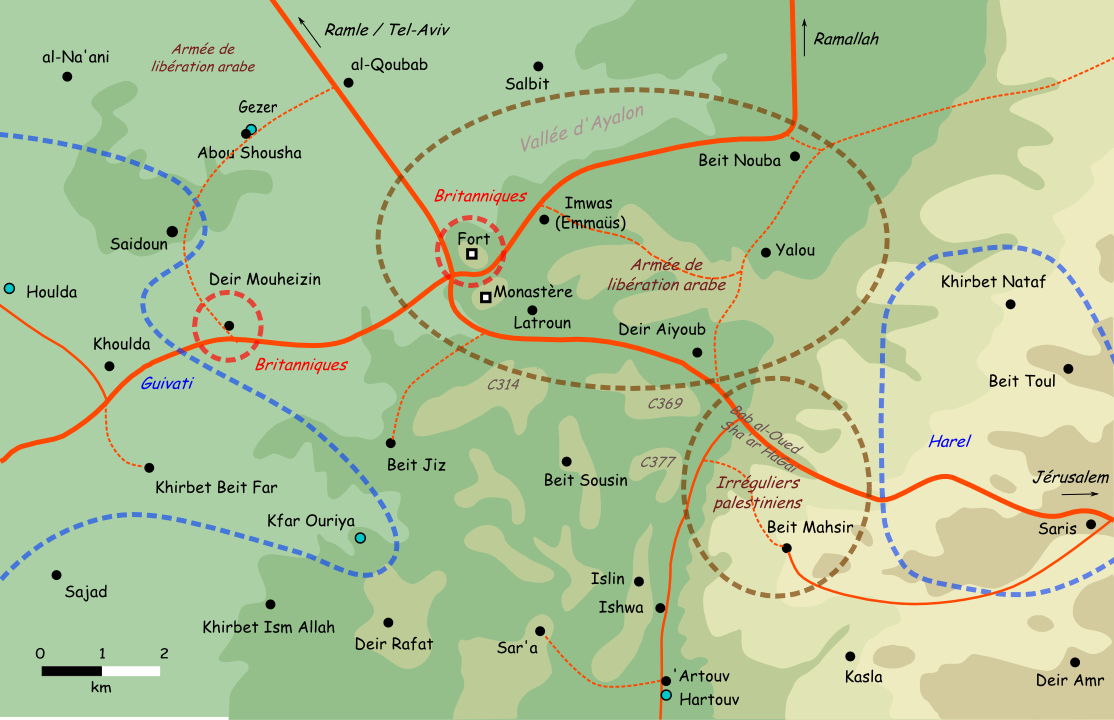
Latrun sat at the crossroads of two critical highways -- the road from Tel Aviv and Jaffa to Jerusalem, and the route from Gaza to Ramallah -- in territory allocated to the Arab state by the UN Partition Plan. A Trappist monastery stood near a fortified British police station built in the Tegart style, thick-walled and commanding. The force that held Latrun controlled access to Jerusalem. By May 1948, the hundred thousand Jewish residents of Jerusalem were running out of food, fuel, and water. The Arab Legion, an elite Jordanian force trained and led by British officers, had deployed its 4th Regiment to the position. Ben-Gurion, overruling his chief of operations Yigael Yadin -- who argued that Egyptian advances toward Tel Aviv posed a more urgent threat -- ordered the taking of Latrun. The decision was strategically necessary but politically delicate: attacking Latrun meant invading territory designated for the Arab state, violating non-aggression understandings reached with King Abdullah of Jordan.
Five Assaults, Five Failures
The first attack, Operation Bin Nun Alef on May 24-25, was led by Shlomo Shamir, a former British army officer, with raw troops and antiquated weapons -- two French 65mm mortars dating from 1906 and a single Davidka improvised mortar. Many of the soldiers were Holocaust survivors who had arrived in Israel only days earlier, barely trained and unfamiliar with the terrain. The assault collapsed under fire on open ground, and Shamir ordered retreat at 11:30 a.m. Under heavy sun and without water, soldiers were cut down as they withdrew. Subsequent operations fared no better. During Operation Yoram on June 8-9, the elite Yiftach Brigade under Yigal Allon launched a third attack, supported by artillery. A Jordanian counterattack overran Kibbutz Gezer after a four-hour battle; sixty-eight defenders, including thirteen women, held out before the position fell. A final frontal assault on July 18, one hour before a UN-mandated truce, used two Cromwell tanks driven by British army deserters but still failed to take the fort.
The Burma Road
What the Israeli army could not take by force, it circumvented with engineering. Even as the assaults continued, work began on a bypass road through the hills south of Latrun. On the night of June 6-7, with Jerusalem's supplies critically low, three hundred conscripted Tel Aviv civilians carried food on their backs through the kilometers of track not yet passable by trucks, delivering enough provisions to feed the city for one more day. The road was pushed through with desperate urgency, its first phase completed by the June 10 truce. It was rough, barely passable, and subject to fire from the heights above, but it worked. Convoys began moving food, arms, munitions, and equipment to West Jerusalem. The Burma Road transformed Latrun from a decisive defeat into a strategic stalemate: the Jordanians held the main highway, but the Israelis could still supply their capital. During the subsequent armistice negotiations at Rhodes, Israel unsuccessfully demanded the removal of Jordanian forces from Latrun.
Whose Defeat, Whose Memory
The battles left their deepest mark not on the ground but on Israeli collective memory. As historian Anita Shapira documented, two competing narratives emerged. The first, crafted by Ben-Gurion and his allies, cast Latrun as a heroic sacrifice that tied down Jordanian forces and enabled the Burma Road's construction. The Israeli press initially reported only ten Israeli dead. The second narrative, which gained traction in the 1970s, accused Ben-Gurion of exploiting newly arrived Holocaust survivors, sending them to die in a hopeless assault with inadequate training and equipment. The poet Gabi Daniel wrote bitterly of 'innocent young Jews of the Superior Race, who, without name or vision, found themselves the saviours of Israel.' Jordanian accounts claim the opposite kind of glory: Habes al-Majali, commander of the 4th Regiment, is celebrated as the only Arab officer to have defeated Israel in 1948. Today, the old Tegart fort houses an Israeli Armored Corps museum with nearly 200 tanks, and a memorial wall inscribed with the names of soldiers who have fallen since 1947. Palestinian historiography focuses on a different legacy -- the approximately twenty villages and ten thousand people displaced from the Latrun area during the fighting, most of whom were never allowed to return.
From the Air
Located at 31.84N, 34.98E at the junction of the Tel Aviv-Jerusalem and Gaza-Ramallah highways, where the road enters the Judean foothills at Bab al-Wad (Sha'ar HaGai). The former Tegart fort, now the Yad La-Shiryon armored corps museum, is visible from the air as a large compound with tanks arranged in open display. The Burma Road path can be traced through the hills to the south. Nearest airports: Ben Gurion International (ICAO: LLBG) approximately 20 km to the west-northwest. Elevation is approximately 250 meters at the valley floor, rising sharply into the Judean Hills to the east. Fly at 2,000-4,000 ft AGL.