Battles of Narvik
Captain Odd Isaachsen Willoch of the Norwegian coastal defense ship Eidsvold received the German demand to surrender at approximately 04:15 on 9 April 1940. His reply to his commanding officer was three words: "I am attacking." Minutes later, two torpedoes from the German destroyer Wilhelm Heidkamp struck Eidsvold's magazine. The ship broke in two and sank in seconds. Of her crew of 183, eight survived in the freezing water. The destruction of Eidsvold and her sister ship Norge in Narvik harbour that morning began two months of fighting that would involve warships, mountain troops, Foreign Legionnaires, and paratroopers from five nations in one of the fiercest battles of the Second World War's early months.
Iron Ore and Fjord Water
Narvik mattered because of what moved through it. The small port at the head of Ofotfjord provided an ice-free harbor in the North Atlantic for iron ore shipped by rail from the mines at Kiruna in Sweden. Both Britain and Germany depended on Scandinavian iron, and both understood that controlling Narvik meant controlling the supply. Hitler ordered the invasion of Norway on 1 March 1940, codenamed Operation Weserübung, partly to secure the ore route and partly as a preemptive strike against an openly discussed Franco-British plan to occupy Norwegian ports. On 6 April, Group I departed Bremerhaven: ten destroyers carrying 1,900 mountain troops of the 139th Mountain Regiment under General Eduard Dietl, escorted by the battleships Scharnhorst and Gneisenau. Each destroyer carried roughly 200 soldiers. Their destination was the end of the Ofotfjord.
Ten Destroyers in a Trap
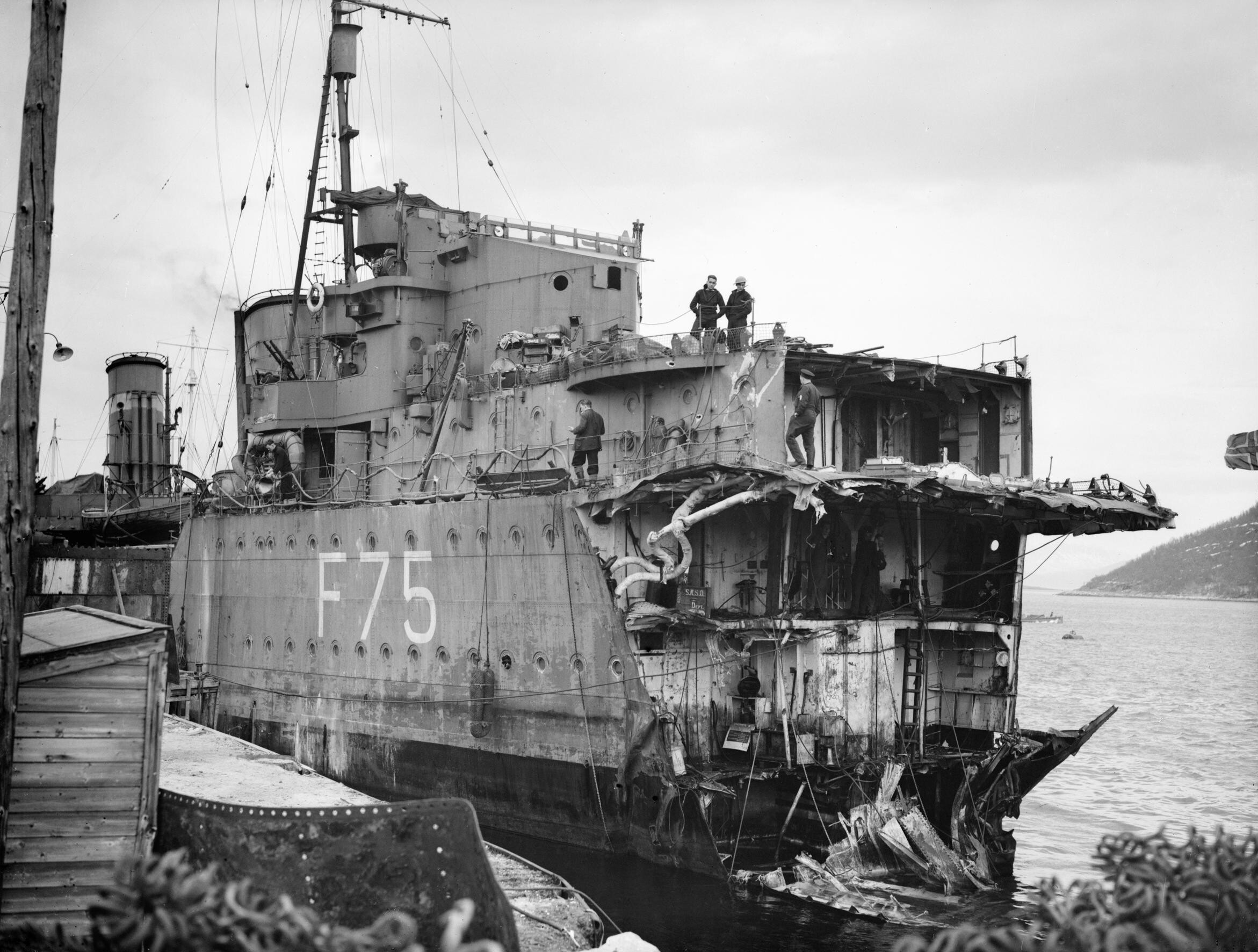
The German destroyers delivered their troops successfully on 9 April, overwhelming the Norwegian garrison after sinking Eidsvold and Norge. But the ten warships were now stranded. Their fuel tanker, the ex-whale factory ship Jan Wellem, had only improvised refueling equipment and worked agonizingly slowly. By dawn on 10 April, she had managed to fully refuel only three destroyers. A second tanker, Kattegat, had been delayed by British mining operations and never arrived. When five British H-class destroyers under Captain Warburton-Lee attacked the harbour at dawn on 10 April, the German ships fought back but could not pursue -- most simply lacked the fuel. The British sank or damaged several German vessels and killed Commodore Friedrich Bonte, the German flotilla commander, but lost two destroyers of their own. Three days later, the battleship Warspite returned with nine destroyers and finished the job. All eight remaining German destroyers were sunk or scuttled. The Kriegsmarine lost half its entire destroyer force at Narvik.
Five Nations in the Mountains
The naval victories left the Germans ashore but isolated. About 2,600 shipwrecked sailors joined Dietl's mountain troops, forming an improvised marine unit called the Gebirgsmarine and manning guns salvaged from their sunken destroyers. Against them came a multinational Allied force that eventually numbered 24,500 troops: Norwegian units under General Carl Gustav Fleischer, French Alpine troops and Foreign Legionnaires under General Antoine Bethouart, Polish mountain battalions, and British infantry. From 5 to 10 May, the fighting around Narvik was the only active land combat in the entire Second World War. The cold and snow punished all sides, but the Norwegians -- the only troops fully equipped with skis and trained to use them -- held an advantage in the mountainous terrain. Allied cooperation was uneven, with separate command structures and frequent disagreements over tactics. The British Army and Navy commanders could not even agree on whether to attack from the sea or advance cautiously overland.
Victory Abandoned
On 28 May, an amphibious assault finally seized Narvik itself. French Foreign Legionnaires landed from boats under naval bombardment, supported by five Hotchkiss H39 light tanks, while Norwegian forces advanced from the east. The German commander evacuated the town before 07:00, and the Allies had their first major land victory of the war. The Germans were pushed steadily back toward the Swedish border, and their position appeared hopeless. But events 2,000 kilometers to the south had already sealed Narvik's fate. Germany's invasion of France was succeeding beyond all expectation, and London had secretly decided on 24 May to evacuate Norway entirely. The Norwegian government learned in early June, receiving the news with disbelief and bitterness. King Haakon and his cabinet were evacuated to Britain on 7 June. All Allied troops left between 4 and 8 June, and General Dietl retook the empty town on the 8th. The last Norwegian forces surrendered on 10 June.
Wrecks and Remembrance
The cost was staggering. Germany lost ten destroyers, a submarine, and over 1,000 sailors -- half the Kriegsmarine's destroyer strength gone in a single campaign. On the Norwegian side, 276 sailors died aboard Eidsvold and Norge alone. The British lost the aircraft carrier Glorious and two destroyers during the evacuation when they were intercepted by the battlecruisers Scharnhorst and Gneisenau, with more than 1,500 men lost. Today, parts of the German destroyer Georg Thiele's bow still protrude from the water at Rombaksbotn, and the wrecks scattered through the Ofotfjord remain popular diving sites. Three German destroyers were raised in 1964 and moved to clear shipping lanes; they rest in 12 meters of water and are open for diving. A war museum opened in Narvik in 1964, now housed in the Narvik War and Peace Centre. At least 1,200 French, British, and Polish participants received the Norwegian War Cross. All 8,577 German personnel who fought at Narvik received the Narvik Shield.
From the Air
Narvik sits at approximately 68.42°N, 17.56°E at the head of the Ofotfjord in northern Norway. The fjord system where both naval battles took place is dramatic from the air -- deep, steep-sided channels cutting through snow-capped mountains. Wrecks are visible in the shallows at Rombaksbotn (eastern end of Rombaksfjord) and near Narvik harbour. Fly at 3,000-8,000 feet for the best view of the fjord geography and battle sites. Nearest airport is Harstad/Narvik Airport, Evenes (ENEV), approximately 60 km west. Bardufoss (ENDU) is another option. Weather is frequently overcast with snow in winter and rain in summer; clear days reveal spectacular mountain-and-fjord scenery.