Battles of the Isonzo
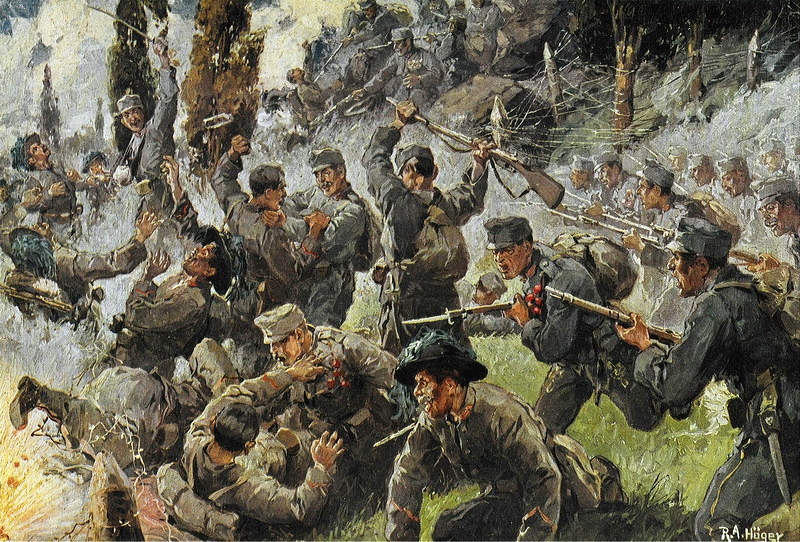
The Italian army attacked across the Isonzo River twelve times in twenty-nine months. Twelve times, roughly the same thing happened: men advanced into a landscape of exposed limestone, river crossings under fire, and fortified mountain positions held by Austro-Hungarian defenders who had dug in before the war even began. Half of all Italian soldiers killed in World War I, some 300,000 of 600,000, died along this single river in what is now the border region between Italy and Slovenia. The Austro-Hungarians lost around 200,000 of their own. That the battles were always numbered rather than given distinct names became, in itself, a kind of verdict: the same fight, repeated, with the same results.
A River That Ran Through Empire
The Isonzo, known as the Soca in Slovenian, runs 138 kilometers from the Vrsic Pass in the Julian Alps to the Adriatic Sea. In 1915, the entire river lay within Austria-Hungary, parallel to the Italian border. North of Gorizia, the river widened and the valley opened into a narrow corridor connecting northern Italy to Central Europe through the Vipava Valley and the Postojna Gate. This corridor was the strategic prize. Italian commander Luigi Cadorna, entering the war in May 1915 after the secret Treaty of London promised Italy territorial gains from the Austro-Hungarian Empire, planned to push through to Gorizia and Trieste, then onto the Slovenian plateau toward Ljubljana and Vienna. The plan assumed that frontal assault would achieve breakthrough. The terrain ensured it would not. The Karst Plateau, riddled with sinkholes and bare of cover, turned every advance into an ordeal of exposure.
The Dilemma of the Mountains
Along the 400-mile length of the Italian Front, the Isonzo sector was the only practical area for offensive operations. Everywhere else, the mountains were dominated by Austro-Hungarian positions fortified before Italy entered the war on May 23, 1915. But even here, the geography imposed a cruel paradox. To cross the river safely, the Italian army needed to suppress the Austro-Hungarian defenders on the heights above. To suppress those defenders, the army needed first to cross the river. Cadorna knew the Isonzo flooded unpredictably, and indeed the years 1914 to 1918 brought record rainfall to the region. The first battle began on June 23, 1915, and ended on July 7 without meaningful gains. The second followed almost immediately, from July 18 to August 3. By the time the fourth battle concluded in December 1915, the pattern was set: enormous casualties for negligible territorial progress.
The Sixth Battle and the Fall at Caporetto
The Sixth Battle of the Isonzo, fought in August 1916, finally delivered Gorizia to the Italians and earned distinction as the Battle of Gorizia, one of the few Isonzo engagements given its own name. But the city's capture did not break the front. Five more battles followed through 1916 and 1917, each grinding away at the same positions. The eleventh battle, in August and September 1917, was the last Italian offensive. Then came the twelfth, the one that carried a different name and a different outcome. In October 1917, German reinforcements joined the Austro-Hungarians for a combined assault at Kobarid, known to the Italians as Caporetto. The Italian line shattered. The retreat from Caporetto became one of the defining catastrophes of the war, a rout that Ernest Hemingway later wove into A Farewell to Arms. The front moved west to the Piave River, and the Isonzo battles were over.
What the River Carries
More than 30,000 of the dead were ethnic Slovenes, citizens of Austria-Hungary who served in the Austro-Hungarian Army and found themselves fighting on their own land. Slovenian civilians from the Gorizia and Gradisca region suffered in additional thousands, forcibly resettled in Italian refugee camps where they were treated as enemies and where thousands died of malnutrition. The Italian poet Giuseppe Ungaretti, stationed on the front, wrote his autobiographical poem "I Fiumi" about the Isonzo. Hemingway set his novel in this landscape. The Swedish author F. J. Nordstedt wrote a novel called Caporetto. Emilio Lussu published A Soldier on the Southern Front, an account from the Italian side. Today, the Kobarid Museum in Slovenia and the Walks of Peace Foundation preserve the heritage of the front. The Isonzo still runs through its valley, clear and cold, past terrain that has healed over but never forgotten what it absorbed.
From the Air
The Isonzo/Soca River runs through the border region of Italy and Slovenia at approximately 46.05°N, 13.55°E. From 5,000-8,000 feet AGL, the river valley is clearly visible, winding from the Julian Alps in the north to the Adriatic Sea. Key landmarks include the city of Gorizia (Nova Gorica on the Slovenian side), the Karst Plateau to the south, and the town of Kobarid (Caporetto) in the upper valley. The nearest airports are Trieste-Friuli Venezia Giulia Airport (LIPQ/TRS) to the south and Ljubljana Joze Pucnik Airport (LJLJ) to the northeast. The Julian Alps provide dramatic terrain to the north and west.