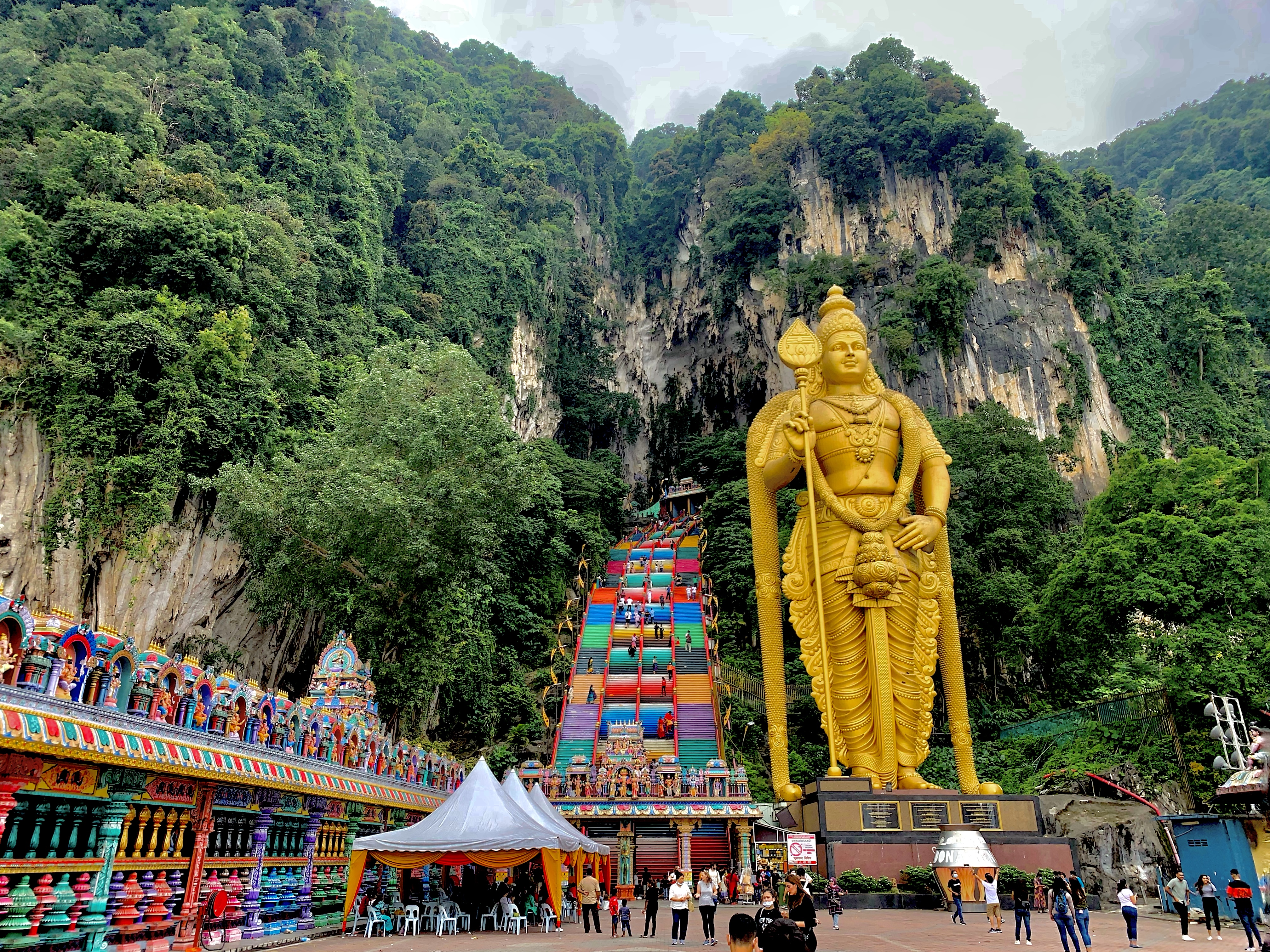
Batu Caves
Every January or February, depending on the Tamil calendar, over a million pilgrims climb 272 steps to a cathedral-sized limestone cavern and offer their bodies as acts of devotion. Metal skewers pierce skin. Hooks suspend portable altars from flesh. Drums and chanting carry devotees into trance states achieved through 48 days of fasting and prayer. This is Thaipusam at Batu Caves -- the largest celebration of the Tamil Hindu festival anywhere in the world, held inside a geological formation that predates complex life on Earth. The caves themselves are 400 million years old, carved by water into a 325-meter mogote of limestone in Gombak, Selangor, just north of Kuala Lumpur. Long before the temples, before the colonial surveyors, before the Chinese guano miners, the indigenous Temuan people -- part of the Orang Asli communities -- used these caves as shelter. The rock remembers all of them.
Layers of Occupation
The Temuan were the first known inhabitants, but the caves' modern history begins with commerce, not faith. In the 1860s, Chinese settlers discovered the caves were rich in bat guano -- nitrogen-dense fertilizer worth excavating. American naturalist William Hornaday visited in 1878 and recorded what he found. But the transformation from geological curiosity to sacred site came through one man: K. Thamboosamy, an Indian Tamil trader who recognized the caves' cathedral quality and promoted them as a place of Hindu worship. The main shrine was dedicated to Murugan, the Tamil deity of war and victory, son of Shiva and Parvati. A towering statue of Murugan now stands at the base of the steps -- gold-painted, 42.7 meters tall, one of the largest Murugan statues in the world. Its construction took three years and 1,550 cubic meters of concrete, 350 tons of steel bars, and 300 liters of gold paint. The statue gazes out over a landscape that has shifted from jungle to suburb, housing developments pressing closer each decade.
The Weight of Devotion
Thaipusam is not a spectacle. It is a practice of kavadi -- a Tamil word meaning "burden" -- in which devotees carry physical weight as spiritual offering. In its simplest form, kavadi consists of two semicircular pieces of wood or steel bent and attached to a cross structure, balanced on the shoulders. The most intense practitioners carry vel kavadi: portable altars decorated with peacock feathers and flowers, attached to the body through skewers and hooks pierced into the chest and back. Others pierce their tongues or cheeks with vel skewers. Holy ash called vibuthi covers the body and the piercing sites. The preparation is as demanding as the act itself. Devotees observe 48 days of vegetarian diet, regular prayers, celibacy, and fasting. Drumming and chanting guide them into trance. Worshippers carry pots of cow's milk -- paal kudam -- up the 272 steps as offerings. The festival draws hundreds of thousands of participants and observers, filling the cave complex and the surrounding streets with color, sound, and a devotional intensity that is difficult to witness without being moved by its sincerity.
A Darkness Full of Life
Below the religious drama on the surface, Batu Caves harbors a quieter world. The cave system comprises 20 recognized caves, including four large interconnected systems, and this underground labyrinth is a biodiversity hotspot. Researchers have documented 269 species of vascular plants, with 56 species -- 21 percent -- classified as calciphiles adapted specifically to limestone environments. The endemic trapdoor spider Liphistius batuensis lives here and nowhere else on Earth. Twenty-one bat species roost in the dark chambers, their guano supporting an ecosystem of its own, including the native cockroach Pycnoscelus striatus. The dark cave complex teems with haplotaxids, scorpions, springtails, beetles, and snails. Long-tailed macaques patrol the surface, bold enough to steal food from visitors' hands -- a habit that has earned them the nickname "urban monkey gangs" in local press. The Malaysian Nature Society restricts access to the inner caves, organizing educational trips to protect what development and foot traffic threaten. In 2018, the famous 272 steps were repainted in a rainbow of colors, and in 2024, plans emerged for an escalator to the temple -- proposals that sharpen the tension between accessibility and preservation.
Stone and Faith, Unresolved
Batu Caves sits at a crossroads that has no easy resolution. Housing development creeps closer. Industrial activity surrounds the karst formation. NGOs have demanded explanations for land grants within the cave reserve. Meanwhile, the religious significance only deepens -- each Thaipusam larger than the last, each year drawing more pilgrims from across Malaysia and beyond. At the base of the hill, the Cave Villa complex holds Art Gallery Cave and Museum Cave, filled with statues and paintings from Hindu mythology illustrating the life and stories of Murugan. On the northeastern face, 160 climbing routes scale the Damai caves, attracting rock climbers who see the limestone as a physical challenge rather than a spiritual one. The caves accommodate all of these uses without comment, as limestone does. Four hundred million years of geological patience have produced a formation that now serves as temple, laboratory, climbing wall, and tourist attraction simultaneously. What the next century brings -- escalators, expanding suburbs, rising devotion -- the rock will outlast.
From the Air
Batu Caves (3.2374N, 101.6839E) is a prominent limestone mogote rising 325 meters in Gombak, Selangor, approximately 13km north of central Kuala Lumpur. The dramatic white-grey limestone cliff face and the gold Murugan statue at its base are visible from moderate altitudes. The rainbow-painted steps are identifiable from lower approaches. Nearest airports are Sultan Abdul Aziz Shah Airport (WMSA/SZB) about 15km to the southwest and Kuala Lumpur International Airport (WMKK/KUL) approximately 60km to the south. The mogote stands out sharply from the surrounding flat terrain and suburban development. Tropical climate; best viewed in morning before afternoon cloud buildup. During Thaipusam (January/February), massive crowds are visible from the air.