Bay View Association
Chief Petoskey's granddaughter once accompanied hymns on a pump organ here, playing for crowds of Methodists who had traveled by rail and steamboat to worship under the open sky. That scene, from the earliest days of the Bay View Association, captures something essential about this place on the shores of Little Traverse Bay in northern Michigan: it has always been a crossroads where different traditions meet, mingle, and make something unexpected together. Founded in 1875 as a Methodist camp meeting ground, Bay View evolved into one of the nation's most enduring independent Chautauquas, a community where tent revivals gave way to chamber music festivals, Sunday school congresses yielded to lectures by Jane Addams and Helen Keller, and a cluster of canvas shelters blossomed into 440 Victorian cottages that still stand today.
A Deal Struck by Faith and Rail
Bay View exists because of a three-way bargain between Michigan Methodists, the citizens of Petoskey, and the Grand Rapids and Indiana Railroad. The Methodists wanted a site for their camp meetings. Petoskey wanted the economic boost of a railroad extension. The railroad wanted a guaranteed attraction at the end of its new line. In 1875, they struck a deal: Petoskey would fund the rail extension, the railroad would purchase the land, and the Methodists would improve the site and hold camp meetings for fifteen years. The first group arrived in 1876, cleared underbrush, erected a preaching stand under the trees, and pitched their tents. Shelter was minimal. But cottages began rising almost immediately, and by 1881, 150 dotted the terraced hillside that drops in steps from blufftop down to the bay's shoreline. By 1901, there were 500.
From Revival Tents to the Chautauqua Stage
Under the leadership of John M. Hall, Bay View made a pivotal transformation in 1886. The Methodist camp meeting adopted a Chautauqua program, adding educational lectures, classes, entertainment, political speeches, and music to the summer calendar. The shift was electrifying. Cottage construction soared from 200 in 1887 to 400 by 1895. Newcomers poured in from every denomination, staying all summer rather than a few revival weeks. Hall himself marveled at the change, writing that Bay View, though founded by Methodists, had become a place where the hospitality of ideas was so beautiful that one's specific church affiliations never occurred to anyone. The Bay View Summer University opened in 1887 and was later associated with Albion College from 1919 to 1969. Guest lecturers became a tradition: Jane Addams spoke on Hull House in 1895, and Helen Keller lectured on the senses in 1913.
A Music Festival That Endures
The Bay View Music Festival, launched in 1886 with a choir from Court Street Methodist Church in Flint, Michigan, grew into one of the longest-running collegiate chamber music festivals in North America. The program attracted musicians from conservatories in Detroit, Ann Arbor, and Chicago, and earned accreditation through institutions including Oberlin College, the University of Michigan, and DePaul University. Its stages have welcomed legendary performers: opera stars Madame Schumann-Heink and Jerome Hines, baritone Sherrill Milnes, soprano Martina Arroyo, and the Fisk Jubilee Singers, who appeared four times. Today, the festival offers scholarships to approximately 180 students and produces nearly 80 performances across a ten-week season, spanning chamber music, opera, musical theater, and jazz.
Victorian Gingerbread by the Bay
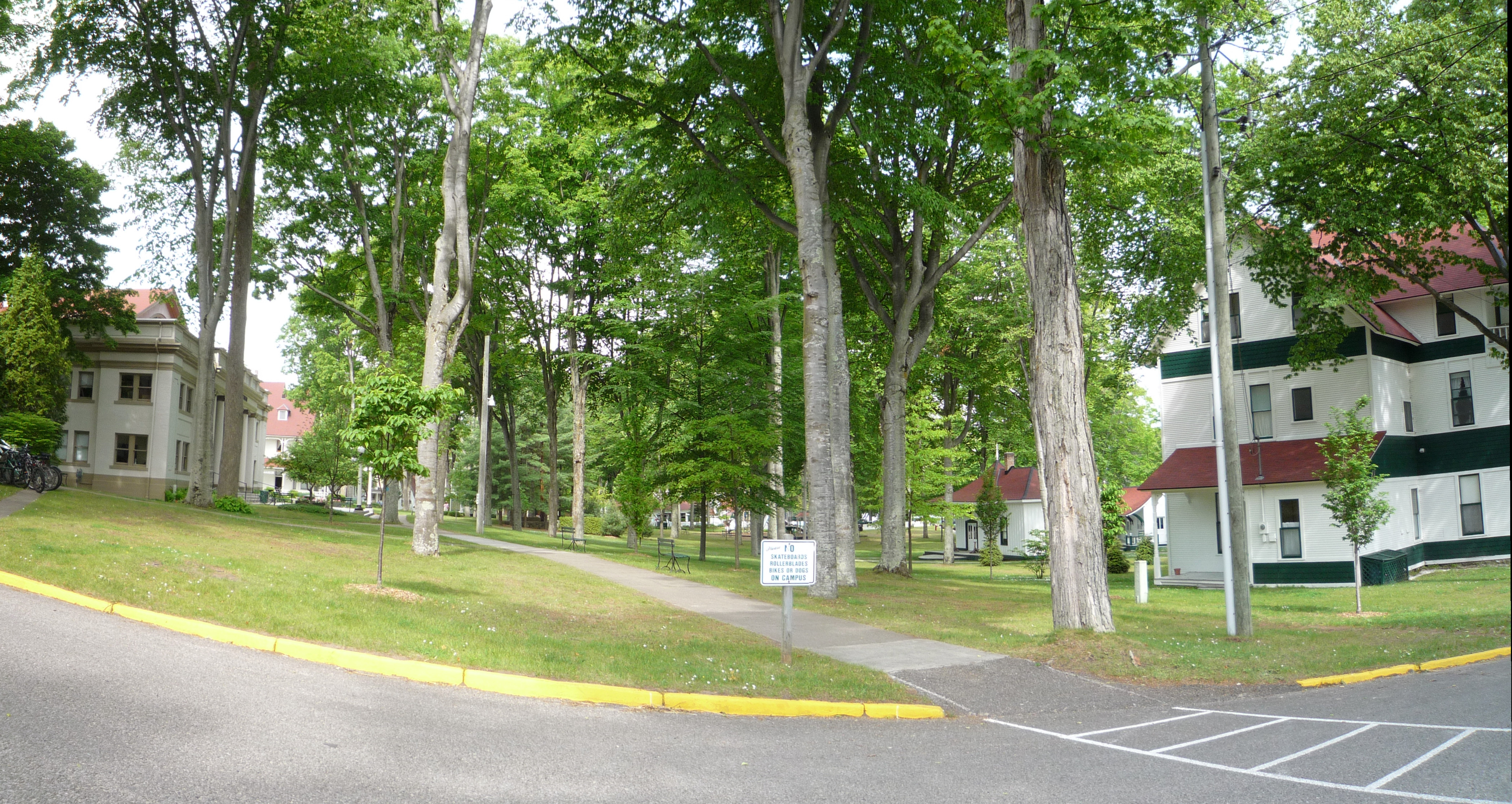
Nearly all of Bay View's structures were built between 1875 and 1900, creating a remarkably intact collection of late-nineteenth-century architecture. The cottages and community buildings showcase Eastlake and Stick style detailing, with some Queen Anne and Shingle style examples scattered among them. Two hotels anchor the grounds: Stafford's Bay View Inn, which dates to 1886, and The Terrace Inn with its 1911 Restaurant. The community spreads across approximately 167 acres of terraced land and wooded trails, dropping in steps to a waterfront that includes a beach, a children's pool, and a sail house. A 125-foot pier extension completed in 2020 expanded the waterfront infrastructure. The whole ensemble earned Bay View designation as a National Historic Landmark, one of only a handful of Methodist camp meeting communities recognized at that level.
Reckoning and Renewal
Bay View's history is not without difficult chapters. Membership was originally open to all, but in 1942, the board adopted a resolution restricting membership to white Christians. A Caucasian-race requirement was removed in 1959, and a Catholic membership quota was abandoned in the 1980s. The Christian-persuasion requirement persisted longer, surviving a failed amendment vote in 2013. In 2017, the Bay View Chautauqua Inclusiveness Group filed a civil rights lawsuit in federal court. On August 7, 2018, nearly 70 percent of members voted to remove the Christian requirement. A consent decree in 2019 eliminated the remaining Methodist board-seat mandate. Today, Bay View has no religious or racial membership requirements, though its religious programming continues as a central part of the Chautauqua tradition. The community remains what it has always aspired to be: a place where ideas and fellowship transcend boundaries.
From the Air
Bay View Association sits at 45.386N, 84.930W on the south shore of Little Traverse Bay, just east of Petoskey, Michigan. From the air, look for the dense grid of Victorian cottages terracing down a bluff to the bay shore, with the distinctive pier extending into the water. Best viewed at 2,000-3,000 feet AGL. Nearby airports: Pellston Regional Airport (KPLN, 14 nm NE) and Harbor Springs Airport (KMGN, 8 nm N). The bay's clear waters and wooded shoreline make this area visually striking in summer months.