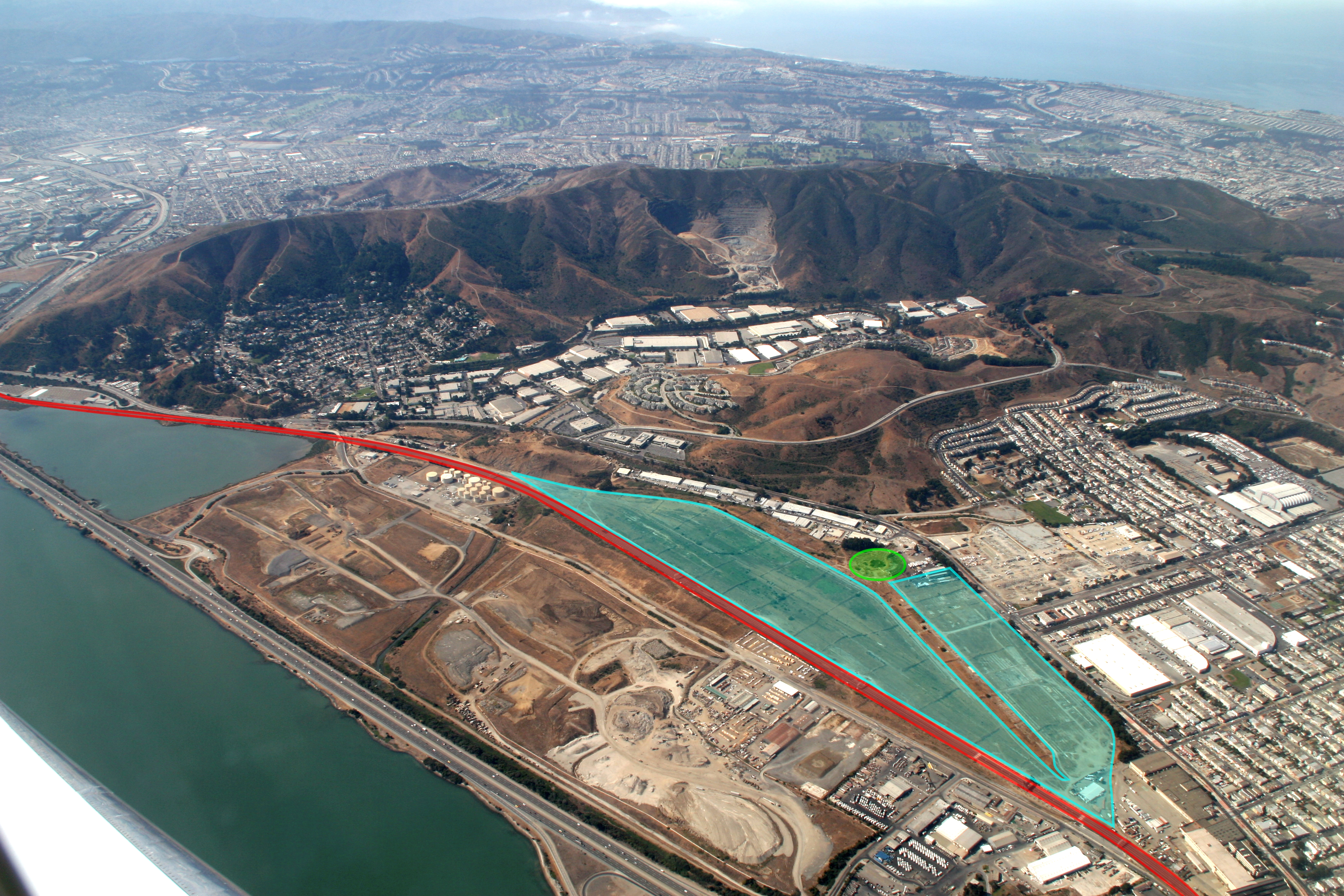
Bayshore Cutoff
Seven million dollars in 1907 -- equivalent to well over $200 million today. That is what Southern Pacific spent to build the Bayshore Cutoff, a rail line along the eastern shore of the San Francisco Peninsula connecting San Francisco to San Bruno along the bay side rather than the inland route. The investment reflected the railroad's confidence that the bay shore would become the peninsula's primary transportation corridor, a bet that proved correct. The cutoff's route parallels what is now U.S. Highway 101 and carries Caltrain commuter trains through the same industrial landscape that Southern Pacific's engineers carved out of tidal flats and hillsides more than a century ago.
Building Along the Bay
The Bayshore Cutoff was completed in 1907, running through terrain that required extensive grading, fill, and bridge construction along the San Francisco Bay shoreline. The route bypassed the steeper inland routing through the peninsula's hills, providing a faster, more level alignment for both freight and passenger service. The line passed through the industrial areas of southeastern San Francisco and the bayside communities of Brisbane, South San Francisco, and San Bruno, connecting at its southern end with the existing mainline that continued down the peninsula to San Jose.
Bayshore Yard and the Roundhouse
At the San Francisco end, the Bayshore Yard and Roundhouse served as major maintenance and staging facilities for Southern Pacific's peninsula operations. The roundhouse, where locomotives were serviced and turned, became a landmark of the industrial waterfront. The yard handled freight switching and car storage for the southern approach to San Francisco. As diesel locomotives replaced steam and freight operations shifted, the facilities' importance diminished, but the corridor itself remained vital as the backbone of commuter rail service on the peninsula.
A Working Corridor
Today the Bayshore Cutoff carries Caltrain service between San Francisco's 4th and King Street station and the peninsula suburbs, one of the busiest commuter rail corridors in Northern California. The route passes through neighborhoods that have transitioned from heavy industry to a mix of biotech campuses, residential development, and surviving industrial operations. The electrification of Caltrain, completed in recent years, brought a new generation of electric multiple-unit trains to the corridor that Southern Pacific's steam engineers would not recognize. But the route is the same one they laid out in 1907, when seven million dollars could build a railroad along the bay.
From the Air
Located at 37.76°N, 122.39°W along the bay side of the San Francisco Peninsula. The rail corridor is visible as a linear feature paralleling US-101 and the bay shore. KSFO is approximately 7 nm south along the same corridor.