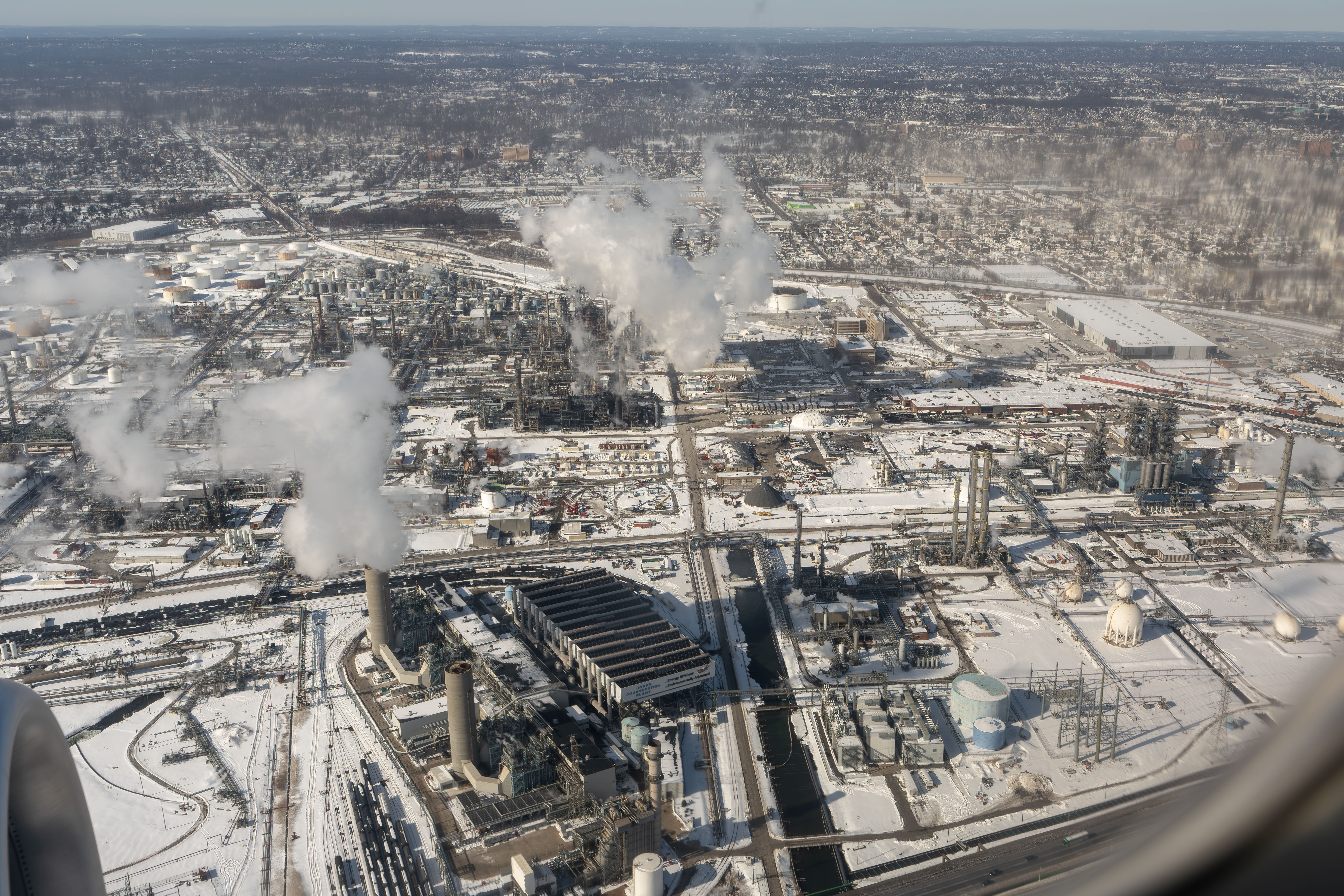
Bayway Refinery
In 1919, scientists at a refinery in Linden, New Jersey, synthesized isopropyl alcohol from petroleum byproducts -- the world's first petrochemical. Five years later, workers at the same facility began hallucinating, suffering severe mental breakdowns, and dying from exposure to tetraethyl lead. The Bayway Refinery has always contained these two impulses, innovation and recklessness, in roughly equal measure. Now owned by Phillips 66 and processing approximately 238,000 barrels of crude oil per day, it remains the northernmost refinery on the U.S. East Coast, a sprawling industrial complex visible from the New Jersey Turnpike whose giant plumes of water vapor have become as much a landmark as any monument.
Rockefeller's Last Refinery
In 1907, Standard Oil founder John D. Rockefeller acquired several hundred acres of the Morse family estate between Linden and Elizabeth, New Jersey. Construction began that October, and by January 2, 1909, the first crude stills were symbolically fired up by William C. Koehler. Initial capacity was 10,000 barrels per day, growing to over 17,000 by 1911. That same year, the Sherman Antitrust Act broke Standard Oil into smaller companies. Bayway fell to Standard Oil Company of New Jersey -- the predecessor of Esso, then Exxon -- and the refinery began its long evolution from a simple crude-processing facility into a center of petrochemical research. It was the first facility in the United States to use hydrogenation to increase yields from crude oil, a technique that would reshape the industry.
The Loony Gas Building
In 1924, the Ethyl Corporation -- a joint venture of General Motors and Standard Oil -- built a plant at Bayway to manufacture tetraethyl lead, the additive that made leaded gasoline possible. Within two months, seventeen workers suffered severe lead poisoning. They experienced hallucinations and severe psychological breaks. Five died in quick succession. The New Jersey state government shut the plant down in October 1924, and Standard Oil was forbidden from manufacturing the compound at Bayway again without explicit state permission. Workers at other tetraethyl lead plants had nicknamed their workplaces the "loony gas building." The Bayway deaths became part of a broader public health crisis that would take decades to resolve, as leaded gasoline remained in widespread use until the 1980s despite early and clear evidence of its dangers.
Arsenal of Democracy
When the United States entered World War II, Bayway became essential to the war effort. The refinery's first catalytic cracker -- the "cat cracker" -- went into operation on January 18, 1943, enabling the production of high-octane aviation fuel that kept Allied aircraft in the sky. The same technology allowed Bayway to produce synthetic butyl rubber and materials for explosives. After the war, Esso invested $26 million in a major expansion to meet booming demand for gasoline and heating oil as American homes shifted away from coal. A second, far larger catalytic cracker came online in October 1949 with a processing capacity of 49,000 barrels per day. It was the largest in the world at the time and remained the largest in the Western Hemisphere into the 2000s.
Explosions, Spills, and Settling Up
Bayway's history is punctuated by violent episodes. On December 5, 1970, a series of explosions shattered windows as far away as Staten Island and was felt over thirty miles from the plant. A 1979 explosion and fire injured seven people and destroyed a process unit. On New Year's Day 1990, a cracked underwater pipeline leaked 567,000 gallons of fuel oil into the Arthur Kill. Exxon argued that since the waterway was already heavily industrialized, it should not have to pay damages -- an argument the court rejected, ordering $15 million in reparations. In 2015, New Jersey reached a legal settlement with ExxonMobil over environmental damage at the site. The refinery has been cited nearly 200 times since 2005 for violations of state environmental laws and ranked among the worst polluters in the nation.
The Wet Gas Scrubber and the Turnpike View
Drive the New Jersey Turnpike through Linden and the refinery announces itself with billowing white plumes. Since 1976, the Wet Gas Scrubber has been the refinery's most recognizable feature -- a device that removes seven to eight tons of dust per day along with gases from the catalytic cracking process. It is recognized as one of the most efficient units of its kind anywhere. Ownership has changed hands multiple times: Exxon sold to Tosco in 1993 for $175 million, Phillips Petroleum bought Tosco in 2001, merged with Conoco in 2002, and spun off the downstream assets into Phillips 66 in 2012. Through it all, the refinery keeps running -- converting crude from the North Sea, Canada, West Africa, and the Bakken Formation into the gasoline, diesel, jet fuel, and heating oil that the East Coast consumes.
From the Air
Located at 40.64°N, 74.21°W in Linden, New Jersey, straddling the border with Elizabeth and bisected by Morses Creek. The refinery is immediately visible from the air as a large industrial complex with distinctive vapor plumes from the Wet Gas Scrubber, located alongside the New Jersey Turnpike. Newark Liberty International Airport (KEWR) is approximately 4 miles to the northeast. Linden Airport (KLDJ) is nearby to the south. Best viewed at 2,000-4,000 feet AGL. The Arthur Kill waterway and Staten Island are visible to the east.