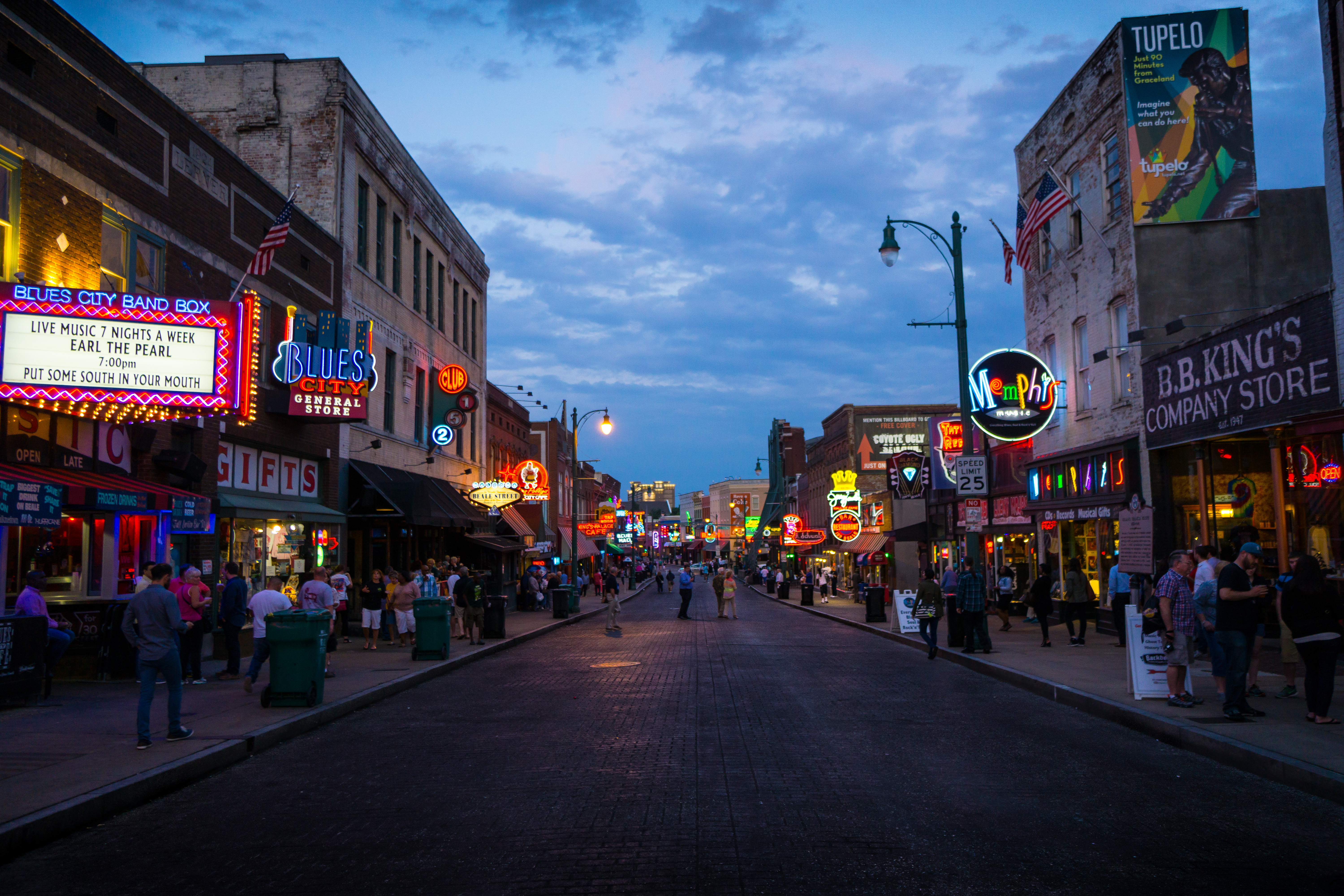
Beale Street
W.C. Handy wrote the oldest known song about Beale Street, and Marc Cohn claimed to walk "with my feet ten feet off of Beale." Between those two bookends stretches the entire arc of American popular music. Created in 1841 by developer Robertson Topp and named for Mexican-American War hero Edward Fitzgerald Beale, this street in downtown Memphis runs roughly two miles from the Mississippi River to East Street. By the early twentieth century, it had become the cultural heart of Black Memphis -- a place where blues was not a genre but a living, breathing, nightly occurrence. The street nearly died in the 1960s when urban renewal gutted its commercial core. Today it lives again as a neon-lit entertainment district, a National Historic Landmark, and a stop on the U.S. Civil Rights Trail.
The Mayor of Beale Street
In 1938, Lewis O. Swingler, editor of the Memphis World Newspaper, hatched a circulation stunt that became an institution. He invited readers to vote for a "Mayor of Beale Street." Matthew Thornton Sr., a community leader and charter member of the Memphis Branch of the NAACP, won the contest with 12,000 of the 33,000 votes cast, defeating nine opponents. Thornton held the honorary title until his death in 1963 at age 90. The contest captured something real about Beale Street's role in Memphis life: it was not just an entertainment strip but a center of Black civic power, organizing, and identity. The Church Park Auditorium on Beale hosted speakers including Woodrow Wilson, Booker T. Washington, and Franklin D. Roosevelt. The street's significance extended far beyond the music that gave it national fame.
Where the Blues Came to Stay
Beale Street did not invent the blues, but it gave the music a permanent address. W.C. Handy, an Alabama-born musician who settled in Memphis, composed "Beale Street Blues" and "Memphis Blues" in the early 1900s, translating the sound he heard in Delta juke joints into published sheet music that reached a national audience. His historic home still stands at 352 Beale. The street's clubs and theaters became incubators for a sound that would reshape global music. B.B. King, whose club still anchors the strip at 143 Beale, was part of a tradition that flowed directly from Beale Street into rock and roll. A young Elvis Presley, growing up in Memphis, drew deep inspiration from the music he absorbed on Beale -- the rhythms, vocal styles, and raw emotional power that he would channel into a cultural revolution broadcast from Sun Studio just a few blocks away.
Decline and Resurrection
By the 1960s, Beale Street was dying. Urban renewal, suburban flight, and changing demographics hollowed out the commercial district. Businesses shuttered. The section from Main Street to Fourth Street was declared a National Historic Landmark on May 23, 1966, but the designation alone could not revive the street. Joni Mitchell's 1976 song "Furry Sings the Blues" lamented the destruction, referencing the old and new Daisy Theatres amid the rubble of redevelopment. For years, Beale Street existed more as memory and myth than as a living place. The revival came gradually, driven by tourism and a recognition that the street's musical heritage was an irreplaceable economic asset. Today, blues clubs, restaurants, and music venues line the blocks that once seemed destined for demolition. B.B. King's, Rum Boogie Cafe, and Silky O'Sullivan's draw crowds nightly. A. Schwab's, a quirky dry goods store founded in 1876, survived the lean decades and remains a beloved landmark.
Living Soundtrack
The music has never really stopped on Beale Street. Since 1987, the band FreeWorld, led by Richard Cushing with saxophonist Herman Green, has been the longest continuously performing band in Beale Street history. The Beale Street Music Festival, held during the first weekend of May as the kickoff to the month-long Memphis in May celebration, brings major acts across genres to Tom Lee Park at the foot of the street, where the Mississippi River provides a backdrop that connects the music to the waterway that carried the blues north. In 2020, the Beale Street Historic District and Memphis radio station WDIA -- the first radio station in the nation programmed entirely for Black audiences -- were added to the U.S. Civil Rights Trail. The recognition linked music and activism in a pairing that anyone who understood Beale Street's history would have considered long overdue. The street runs barely two miles. The sound it launched has no measurable boundary.
From the Air
Located at 35.139°N, 90.052°W in downtown Memphis, Tennessee, running east-west from the Mississippi River bluffs. The street is part of the dense downtown grid clearly visible from altitude, with FedExForum arena at 191 Beale serving as a major landmark. Memphis International Airport (KMEM) is approximately 10 nm southeast. The Mississippi River forms the western edge of the city. Tom Lee Park, where the Beale Street Music Festival is held, is visible at the river end of the street. Best viewed at 2,000-3,000 feet AGL on approach from the west over the river.