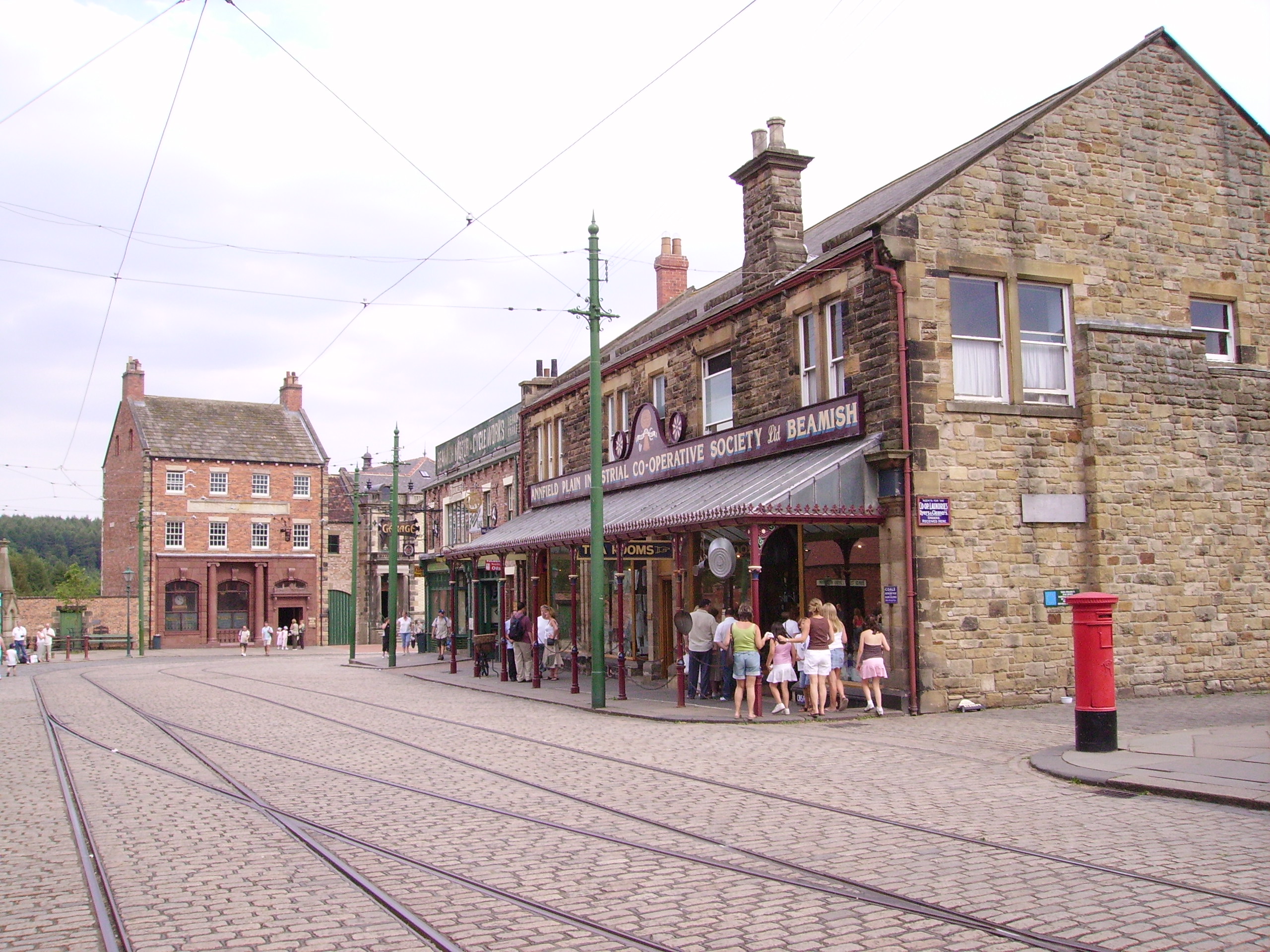
Beamish Museum
Frank Atkinson had a policy he called "unselective collecting." You offer it to us, he said, and we will collect it. By the time he was done, people had given him locomotives, entire shop fronts, rows of terraced houses, a Methodist chapel, a colliery winding engine, a dentist's surgery complete with extraction chair, and a stuffed racing greyhound named Jake's Bonny Mary. All of it went to Beamish, the open-air museum Atkinson willed into existence in the hills of County Durham, where the past is not displayed behind glass but rebuilt at full scale and set in motion.
Saving What Was Disappearing
Atkinson presented his case to Durham County Council in the early 1960s, arguing that the everyday life of the North East was vanishing and that someone needed to collect its material evidence before it was too late. He was not interested in the grand or the aristocratic. He wanted the ordinary: the kitchen ranges, the pit-head gear, the Co-op shop counters, the tram tickets. The first donations filled spare rooms at the Bowes Museum, then overflowed into twenty-two huts and hangars at a former army tank depot at Brancepeth. The first trams ran on a short demonstration line in 1973, and by 1976 the reconstructed colliery winding engine house was complete and miners' cottages from Hetton-le-Hole had been rebuilt stone by stone.
A Town Assembled from Everywhere
The Edwardian town at Beamish was not moved from any single location. It was assembled piece by piece from across the region. The Co-operative store came from Annfield Plain. The pub, originally known as The Tiger Inn, arrived from Bishop Auckland, where it had served miners from Newton Cap colliery. Ravensworth Terrace, a row of professionals' houses built between 1830 and 1845, was rescued from demolition on Bensham Bank in Gateshead. The dentist's surgery uses fittings from a real Mr. J. Jones of Hartlepool, where giving daughters a set of dentures on their twenty-first birthday was considered a practical kindness. A 1.5-mile tramway links the town's elements together, its electric trams representing the systems that transformed North East cities from the 1890s onward.
Down the Drift Mine
The colliery area recreates the coal industry that defined the region for centuries. A drift mine -- a horizontal tunnel into a hillside rather than a vertical shaft -- opened as an exhibit in 1979 and takes visitors underground to experience the confined, dark conditions where men and boys spent their working lives. Nearby, the pit village includes six miners' cottages from Hetton-le-Hole, originally built in the 1860s by the Hetton Coal Company. Each cottage tells a different story: one belongs to a Methodist family with good "Pitman's mahogany" furniture, another to a prosperous Irish Catholic immigrant family, a third to a widowed woman who supplements her income doing laundry. In the back lanes, chalkboard slates on rear walls were used to tell the colliery's "knocker up" when each miner wanted waking for his shift.
The Georgian North
The museum reaches further back in time at Pockerley, a hilltop farm dating to at least 1183 whose Old Hall has roof timbers carbon-dated to the 1440s. This area represents the period around 1825, when agriculture was being transformed by new machinery, improved field management, and better breeding stock. The surrounding farmland has been returned to its post-enclosure landscape with ridge-and-furrow topography, worked by traditional methods using Fell ponies and Cleveland Bay horses. A waggonway demonstrates the early railway technology that would eventually carry coal from the mines to the rivers and ports, powered first by gravity and horses, then by the steam locomotives that George Stephenson pioneered just a few miles away.
Living History, Not a Theme Park
Beamish has been roughly ninety-six percent self-funding for years, sustained mainly by admission charges. It works because it does not feel like a museum. The fish and chip shop fries in beef dripping over coal-fired ranges, using equipment from the last coal-fired chippy in Tyneside. The bakery produces bread and cakes in working ovens for sale to visitors. The pub serves beer. The sweet shop makes confections using period rollers. Staff in period costume operate the machinery, tend the livestock, and answer questions not as actors but as interpreters. A major expansion called "Remaking Beamish," funded partly by the Heritage Lottery Fund, has added a 1950s town, welfare hall, and bus depot, extending the museum's timeline into the postwar period that many living visitors can still remember.
From the Air
Beamish Museum occupies approximately 350 acres of a basin-shaped valley at 54.889N, 1.655W in County Durham, between Chester-le-Street and Stanley. The open-air layout including the town, colliery, railway, and farms is spread across the site. The tramway loop is visible from the air. Best viewed at 2,000-4,000 ft AGL. Nearest ICAO: EGNT (Newcastle) approximately 10nm northeast.