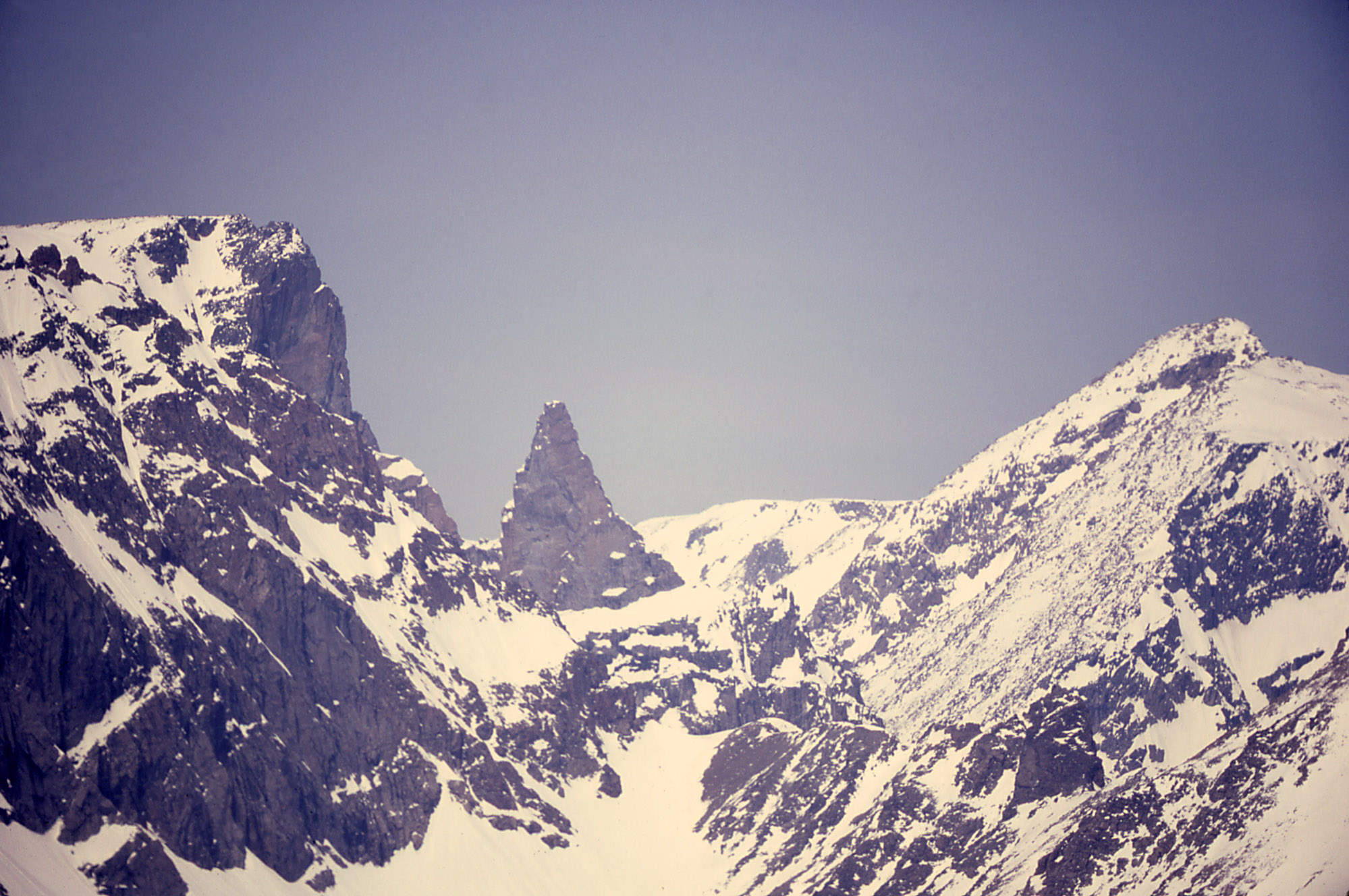
Beartooth Mountains
The rocks beneath your feet are older than life itself. In the Beartooth Mountains of south-central Montana and northwest Wyoming, Precambrian granite and metamorphic formations date back 2.7 to 4 billion years, making them among the oldest exposed rocks on Earth. The International Union of Geological Sciences recognized this in 2022, naming the Archean Rocks of the Eastern Beartooth Mountains one of only 100 geological heritage sites worldwide. Yet these ancient sentinels remain wild and alive, sheltering grizzlies, wolves, and one of North America's largest elk herds within the Greater Yellowstone Ecosystem.
A Tooth in the Sky
The name comes from Beartooth Butte, a massive block of Paleozoic sedimentary rock sitting on the Beartooth Plateau that features a distinctive tooth-like projection. The U.S. Forest Service later attributed the name to Beartooth Peak itself, whose jagged profile resembles a bear's fang against the Montana sky. Rising to 12,807 feet at Granite Peak, the highest point in Montana, these mountains dominate the landscape just northeast of Yellowstone. Over 25 peaks exceed 12,000 feet, and the range contains more than 300 pristine alpine lakes scattered across its expansive plateaus. Approximately 25 small glaciers cling to the high cirques, including the distinctive Grasshopper Glacier.
Crow Country
Long before European explorers arrived, the Crow Nation found shelter in these valleys, using them for hunting game and escaping the harsh winds that swept across the plains. The region remained largely unknown to outsiders until the 1870s. Trappers had ventured in during the 1830s, but formal U.S. Government exploration did not occur until 1878. Gold discoveries in the mountains sparked mining expansion beginning in 1882, and by the early twentieth century, six companies operated in the New World Mining District. Between 1900 and 1955, the district yielded significant quantities of gold and silver, along with copper, zinc, and lead. The Stillwater igneous complex within the mountains holds the largest known deposits of platinum and chromium in the United States.
The Park That Almost Was
These mountains nearly became a national monument. In 1939, the National Park Service director drafted a presidential proclamation outlining boundaries for Beartooth National Monument, but Franklin D. Roosevelt never signed it. In 1960, The Wilderness Society organized an expedition into the Beartooths, bringing together Forest Service and National Park Service officials to debate whether the mountains deserved wilderness or national park status. They reached no consensus. Meanwhile, a controversial 1989 proposal by Crown Butte Mines to expand operations near Yellowstone sparked public outrage over potential contamination. In 1996, the federal government paid $65 million to stop the mining plans and $22.5 million went toward environmental restoration. Finally, in 1975, the Beartooths gained protection as part of the Absaroka-Beartooth Wilderness.
Wilderness Intact
The Beartooth ecosystem remains one of the most intact wilderness areas in the contiguous United States. As part of the Greater Yellowstone Ecosystem, it provides crucial habitat for species that have vanished from most of their historic range. Grizzly bears roam these slopes, one of the few remaining populations in the lower forty-eight states. Lynx and wolverines make rare appearances. Cougars prowl the forests, and recently reintroduced wolves have returned to their ancestral hunting grounds. Bison and elk herds rank among the largest in North America. All bodies of water within the wilderness carry Outstanding National Resource Waters classification, the highest protection under the Clean Water Act, and serve as benchmarks for water quality throughout the northern Rockies.
The High Road
The Beartooth Highway, U.S. Route 212, traverses this range in one of America's most spectacular mountain drives. The road climbs to Beartooth Pass at 10,947 feet, crossing alpine tundra where summer brings carpets of wildflowers and winter buries everything under heavy snow and relentless wind. Below the treeline, Engelmann spruce, subalpine fir, whitebark pine, and lodgepole pine create dense forests. Higher up, only grasses, wildflowers, and sagebrush survive. The three highest peak clusters center on Granite Peak, Mount Wood, and Castle Mountain, with the Castle Mountain group extending south into Wyoming. These plateaus above 10,000 feet offer some of the most expansive high-altitude terrain in the American Rockies.
From the Air
Located at 45.16°N, 109.81°W, straddling the Montana-Wyoming border northeast of Yellowstone National Park. Granite Peak (12,807 ft) is the highest point in Montana. The Beartooth Highway (US-212) crosses at Beartooth Pass (10,947 ft). Nearest airports include Yellowstone Regional (KCOD) to the south and Billings Logan International (KBIL) to the northeast. Approach with caution due to rapidly changing mountain weather, severe turbulence potential, and density altitude challenges at plateau elevations exceeding 10,000 feet.