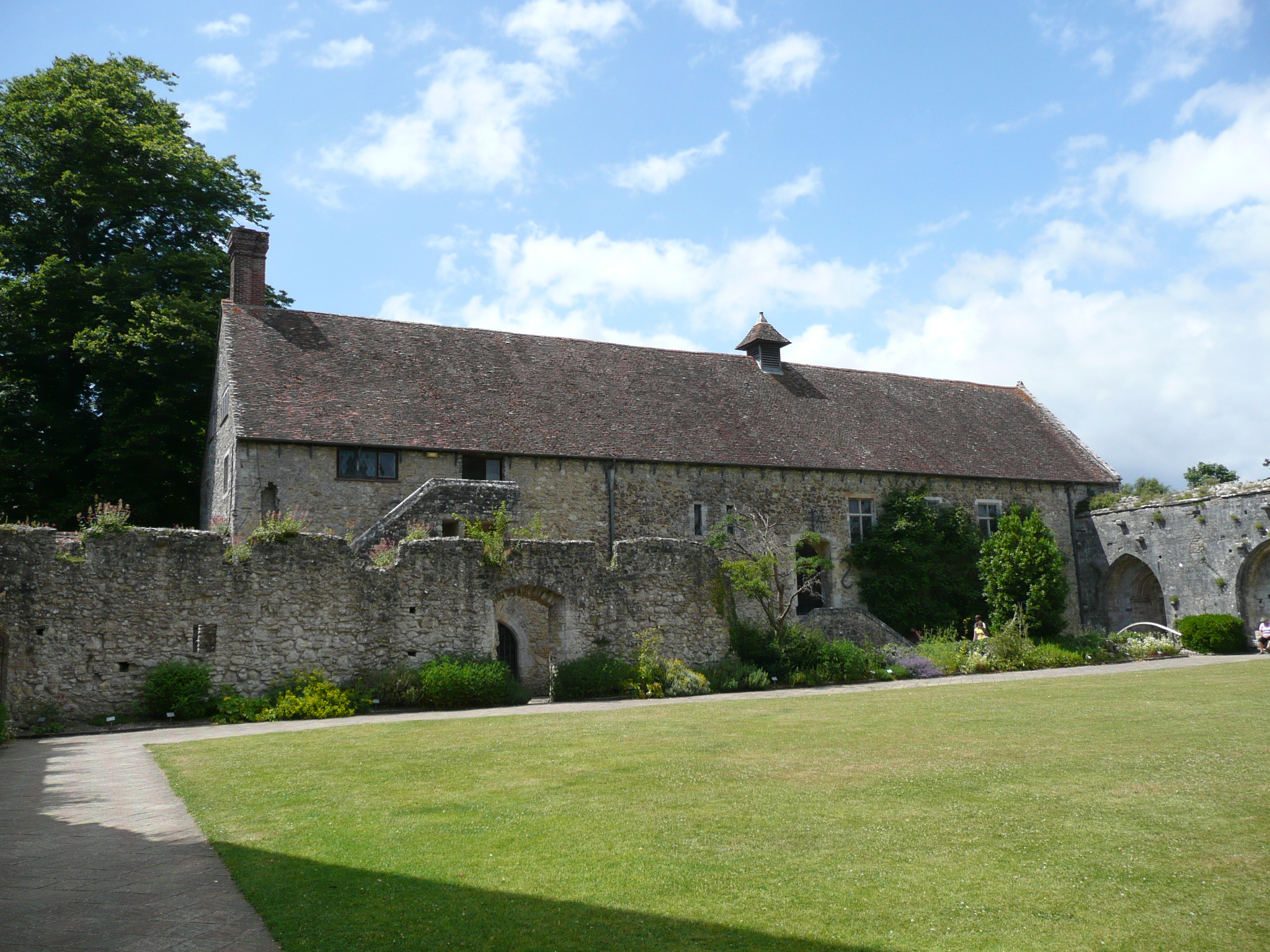
Beaulieu Abbey
According to legend, King John dreamed he was being scourged by the abbots he had persecuted, and awoke to find his body still aching from the blows. Whether the dream was real or a convenient fiction, the king founded Beaulieu Abbey in 1204 as an act of penance that was also a display of power. He took the extraordinary step of populating it with thirty monks sent directly from Citeaux in France, the motherhouse of the Cistercian order. No other British monastery received its founding community from the order's headquarters. Even the name was an assertion of royal taste: Bellus Locus Regis, the beautiful place of the king.
A Church Built for Four Decades
The abbey's buildings reflected the scale of John's ambition. The church stretched 102 meters long and featured a semicircular apse with eleven radiating chapels, an architectural form more common in France than in England. Construction took over four decades, with the church finally dedicated in 1246. Workshops, guesthouses, a mill, fishponds, and extensive gardens surrounded the central complex. Strongly fortified gatehouses controlled entry to the monastic enclosure, which was defended by walls. A water gate allowed direct access to ships on the Beaulieu River. The abbey grew wealthy and influential, its position in the New Forest providing both seclusion and ready access to the coast.
Dissolution and Survival
Henry VIII dissolved the abbey in 1538, giving it to his favoured statesman Sir William Sandys. What happened next at Beaulieu followed a pattern repeated across England: the monastery was dismantled for private use. The inner gatehouse was transformed into what is now Beaulieu Palace House, a country home that still bears traces of its medieval origins in the tierceron vaulting visible inside the blocked-up passage. The former monks' refectory became the parish church. The rest fell to ruin, though the precinct walls still stand and foundations of the infirmary remain visible. The property passed through the Wriothesley family, whose descendants still live there, making Beaulieu one of England's longest-inhabited former monastic sites.
Spies, Motors, and Ghosts
The twentieth century brought Beaulieu a second life no monk could have imagined. During World War II, the estate served as a training ground for the Special Operations Executive, Britain's covert sabotage and espionage organization. Agents learned the skills of clandestine warfare in the abbey's grounds before being dispatched behind enemy lines. After the war, Edward, 3rd Baron Montagu of Beaulieu, opened the National Motor Museum on the estate, which has grown into one of Britain's most important collections of historic vehicles. The juxtaposition is striking: medieval ruins, a Tudor mansion, a spy school, and a motor museum, all sharing the same grounds beside the tidal river.
Where Monks Still Sing
Beaulieu's official website describes it as one of the most haunted places in Britain, with reported sightings spanning over a century. Visitors and staff have reported hearing Gregorian chant drifting through the ruins, sounds that local tradition treats as an omen. The Reverend Robert Frazer Powles, vicar of Beaulieu from 1886 to 1939, claimed to converse regularly with ghostly monks he knew by name and even celebrated midnight Mass for them every Christmas Eve. Literary ghosts haunt the place too. Arthur Conan Doyle set the opening chapters of The White Company at the abbey, and John Betjeman wrote his poem "Youth and Age on Beaulieu River" after visiting the New Forest. Whether or not the monks still walk, the abbey remains a place where eight centuries of history layer upon each other with unusual density.
From the Air
Located at 50.822N, 1.450W in the New Forest, Hampshire, on the west bank of the Beaulieu River. The abbey ruins, Palace House, and National Motor Museum complex are visible as a cluster of buildings amid forest and estuary. Nearest airports: EGHF (Lee-on-Solent, 12 nm southeast), EGHI (Southampton, 10 nm north). Recommended viewing altitude 2,000-3,000 ft. The Beaulieu River estuary provides a clear navigation reference.