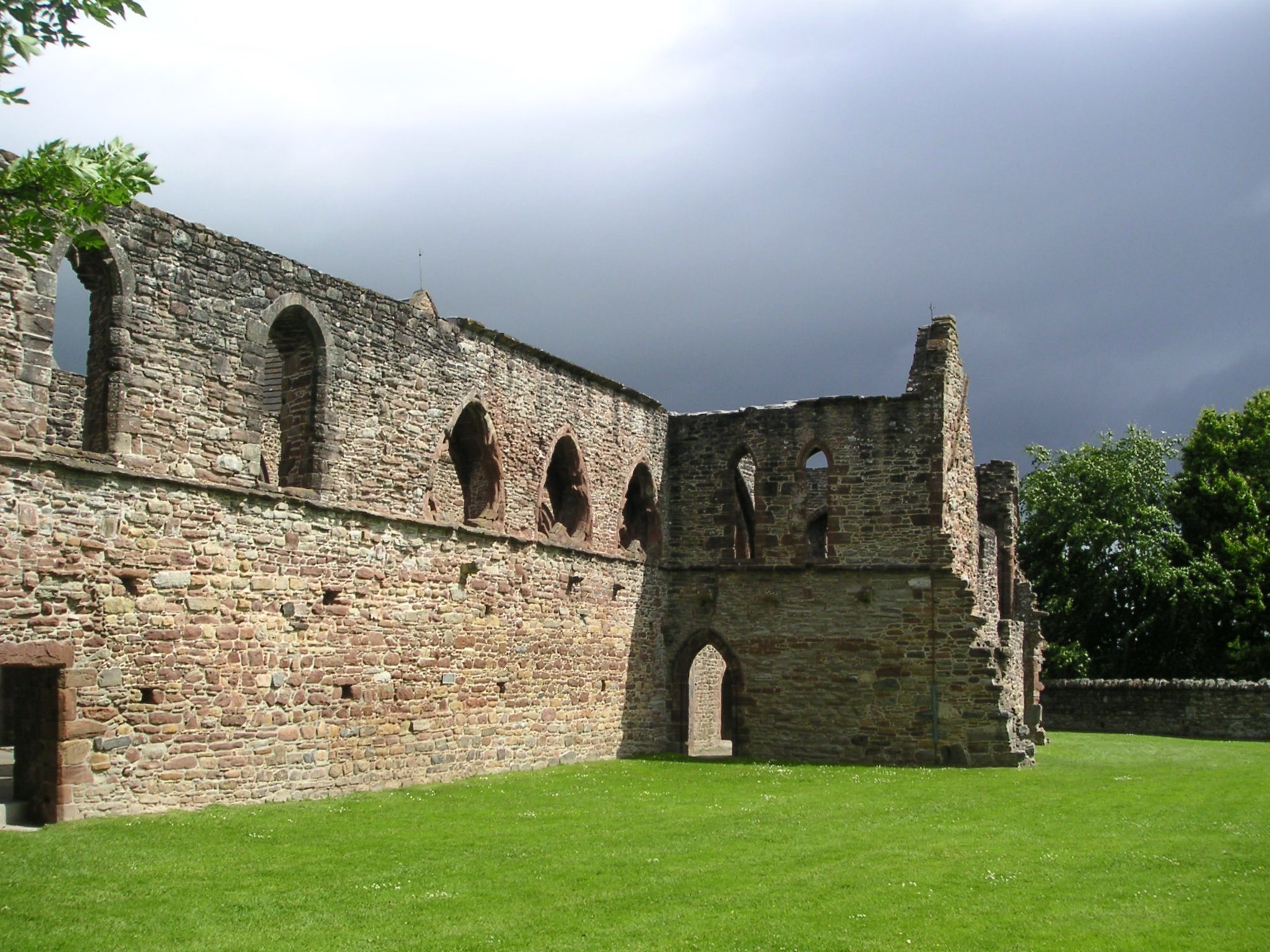
Beauly Priory
John Keats walked into Beauly Priory in August 1818 and found skulls. The ruins of the thirteenth-century monastery had become an open-air ossuary, with human remains from centuries of burial visible among the broken walls. Keats, twenty-two years old and walking through the Highlands with his friend Charles Brown, responded the way poets respond: they wrote a poem together. 'On Some Skulls in Beauley Abbey' was primarily Brown's work, though Keats contributed lines -- a minor collaborative meditation on mortality prompted by the physical evidence of it lying around their feet. But the encounter captures something essential about the priory -- a place where the sacred, the ruined, and the human converge in a single roofless building.
The Beautiful Place
Beauly Priory was founded around 1230 by monks of the Valliscaulian order, a French monastic community based at Val des Choux in Burgundy. The name Beauly itself derives from the French 'beau lieu' -- beautiful place -- though whether the monks named it or adopted a name already in use is uncertain. The Valliscaulians were a small order, never widely established, and their Scottish foundations were few. Beauly was their northernmost house. The priory occupied a sheltered position near the head of the Beauly Firth, where the river meets the tidal water, with fertile land around it and the Highlands rising to the west. In 1510, the community became Cistercian, joining a larger and more established order. The priory continued to function until the Reformation swept through Scotland in the mid-sixteenth century, after which the buildings fell into the disuse and decay that Keats encountered three centuries later.
A Graveyard of Chiefs
Beauly Priory became the burial place of choice for Highland aristocracy. Hugh Fraser, 3rd Lord Lovat, killed at the Battle of the Shirts in 1544 -- that devastating clan fight at Loch Lochy that left both sides nearly destroyed -- was carried here for burial. His tomb survives. The Mackenzie chiefs of Kintail also claimed Beauly as their resting place. The 'Mackenzie's Aisle,' a section of the priory, contains the burials of multiple chiefs of Clan Mackenzie, one of the most powerful families in the northern Highlands. The choice of burial site was not merely practical. Being interred at Beauly associated a clan chief with the spiritual authority of the Church and with the prestige of a foundation that connected the Highlands to the wider world of European monasticism. In death, if not always in life, the Highland chiefs sought to locate themselves within a framework of civilization that extended beyond the mountains.
Ruins in the Market Square
The priory ruins stand in the center of Beauly village, surrounded by the ordinary business of a small Highland town. The surviving structures include parts of the church nave, the south transept, and fragments of the claustral buildings where the monks lived and worked. The stone is local red sandstone, weathered by eight centuries of Highland rain. The secularization of the priory's lands in 1634, when they were granted to the bishop of Ross, marked the formal end of monastic life at the site, though the buildings had ceased to function as a religious community decades earlier. Today the priory is managed by Historic Environment Scotland and is open to visitors year-round. The combination of medieval architecture, clan history, and literary association -- Keats's visit gave the ruins a Romantic-era pedigree -- makes Beauly Priory a site where several strands of Scottish history are braided together in a single, quietly atmospheric space.
From the Air
Beauly Priory is located at 57.48°N, 4.46°W in the village of Beauly, approximately 10 miles west of Inverness. The priory ruins are in the center of the village, near the head of the Beauly Firth. The surrounding landscape is low-lying agricultural land with the Highlands rising to the west. Nearest airport: Inverness (EGPE) approximately 8 nm to the east.