Beaverbrook Art Gallery
When Sotheby's valued the collection in 2002, the appraiser's estimate came back at 35 million pounds -- nearly $90 million Canadian. A single Turner painting, The Fountain of Indolence, was worth between $16.7 million and $25 million on its own. All of it hung in Fredericton, New Brunswick, a provincial capital of barely 60,000 people, in a mid-century modern gallery that Lord Beaverbrook had built on the banks of the Saint John River as a gift to his home province. The question of who actually owned those paintings would consume lawyers, judges, and charity regulators on two continents for the better part of a decade.
A Press Baron's Homecoming
William Maxwell Aitken was born in Ontario but raised in Newcastle, New Brunswick, before making his fortune in Britain as a newspaper publisher and politician. Elevated to the peerage as Lord Beaverbrook, he never forgot the province that shaped him. In 1954, he established the Beaverbrook U.K. Foundation, a charitable trust whose stated purpose included purchasing art for New Brunswick's galleries and museums. With the help of advisors including the managing director of Christie's and the curator of the Boston Museum of Fine Arts, Beaverbrook assembled a collection of over 300 paintings, mostly British masters: J.M.W. Turner, John Constable, Thomas Gainsborough, Joshua Reynolds, Edwin Henry Landseer. He also acquired works by artists he knew personally, including Lucian Freud, whose Hotel Bedroom won second prize at the 1955 Daily Express Young Artists Exhibition.
A Gallery Across from the Legislature
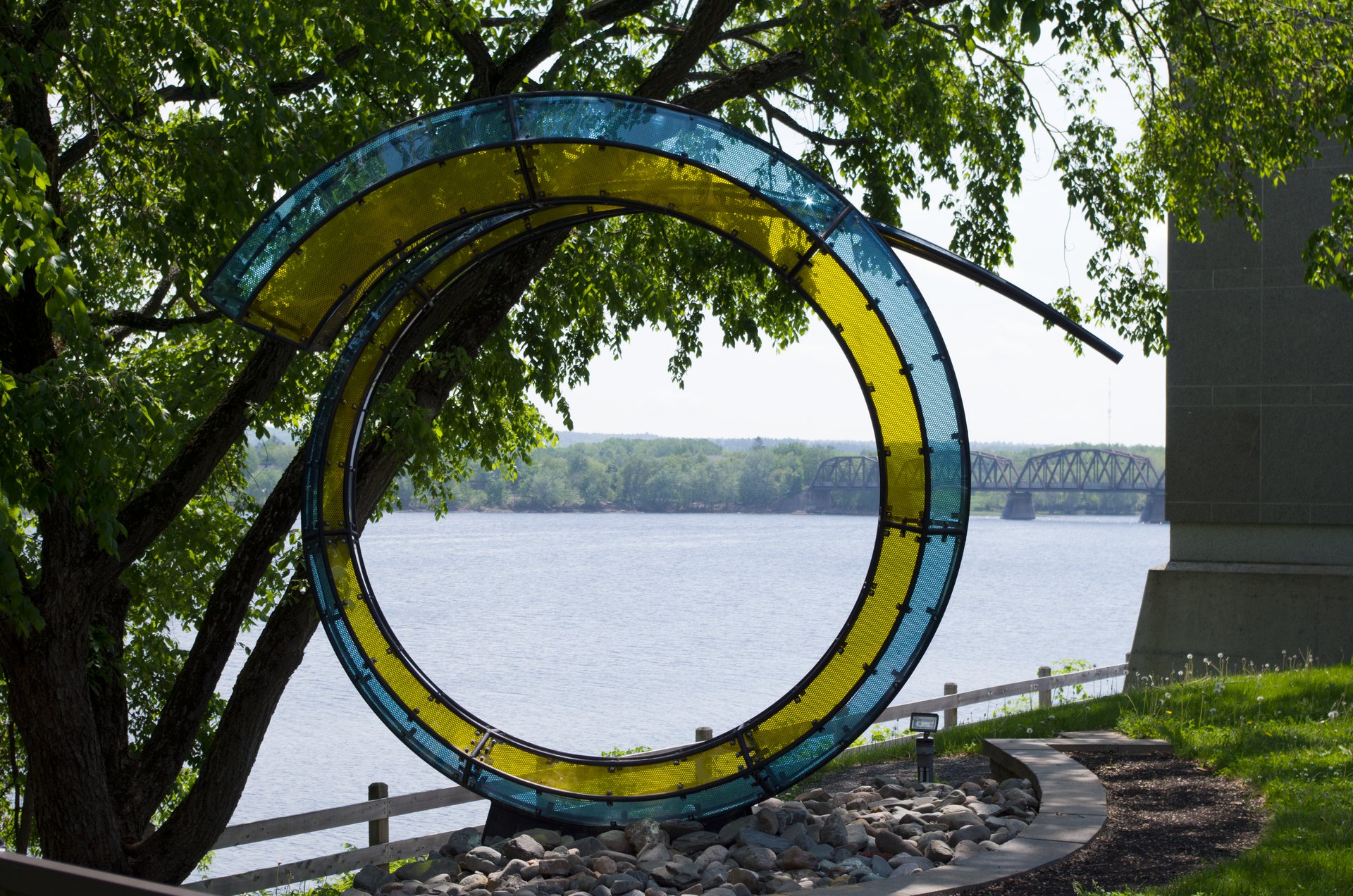
The Province of New Brunswick gave Beaverbrook a site directly across from the Legislative Building, on the southern bank of the Saint John River. Architect Neil Stewart of the Fredericton firm Howell and Stewart designed a flat-roofed, single-storey structure faced in pale semi-glazed brick, with a granite base and a frieze of white marble quarried at Philipsburg, Quebec. The gallery opened in 1959 with those original 300-plus works. Expansions followed in 1983, 1995, and 2017, when a new pavilion designed by Halifax-based MacKay-Lyons Sweetapple Architects made the Beaverbrook the largest art gallery in Atlantic Canada. Outside, the TD Sculpture Garden features works by Dennis Oppenheim and Sorel Etrog along the river. The first commissioned piece, Andre Lapointe's The Birth of Venus, arrived in 2009.
The Fight for the Collection
Lord Beaverbrook died in 1964. Almost immediately, the question of ownership began to fester. His widow, Lady Beaverbrook -- formerly Lady Dunn, widow of industrialist Sir James Dunn -- denied the paintings belonged to the gallery and threatened to withdraw them. In 1970, the Beaverbrook Canadian Foundation purchased the disputed works from her for $250,000 to keep them in Fredericton. But the deeper fight erupted in 2003, when the Beaverbrook U.K. Foundation -- stunned by Sotheby's $90 million valuation of what it had been insuring for $7.6 million -- claimed custody of 133 paintings. The Foundation wanted to sell the most valuable works to fund its charitable activities. The Gallery argued that Lord Beaverbrook intended the art as a permanent gift.
Eighty-Five to Forty-Eight
An arbitration panel ruled that 85 of the 133 disputed paintings were gifts from Lord Beaverbrook and must stay in Fredericton. The remaining 48 would return to the Foundation. The Fountain of Indolence and Hotel Bedroom stayed with the Gallery. The Foundation was ordered to pay $4.8 million in legal costs. Appeals followed -- first to a panel of three retired Canadian judges, who confirmed the split in September 2009, then a threatened challenge in New Brunswick's Court of Queen's Bench, which drew scrutiny from the Charity Commission for England and Wales. In September 2010, the parties finally settled by private agreement, preserving the 85/48 division. Speculation held that the Foundation would avoid paying the Gallery's costs in exchange for the Gallery receiving a share of proceeds when the Foundation sold its 48 returned works. The Beaverbrook's most valuable masterpieces remained where Lord Beaverbrook had placed them.
Broadening the Canvas
The Beaverbrook has expanded well beyond its British core. The Canadian Collection includes extensive holdings by Group of Seven members, Emily Carr, David Milne, Christopher Pratt, and Jean-Paul Riopelle. A dedicated New Brunswick Collection established in 1994, when the gallery received its provincial designation, ensures representation of Acadian, Maliseet, and Mi'kmaq artists. In 2015 and 2016 alone, the gallery acquired more than 2,000 additional works through donor generosity. First Nations artists like Anong Beam, Carl Beam, and Rebecca Belmore have joined the permanent collection alongside international figures such as Hans Hofmann and Edward Kienholz. What began as one press baron's nostalgia for his home province has become a genuinely comprehensive survey of Canadian and international art, anchored on a quiet riverbank in New Brunswick's capital.
From the Air
Located at 45.96°N, 66.64°W on the south bank of the Saint John River in downtown Fredericton, directly across from the New Brunswick Legislative Building. The gallery's low-profile mid-century architecture blends into the riverbank at altitude, but the sculpture garden along the river is a useful visual marker. Fredericton International Airport (CYFC) is approximately 15 km southeast of downtown.