Bedekaspel
The name itself is a confession. Bedekaspel, parsed back through Old Frisian, carries the word bete - penitence - bolted to kerke, church. Long before this little Haufendorf on the northern shore of the Großes Meer settled into its current grid of brick farmhouses and quiet lanes, somebody decided this was a place to come and be sorry. The reason for that name has been lost to time, but the centuries since have given the village plenty of fresh occasions for it.
Names That Forget Themselves
Bedekaspel does not speak about itself easily. The settlement first appears in 1475 as Betekerke - the bare-bones spelling, just penitence and church bolted together. By 1500 a clerk has stretched it into Bedekerspell. Around 1595 the modern form locks in. An older name, Lopessumwalde, may have referred to this same patch of land before the church gave the village its identity. The Emden city archives in 1645 still hedge their bets, calling it Beede-Kirchspiel. Each spelling is a little linguistic fossil: the kaspel ending comes from Middle Low German karkspel, meaning the district where a pastor preaches. A parish, in other words, was originally a speaking-region - the territory within earshot of the sermon.
The Christmas the Sea Came In
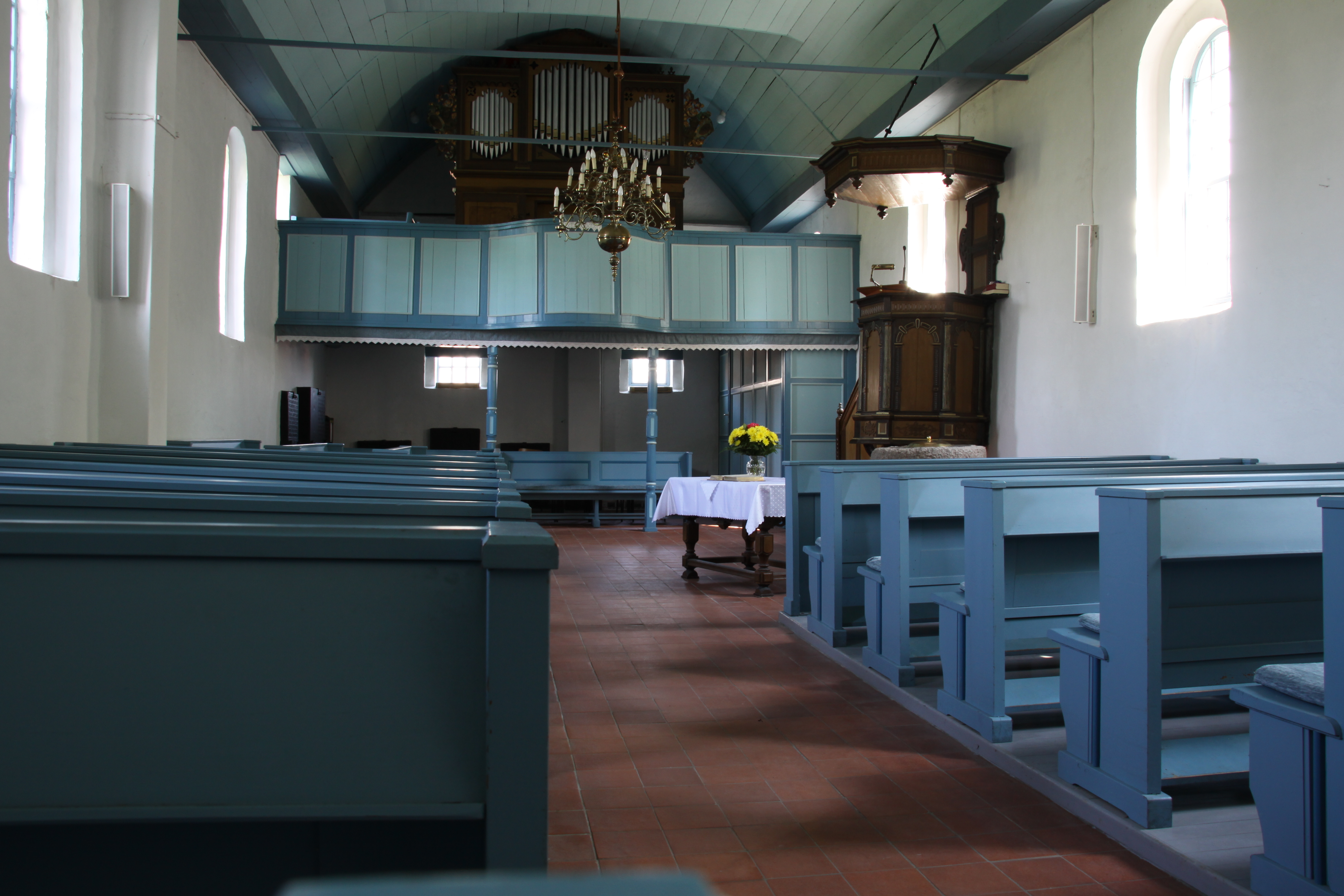
On Christmas night 1717, a storm surge climbed the dykes of the North Sea coast and did not stop. Across East Frisia, Schleswig-Holstein, the Netherlands and Denmark, somewhere around 14,000 people drowned in their beds. It remains one of the deadliest natural disasters in European history. In Bedekaspel, the parish church - already four centuries old, its bones dating back to the 13th century - took the punch and did not recover. The walls were demolished. Only the tower was saved. When the village rebuilt the church, it built around that surviving tower, stacking the new on top of the old. Anyone walking into the church today is walking into a building that was assembled, quite literally, out of the wreckage of a catastrophe.
Großes Meer, Small Village
Großes Meer means Great Sea, which is a generous label for the shallow lake that gives Bedekaspel its address. Once part of a much larger system of peat lakes carved out by medieval cutters digging fuel for kitchens and forges, the Meer today is a placid expanse beloved by sailors, anglers and weekenders. Bedekaspel sits on the northern shore, and a chunk of the village is officially called Wochenendsiedlung - the Weekend Settlement - a postwar grid of recreation cottages where Emden and Aurich families came to fish and sail. The village proper holds the church, a windmill called Agnes, and the Bedekaspeler Marsch reaching off toward the polders. A Haufendorf - a cluster village - it never bothered to organize itself into the neat row patterns the marsh villages favored.
Quiet Now
In 1972 Bedekaspel handed in its independence and became an Ortsteil of the larger municipality of Südbrookmerland, joining a federation of similar small villages stitched into one administrative unit. The change was bureaucratic; the place itself goes about its business as it always has. Cyclists cross the polder roads in summer. Sailboats drift on the Meer. The church tower - that stubborn survivor of 1717 - keeps its eye on the horizon, knowing better than most buildings what the horizon is capable of. Penitence was the original program. Endurance, it turns out, was the practice.
From the Air
Located at 53.44°N, 7.31°E in the East Frisian marshlands of Lower Saxony. The village sits on the northern shore of the Großes Meer, a shallow peat-cutting lake clearly visible from cruising altitude. Nearest airfields: Emden (EDWE) about 25 km southwest and Norden-Norddeich (EDWS) about 20 km northwest. Best viewed from 2,000-4,000 ft on clear days, with the chain of small lakes and polders stretching toward Aurich making for a distinctive flat-land tapestry below.