Beehive (New Zealand)
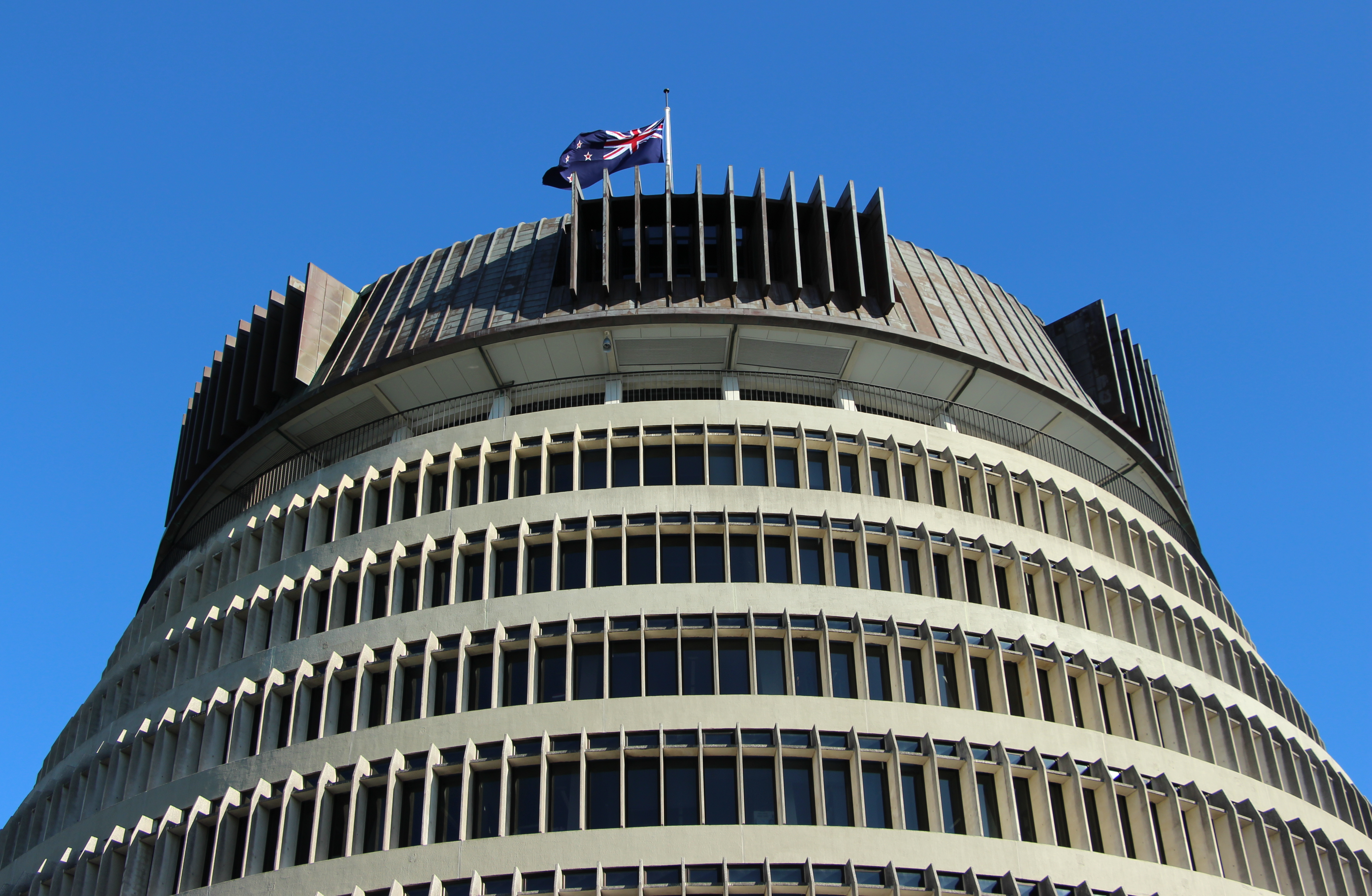
The rooms are the wrong shape. Because the Beehive is round -- ten storeys of concrete and copper tapering upward from Molesworth Street like the traditional woven skep it was named for -- nearly every office inside is wedge-shaped, curved, or asymmetrical. It is the kind of design problem that would normally kill a building in committee. Instead, New Zealand put its entire executive government in it, printed it on the twenty-dollar note, and declared it a Category I heritage site. The Beehive is proof that a country's most recognisable building does not have to be its most practical one.
A Sketch on a Napkin, a Building for a Nation
In the early 1960s, Prime Minister Keith Holyoake wanted to finish Parliament House, which had been only partially built since 1922. But the government architect steered him toward something bolder: a wholly modern executive wing. In 1964, the Scottish architect Basil Spence -- who had already designed Coventry Cathedral -- provided the conceptual design: a circular building rising in steps, unlike anything in Wellington's staid political landscape. The detailed architecture fell to New Zealand government architect Fergus Sheppard and the Ministry of Works. Construction began in 1969 with the podium and an underground civil defence centre, and the ten floors above were completed by the late 1970s. The annexe facing Museum Street followed in 1981, closing a twelve-year construction chapter.
The Queen, the Copper, and the Ninth Floor
Elizabeth II unveiled a plaque in the reception hall in February 1977, and Prime Minister Robert Muldoon formally opened the building three months later. Government ministers moved into the upper floors in 1979, establishing the vertical hierarchy that persists today: the Cabinet room occupies the top floor, the prime minister's office sits on the ninth, and a minister's seniority is legible in their altitude. Junior ministers are banished to Bowen House, connected by a tunnel under Bowen Street. The building's brown roof is made from 20 tonnes of hand-welted and seamed copper, now naturally weathered to a muted patina. Beneath it, the foyer gleams with Takaka marble columns, stainless steel mesh, and a translucent glass ceiling.
Art Inside the Hive
The Beehive was designed to showcase New Zealand's creative artists, and the collection inside is substantial. John Drawbridge's mural in the Banquet Hall stretches 42 metres long and nearly 5 metres high, an immersive portrayal of New Zealand's atmosphere and sky. In the foyer hangs Forest in the Sun, a textile wall hanging by Joan Calvert and Guy Ngan, commissioned for the building's opening. It was hung in 1977 when the Queen visited, removed during renovations in 2003, and returned to its place in 2023 -- a twenty-year absence that ended with the tapestry going back on the same wall, as if it had never left. These are not decorative afterthoughts. They were integral to the building's purpose from the start: a parliament that looks like New Zealand, made by New Zealanders.
A Building Too Loved to Move
In the late 1990s, someone proposed the logical thing: relocate the Beehive behind Parliament House and finish the original 1911 parliamentary design. Public outcry killed the plan. The cost was prohibitive, but the real obstacle was sentiment -- New Zealanders had grown attached to their oddly shaped executive wing. Instead, the interior was modernised between 1998 and 2006 by Christchurch firm Warren and Mahoney, with roof repairs and window replacement following in 2013 and 2014. In July 2015, Heritage New Zealand declared the building "of outstanding heritage significance for its central role in the governance of New Zealand" and assigned it Category I status, the highest possible rating. The application came from Lockwood Smith, a former Speaker of the House, confirming that even Parliament's own members recognised the Beehive had become something larger than an office building. It had become a symbol -- impractical rooms, copper roof, wedge-shaped corridors and all.
From the Air
Located at 41.278S, 174.777E on the corner of Molesworth Street and Lambton Quay in central Wellington. The Beehive's distinctive circular, tiered shape is recognisable from the air, adjacent to the larger rectangular Parliament House. The parliamentary precinct sits near the northern end of Lambton Quay, close to Wellington's waterfront. Nearby landmarks include the Wellington Railway Station and Old St Paul's Cathedral. Nearest airport is Wellington International (NZWN), approximately 6 km to the southeast. Best viewed at 2,000-4,000 ft altitude. The building's copper roof has a distinctive brown-green patina visible from above.