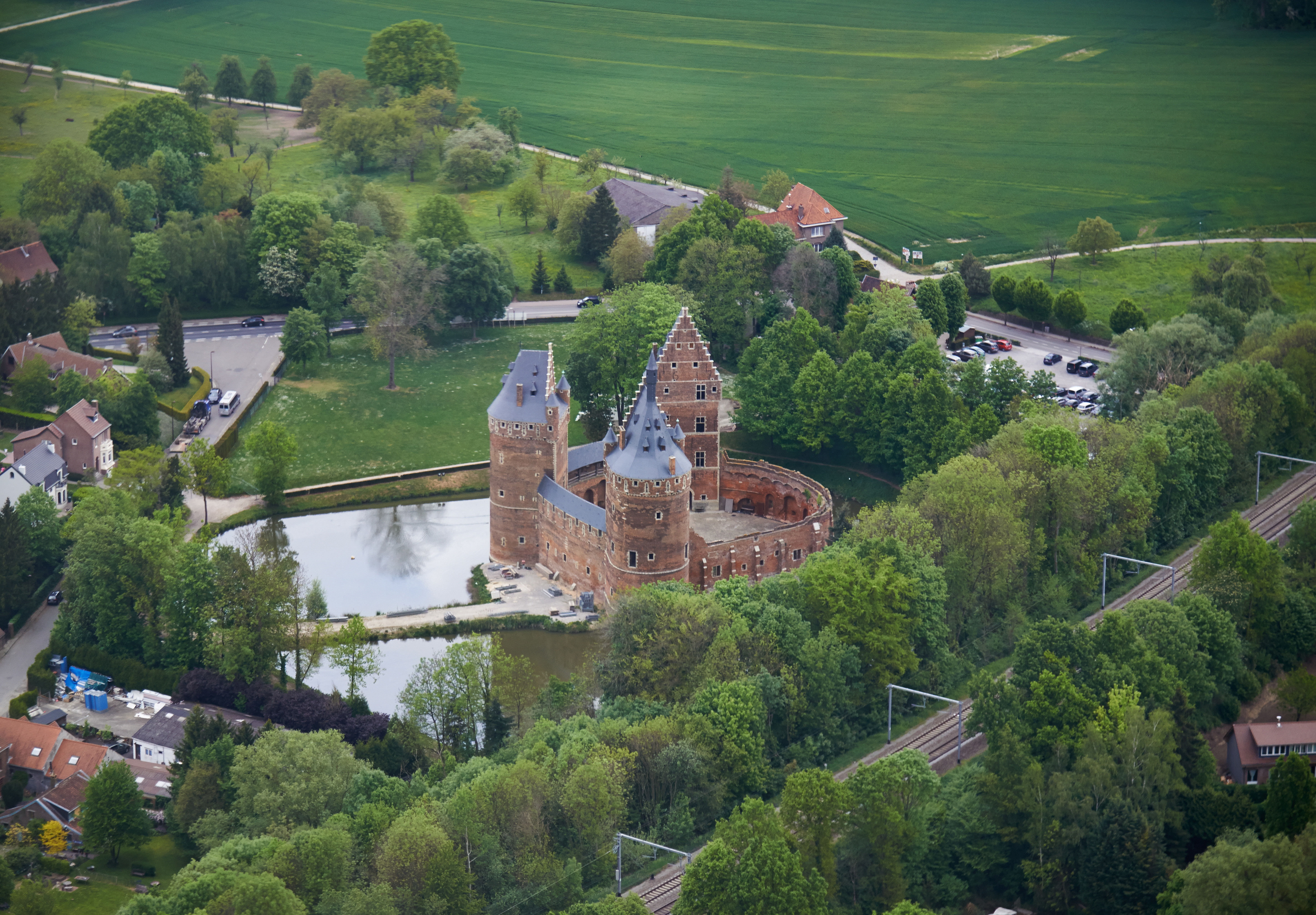
Beersel Castle
Three massive brick towers rise from a moat south of Brussels, their reflections rippling in water that has surrounded this fortress for seven hundred years. Beersel Castle has been besieged twice, sacked, abandoned, converted into a cotton factory, and left to crumble into romantic ruin before Victor Hugo wrote poetry about its decaying walls. Yet here it stands, one of the best-preserved medieval castles in Belgium, its circular walls and three great towers restored to their appearance after a 1617 renovation. Built of brick when stone was the norm for such fortifications, Beersel guards a frontier that no longer exists, between duchies whose names survive only in history books.
Fortress on the Frontier
In 1300, Godefroid of Hellebeke received permission from Jean II, Duke of Brabant, to build a fortification near his residence. Beersel sat at the edge of the Duchy of Brabant, facing the County of Hainaut, southwest of Brussels. The location was strategic; several Brabantine fortifications dotted the area, including nearby Gaasbeek Castle. The original structure lasted only fifty-six years before falling to siege. During the War of the Brabant Succession in 1356, soldiers from the County of Flanders, led by Louis of Male, captured and sacked the castle. What we see today began rising from the ruins in 1357, rebuilt with a circular enceinte and the three great towers that define its silhouette.
The Cannons of Louis XI
The castle's second destruction came from an unexpected source: its own neighbors. When Henry III of Wittem, lord of Beersel, supported Holy Roman Emperor Maximilian I during the revolts of 1483-1492, he placed himself at odds with Brussels, which backed the rebellion. Brussels militias besieged Beersel twice, in 1488 and 1489. During the second siege, cannons provided to the rebels by Louis XI of France battered the southern walls for days before the fortress fell. The damage was extensive. But after Brussels was defeated, Maximilian ordered the city to restore Beersel at its own expense. This forced restoration, begun in 1491, converted the three main towers to accommodate artillery, acknowledging that the age of cannon had fundamentally changed medieval warfare.
From Fortress to Ruin
By the sixteenth century, castles had become military anachronisms. Beersel lost its defensive function and became a private residence. A 1617 restoration added the tiled roofs visible on the towers and ramparts today. But by 1796, the castle was abandoned. The buildings deteriorated. In 1818, entrepreneurs established a cotton factory within the medieval walls, an industrial intrusion that somehow failed to destroy what remained. The property changed hands among Belgian noble families, none of whom invested in its upkeep. Victor Hugo visited the picturesque ruin in 1877 and wrote a verse about it, capturing the romantic appeal of crumbling medieval stone.
Saved by Friends
In 1928, the derelict castle was donated by the House of Merode to the League of Friends of Beersel Castle. For eleven years, from 1928 to 1939, restorers worked to return the three towers and ramparts to their post-1617 appearance. The residential building on the eastern side had deteriorated beyond saving; only its foundations remain. The castle was designated a scheduled historical monument in 1934. Since 1948, it has belonged to the Royal Association of Historic Residences and Gardens in Belgium, leased to the municipal authorities of Beersel. A government-supported restoration between 2008 and 2012 continued the preservation work.
The Castle in Popular Imagination
Beersel's three towers have entered Belgian popular culture. In 1954, cartoonist Willy Vandersteen featured the castle prominently in his Spike and Suzy comic book series, introducing it to generations of Belgian children. More recently, the castle gained international recognition when the video game Age of Empires II: Definitive Edition used its distinctive architecture as the model for the Burgundian civilization's unique castle design. From the air, the moat forms a perfect circle around the brick fortress, the three towers rising from the water like guardians of a vanished medieval world. Trains on the adjacent Line 26 railway pass so close that passengers can almost touch the ancient walls, a jarring collision of centuries.
From the Air
Beersel Castle is located at 50.77N, 4.30E, approximately 10 km southwest of Brussels. The water-filled moat surrounding the circular castle is clearly visible from the air. The castle sits adjacent to Line 26 railway and near the E19 motorway. Brussels Airport (EBBR) lies to the northeast. Best viewed at 1,500-2,500 feet. The three distinctive towers and circular enceinte make identification straightforward in clear conditions.