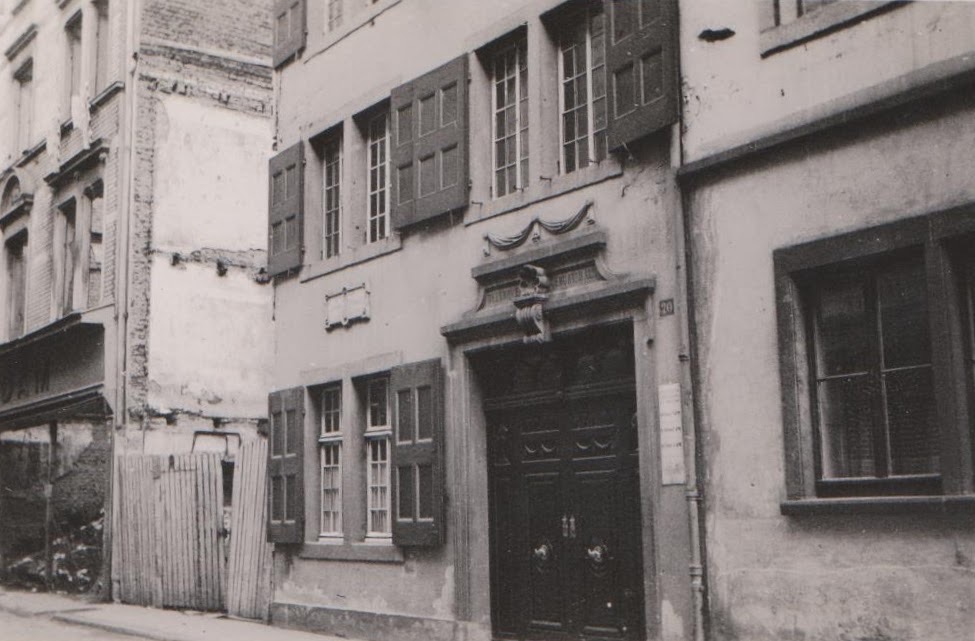
Beethoven House
There is a small room at the top of a steep stair at Bonngasse 20, with sloped attic walls and a single window. It is the back-house, the cheaper section, which is what a court tenor and his wife could afford in Bonn in 1770. Beethoven was probably born in this room - the family rented here from 1767 to 1774, his older sister had died here in infancy, and seven of the next siblings followed. The room is almost empty now. A bust of the composer, a few documents in a case. Most people stay in it for less than a minute. It is the quietest room in Bonn.
A Grocer Buys a Birthplace
For most of the nineteenth century the building on Bonngasse was just a house. Three tailors and a shoemaker worked from it. Five families lived in the front and back buildings at various points. The discovery that this was Beethoven's actual birthplace came around 1840 thanks to Franz Gerhard Wegeler, a physician who had been a friend of Beethoven's, and Carl Moritz Kneisel, a local teacher. By 1873 the owner had opened a restaurant called Beethoven's Geburtshaus on the ground floor. A beer and concert hall went up in the yard in 1887. Then in 1888 a grocery merchant bought the property, sold it a year later, and seemed poised to convert or demolish it. Twelve Bonn citizens founded the Beethoven-Haus association in 1889 to stop this. They bought the building. They preserved what was still mostly an eighteenth-century structure - they had to slightly alter the floor plan of the front building for museum rooms, but Beethoven's actual flat in the back was left almost unchanged. The Verein still owns and runs the building.
What Survives
The permanent exhibition was rebuilt for Beethoven's 250th birthday in 2020, with a thematic rather than chronological layout, but the artifacts are the old ones. The baptism entry from the parish register of St. Remigius. The poster for Beethoven's first public performance, in Cologne in 1778. The first printed composition, from 1783. Portraits of his employers: Maximilian Friedrich von Konigsegg-Rothenfels and Maximilian Franz of Austria, the two prince-electors who put Beethoven on the Bonn court band's payroll as a viola player. His official court viola, the same instrument that paid the family rent for a while. Silhouettes of the von Breuning family, who let the teenage Beethoven into their household when his alcoholic father became a danger. Greeting cards from Eleonore von Breuning. A portrait of Christian Gottlob Neefe, the court organist who taught him. And the original console of the organ at St. Remigius, which the ten-year-old Beethoven played for services - the church was demolished and rebuilt in 1904, and the console came to the museum then. The organ console survived World War II. The church did not.
The Waldstein Note
On display is a copy of perhaps the most famous wish in classical music history. In 1792, just before Beethoven left Bonn for Vienna - he would not return - Count Ferdinand Ernst von Waldstein wrote in the young composer's autograph book: "Receive Mozart's spirit from Haydn's hands." Mozart had died the year before. Haydn was waiting in Vienna to teach the twenty-one-year-old. Waldstein's line is the bridge between two eras of music, written in a friend's parlor in the small Catholic Rhineland city Beethoven was about to leave behind. The original register is in Vienna. Bonn has the photographic facsimile, which is enough.
Behind the Birthplace
The Beethoven-Haus is more than the museum at Bonngasse 20. The buildings at Bonngasse 18 and 24 through 26 house the Beethoven-Archiv - a research center with the largest collection of Beethoven materials in the world. It is the place scholars come when they want to read the actual handwriting on a sketch leaf. The archive's editorial work began under Joseph Schmidt-Gorg in 1952 with a scientifically reviewed edition of Beethoven's sketches and drafts, a series Sieghard Brandenburg continued from 1972 and which is still being published today. Brandenburg also directed work on the complete edition of Beethoven's correspondence - around 2,300 letters spread across collections worldwide, written in a script that is famously difficult to decipher. Six volumes of letters covering 1783 to 1827, plus a register, came out from G. Henle in 1996 and 1998. About six hundred of the letters are available in original digital form. The conversation books - the notebooks that allowed visitors to write down what they wanted to say to the deaf composer - are a separate eleven-volume edition, still incomplete.
The Hall in the Yard
For the association's hundredth anniversary in 1989, a chamber music hall was inaugurated in the building next door. It seats 199 people in a semi-oval amphitheater layout, modeled on the small private concert spaces of the late eighteenth century. The architects Thomas van den Valentyn and Klaus Muller won the German Architect Award in 1989, the Mies van der Rohe Award in 1990, and the Gold Award for interior design in 1991. The hall hosts about forty concerts a year - classic chamber music played by famous ensembles, performances on historical instruments, contemporary jazz, family concerts for school groups, master classes initiated by conductor Kurt Masur in 2006 for young musicians studying Beethoven's works. The Beethoven-Haus is, in other words, two things at once: the most-visited single-composer birthplace in the world, and a working research institution and concert venue that has not let the museum side of itself overwhelm the music. Beethoven left Bonn in 1792. The house refuses to.
From the Air
The Beethoven House stands at Bonngasse 20, in the heart of the old town just north of the Marktplatz, at 50.7369 degrees North, 7.1014 degrees East. Nearest airport is Cologne Bonn (EDDK / CGN), 25 km north. From the air, the old town is the dense cluster of red and grey rooftops around the Bonn Minster's distinctive tower. Bonngasse runs roughly east-west between the Minster and the Rhine. The chamber music hall is in the back yard of the complex - the green dome of the Beethovenhalle is about 700 meters to the north, on the riverbank.