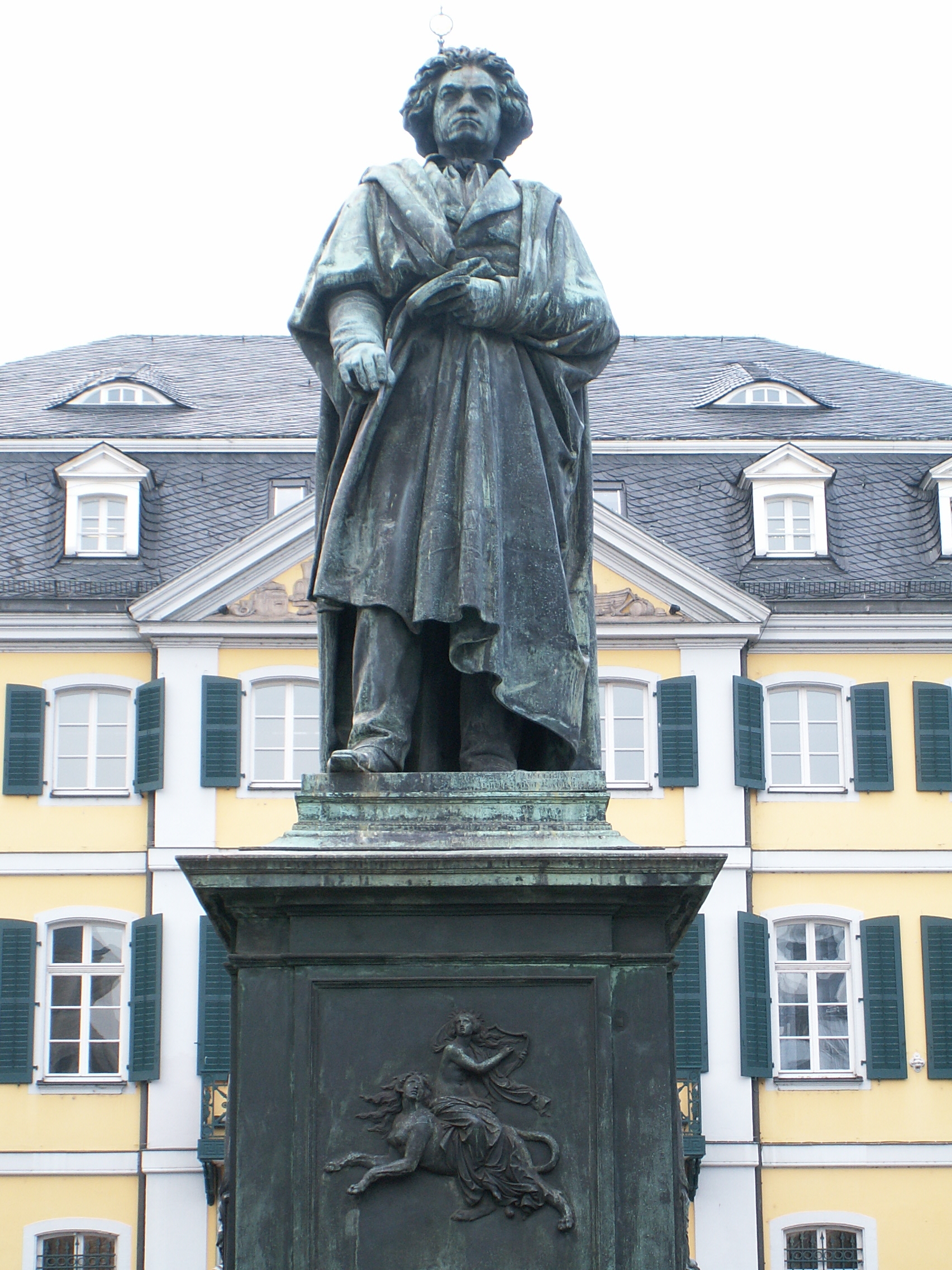
Beethoven Monument
Until 1845, almost no German-speaking city had erected a statue of a composer. Mozart had to wait until 1842 for his in Salzburg. Schiller had been dead thirty-four years before Stuttgart unveiled his statue in 1839. Vienna - where Beethoven had lived for thirty-five years, written nine symphonies, and died - would not produce a statue of him until 1880. Bonn got there first, in 1845, but only because a Hungarian pianist who had never lived in Bonn paid most of the bill himself and then paid for a concert hall when the city realized it had nowhere to put the audience.
The Professor's Idea
The original instigator was a local. Heinrich Carl Breidenstein had held a post at Bonn University since 1823 and was Germany's first professor of musicology. As early as 1828 he was floating the idea of a Beethoven monument in the composer's hometown, and in 1832 he wrote an article suggesting it. He hedged - a statue, he thought, or perhaps better, "a living memorial, one dedicated to art, Bildung, education." His instinct turned out to be right that nothing was easy about this. The German-speaking world simply did not put up statues to musicians. There was no template. The committee Breidenstein helped form spent most of the 1830s trying to raise money and getting nowhere. French contributions, by October 1839, came to less than 425 francs - effectively nothing.
The Hungarian Steps In
Franz Liszt did not let the project fail. He attached himself to the committee in October 1839 and donated more than 10,000 francs of his own money - close to twenty-five times the entire French contribution to date. His one condition was that the sculptor would be Lorenzo Bartolini, an Italian neoclassicist whom Liszt admired - but the committee instead awarded the contract to the German sculptor Ernst Julius Hähnel. (The casting work itself was done in Nuremberg by Jakob Daniel Burgschmiet.) Liszt also kept others involved. Felix Mendelssohn wrote his Variations serieuses in D minor in 1841 specifically to raise money for the monument. Robert Schumann composed works for the same purpose. Berlioz contributed. The unveiling was originally scheduled for 6 August 1843 but slipped to 12 August 1845, in time for the seventy-fifth anniversary of Beethoven's birth and the high point of a three-day Beethoven Festival in the composer's hometown.
The Hall That Wasn't There
A month before the festival, someone realized Bonn had no concert hall big enough to hold the three thousand expected attendees. Liszt offered to underwrite the construction of one himself. The committee accepted. They engaged an architect and a crew and started building less than two weeks before the opening. Ninety-five carpenters and decorators worked around the clock on what became the first Beethovenhalle - a basilica-style wooden building in the Rass' Garden next to the Franciscan Church, with painted friezes and carved wall paneling. It opened on time, accommodated the crowd, was used for two weeks of festival concerts, and was sold for demolition two months later because the fire inspectors looked at all that wood and shook their heads. The site of the first Beethovenhalle is now occupied by the Viktoriabad cultural complex. Schumann and Mendelssohn, who had both written major works for the project, were unable to attend the festival in person. Wagner did not come but wrote to Liszt the week before, proposing they do the same thing for Carl Maria von Weber in Dresden. Queen Victoria and Prince Albert attended. The composer Louis Spohr was there. The whole thing closed with fireworks.
Is It Him?
Bartolini's bronze stands a little over three meters tall on a granite plinth on the Munsterplatz, facing the Bonn Minster. Beethoven holds a stylus and a notebook, looking down and to his right, mid-thought. Whether it looks like him has been argued ever since the unveiling. Sir George Smart, who had met Beethoven in person in 1825, declared the facial features a good likeness. Ignaz Moscheles, the pianist and composer who had also known him, agreed. Anton Schindler - Beethoven's late-life assistant, self-appointed biographer, and the original source for many things about Beethoven that have since been proven false - was contemptuous of the statue. The historical consensus has not been kind to Schindler, but his judgment of the monument is one of the more harmless examples of his negativity.
Down and Up Again
In January 2022, the statue was taken off its plinth for restoration and cleaning. The work lasted six months. The bronze had been outdoors on the Munsterplatz, exposed to Rhineland weather and exhaust, for 177 years at that point. The reinstalled Beethoven looks much as he did in 1845. On a clear morning the shadow of the Minster's tower falls across the plinth, and a small but steady stream of visitors stops to take photographs - more than usually accumulate around Bonn's other major Roccoco-and-Baroque monuments, because this is the one most people came to see.
From the Air
The Beethoven Monument stands at 50.7345 degrees North, 7.0991 degrees East, on the Munsterplatz in central Bonn directly in front of the Bonn Minster. The Minster's distinctive late-Romanesque tower is the main landmark visible from cruising altitude - the monument itself is at ground level on the square. Nearest airport is Cologne Bonn (EDDK / CGN), about 25 km north. The Marktplatz with the gilded Rococo facade of the Altes Rathaus is one block south; the Beethoven House on Bonngasse is two blocks north.