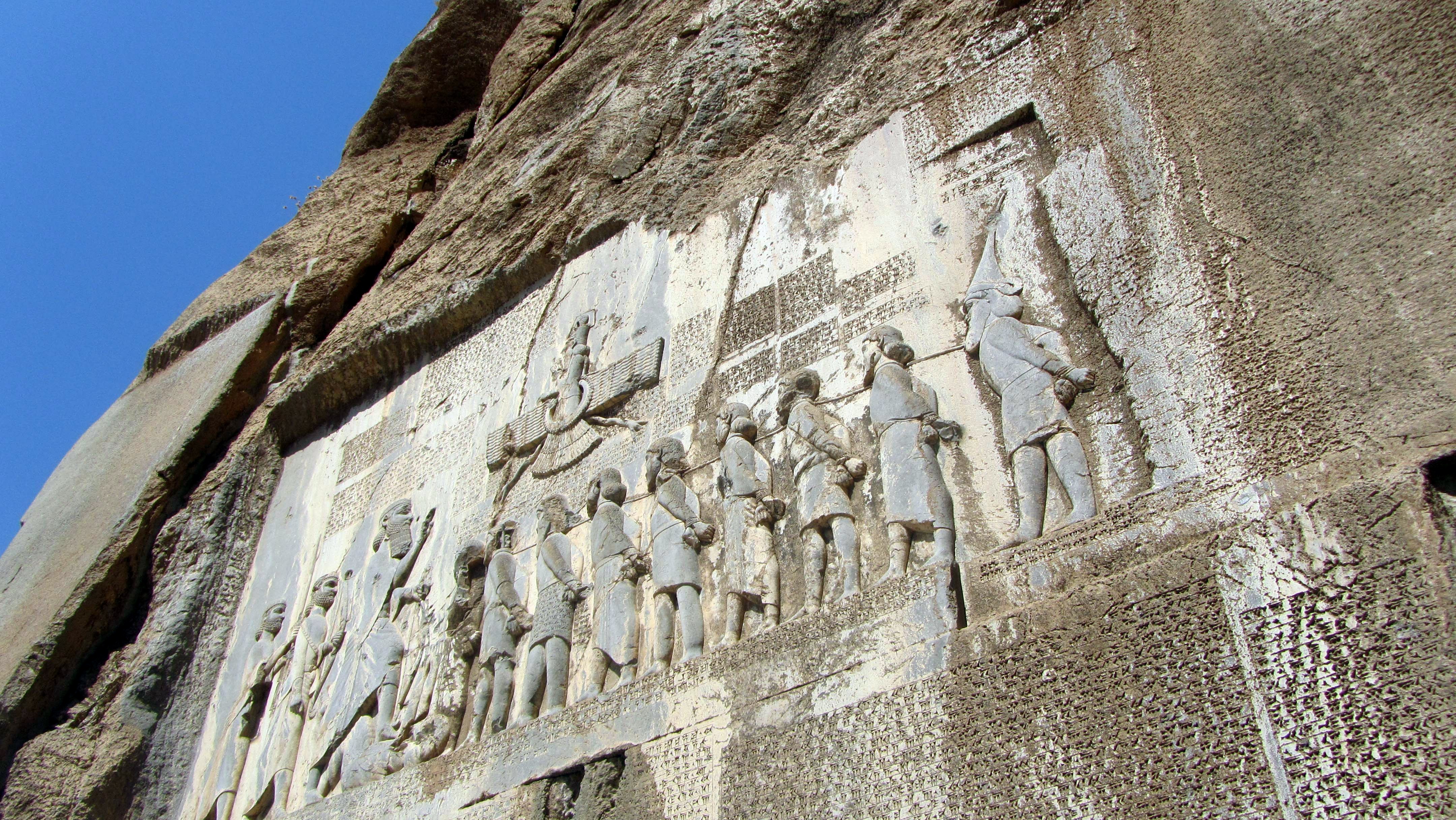
Behistun Inscription
For centuries, nobody could read it. European travelers stared up at the enormous carving on the cliff face near Kermanshah, Iran, and invented explanations. A French general saw Christ and his twelve apostles. A British artist saw the Lost Tribes of Israel. An Italian explorer made drawings but could not decipher a single word. The inscription had been carved around 520 BC by order of Darius the Great, King of Kings of the Persian Empire, in three languages that the modern world had forgotten how to read. It would take a British army officer, a local boy brave enough to scale a sheer cliff, and decades of painstaking scholarship to crack the code -- and in doing so, unlock the entire written history of ancient Mesopotamia.
The King's Billboard
Darius chose his location with a propagandist's instinct. The inscription sits roughly 100 meters up a limestone cliff beside an ancient road connecting Babylon to Ecbatana, the twin capitals of his empire. Every official, merchant, and soldier passing between Mesopotamia and Media would see it. The carving shows Darius life-sized, holding a bow as a symbol of kingship, his left foot planted on the chest of the pretender Gaumata, who lies supine before him. Nine captive figures stand to the right, hands bound, ropes around their necks, representing the rebels Darius crushed. Above the scene floats a Faravahar, the winged symbol of Ahura Mazda, bestowing divine approval. One figure and Darius's beard were added later -- the beard is actually a separate block of stone, fastened with iron pins and lead.
Three Languages, One Boast
The inscription tells its story three times. The Old Persian text runs 414 lines across five columns. The Elamite version covers 260 lines in eight columns. The Babylonian text compresses the account into 112 lines. Darius's autobiography begins with his lineage, traces his coronation in 522 BC, and then details nineteen battles fought in a single year to suppress revolts across the empire after the death of Cambyses II. Each rebellion is named, each rebel identified, each victory attributed to the grace of Ahura Mazda. The redundancy was not literary indulgence; it was administrative necessity. The empire's subjects spoke different languages, and Darius wanted every one of them to understand exactly who was in charge and how he got there.
The Man Who Climbed the Cliff
Henry Rawlinson arrived in Persia in 1835 as a British East India Company officer. The inscription consumed him. He scaled the cliff himself to copy the Old Persian text, a feat requiring both mountaineering skill and scholarly nerve. The Elamite text lay across a chasm. The Babylonian hung four meters above the accessible ledge. Rawlinson enlisted a local boy to reach the most dangerous sections, making squeezes and transcriptions that he sent to Europe in 1847. Working from these copies, Rawlinson and other scholars began to crack Old Persian cuneiform, building on earlier breakthroughs by Georg Friedrich Grotefend, who had deciphered ten of the script's 37 symbols by 1802. The Behistun Inscription became cuneiform's Rosetta Stone -- the trilingual key that made the entire written record of ancient Mesopotamia readable.
Damage and Preservation
The inscription has survived 2,500 years of weather and considerably less time of human violence. Rainwater has dissolved portions of the limestone while depositing new layers over other sections, obscuring text that Rawlinson never copied. During World War II, Allied soldiers used the cliff face for target practice during the Anglo-Soviet invasion of Iran, adding bullet scars to the surface. In 1938, the Nazi think tank Ahnenerbe had planned its own research expedition to the site, though the war intervened. Twentieth-century damage prompted Iranian archaeologists to begin systematic documentation in 1999, using photogrammetry to create three-dimensional records of what remained. The site became a UNESCO World Heritage Site in 2006.
Why It Still Matters
Without Behistun, we might still be unable to read Sumerian, Akkadian, or Babylonian. The inscription's trilingual format -- the same text in three cuneiform scripts -- gave scholars the leverage they needed to decode languages that had been silent for two thousand years. Expeditions by the British Museum in 1904 and the University of Michigan in 1948 recovered passages Rawlinson had missed and revealed the full scope of the text. In 2012, an international team organized by the Bisotun Cultural Heritage Center returned for yet another examination. The inscription keeps yielding new readings, new details, new corrections. Darius intended his words to last. They have outlasted his empire, his language, and the very ability to read them -- only to be recovered again, one painstaking symbol at a time.
From the Air
Located at 34.39N, 47.44E on Mount Behistun in Kermanshah Province, western Iran. The inscription is carved into a limestone cliff face roughly 100 meters above the ancient road below. Nearest airport is Kermanshah (OICC), approximately 30 km to the south. The cliff face is visible from the air on the eastern side of the mountain. Best viewed at 3,000-5,000 feet AGL. The modern town of Bisotun sits at the base of the mountain. UNESCO World Heritage Site since 2006.