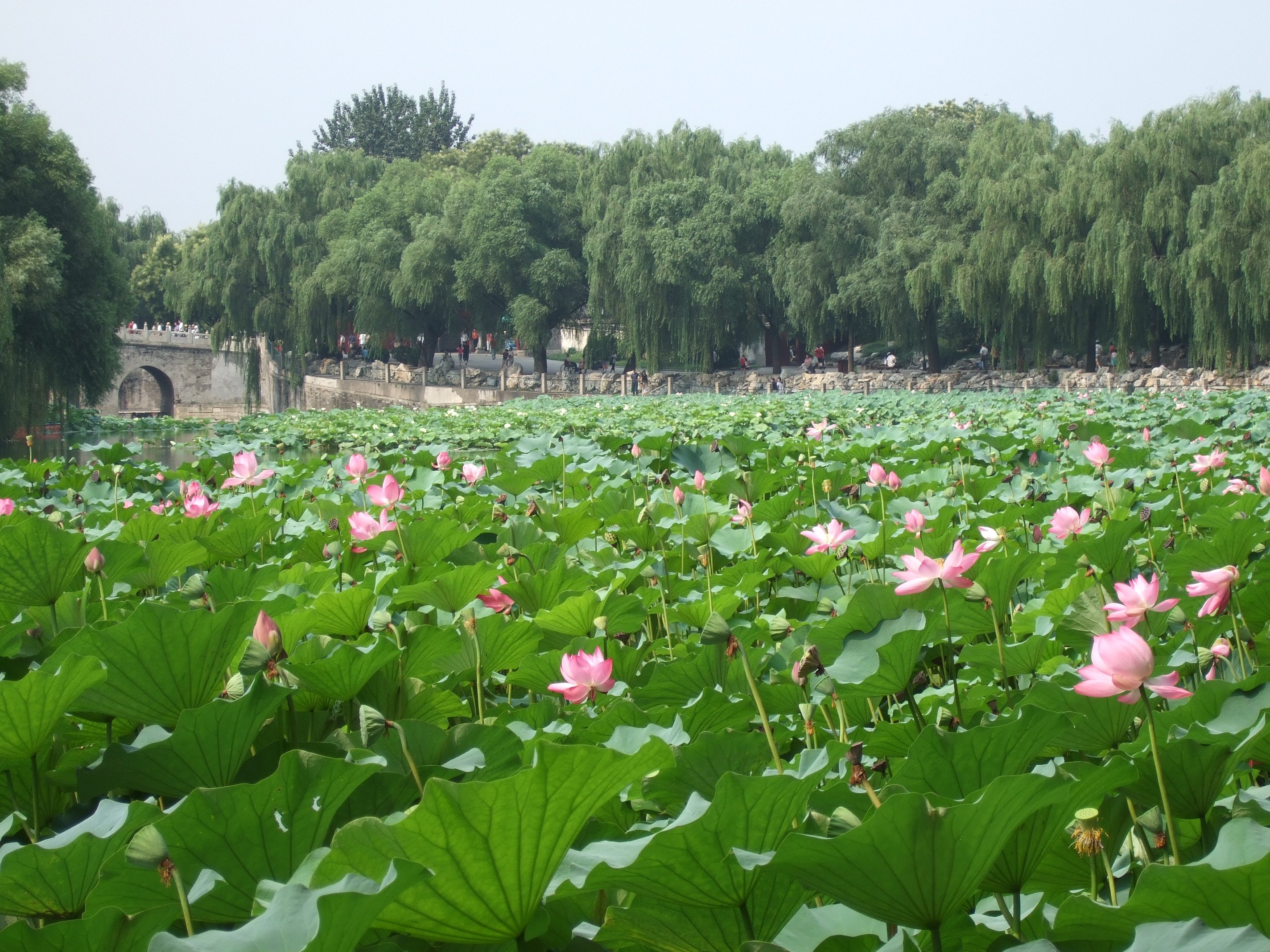
Beihai Park
Stand at the right angle in central Beijing and the White Dagoba appears to float above the city. The 40-meter Tibetan-style stupa rises from Jade Flower Island in the middle of a lake, its white stone form commanding the skyline northwest of the Forbidden City. It was built in 1651 to honor the visit of the 5th Dalai Lama, destroyed by the catastrophic 1679 Sanhe-Pinggu earthquake, rebuilt the following year, damaged again by the 1976 Tangshan earthquake, and repaired once more. The dagoba has proven as resilient as the garden surrounding it -- Beihai Park, one of the oldest and largest surviving imperial gardens in China, a landscape that has been continuously shaped by rulers for nearly nine centuries.
A Lake for Emperors
Beihai's origins reach back to the 12th century, but the garden took its defining form under Kublai Khan and the Mongol Yuan dynasty. The Khan's architects -- including the polymath Guo Shoujing and the administrator Liu Bingzhong -- redesigned Jade Flower Island and enclosed the lake, then called Taiye, within the walls of the Imperial City of Khanbaliq, the Yuan capital built on the bones of what would become Beijing. When the Ming dynasty returned the capital north under the Yongle Emperor in the early 15th century, the lake was divided by bridges into three bodies of water: the Northern, Central, and Southern "Seas." These formed part of an extensive royal estate called the Western Garden. The central and southern lakes are today enclosed within Zhongnanhai, the Communist Party's leadership compound -- still serving as the seat of power, nine hundred years after the first pavilions rose beside the water.
A Garden of Borrowed Landscapes
Chinese imperial gardens were not meant to be original. They were meant to be encyclopedic -- compendiums of the empire's most celebrated landscapes, gathered into a single space for the emperor's contemplation. Beihai follows this tradition with particular ambition. Various sections evoke the pavilions and canals of Hangzhou and Yangzhou, the intimate gardens of Suzhou, and the natural scenery around Lake Tai with its famously porous limestone rocks. The Taihu rocks in Beihai were shipped from Henan Province. Sculptures, jade jars from the Yuan dynasty, and a collection of 495 centuries-old stelas fill the grounds. The Five Dragon Pavilions -- five connected structures with spires and pointed upswept eaves, built under the Ming -- line the lake's north bank, their reflections doubling their presence in the still water.
Dragons in Glazed Brick
North of the Five Dragon Pavilions stands one of China's three surviving Nine-Dragon Walls. Built in 1756 under the Qianlong Emperor, it is constructed of glazed bricks in seven colors, with nine complete dragons playing among clouds decorating both sides. The wall was originally a spirit screen, positioned to deflect evil spirits that Chinese cosmology held could only travel in straight lines. Whether or not it succeeded in its supernatural purpose, it has certainly succeeded as art -- each dragon distinct in posture and expression, the colors still vivid after more than six centuries. In 1747, the Qianlong Emperor ordered 134 calligraphic works from the imperial collection, including three rare pieces by the legendary Wang Xizhi and his son Wang Xianzhi, to be carved into stone and displayed at the Pavilion of Reviewing the Past beside the park.
Jade and Violence
Inside the Round City, the Hall of Received Light houses a Buddha statue carved from a single piece of pure white jade, standing 1.6 meters tall and inlaid with precious stones. It was a gift to the Guangxu Emperor from a Khmer king. During the Eight-Nation Alliance's occupation of Beijing in 1900, foreign soldiers damaged the statue's left arm -- one small act of vandalism in what became a wholesale sacking of the capital. The damage remains visible, a reminder that Beihai's serenity has been interrupted more than once by the violent upheavals that have periodically swept through Beijing.
From Imperial Seclusion to Public Park
Beihai opened to the public in 1925, four years after the fall of the Qing dynasty. What had been an emperor's private garden became a park for a city of millions. Buddhist temples dot the grounds, including the Temple of Everlasting Peace on Jade Flower Island and the Chanfu Temple. Smaller gardens are scattered throughout, like the Jingxin -- the "Quieting Heart Room" -- covering more than 4,000 square meters on the north bank. Beihai's influence extends beyond its own walls: the Five-Pavilion Bridge and Lotus Tower in Yangzhou's Slender West Lake were deliberately modeled on Beihai's Five Dragon Pavilions and White Dagoba in the 18th century, local officials hoping to flatter the Kangxi and Qianlong Emperors during their southern tours. The park they imitated continues to evolve, still adding to a landscape that has been under continuous cultivation since before the Forbidden City was built.
From the Air
Located at 39.92°N, 116.38°E, immediately northwest of the Forbidden City. The White Dagoba on Jade Flower Island is the most prominent landmark, visible from considerable distance as a white stupa rising above tree cover and a lake. Best viewed at 2,000-4,000 feet AGL. Beijing Capital International Airport (ZBAA/PEK) is 14 nm to the northeast.