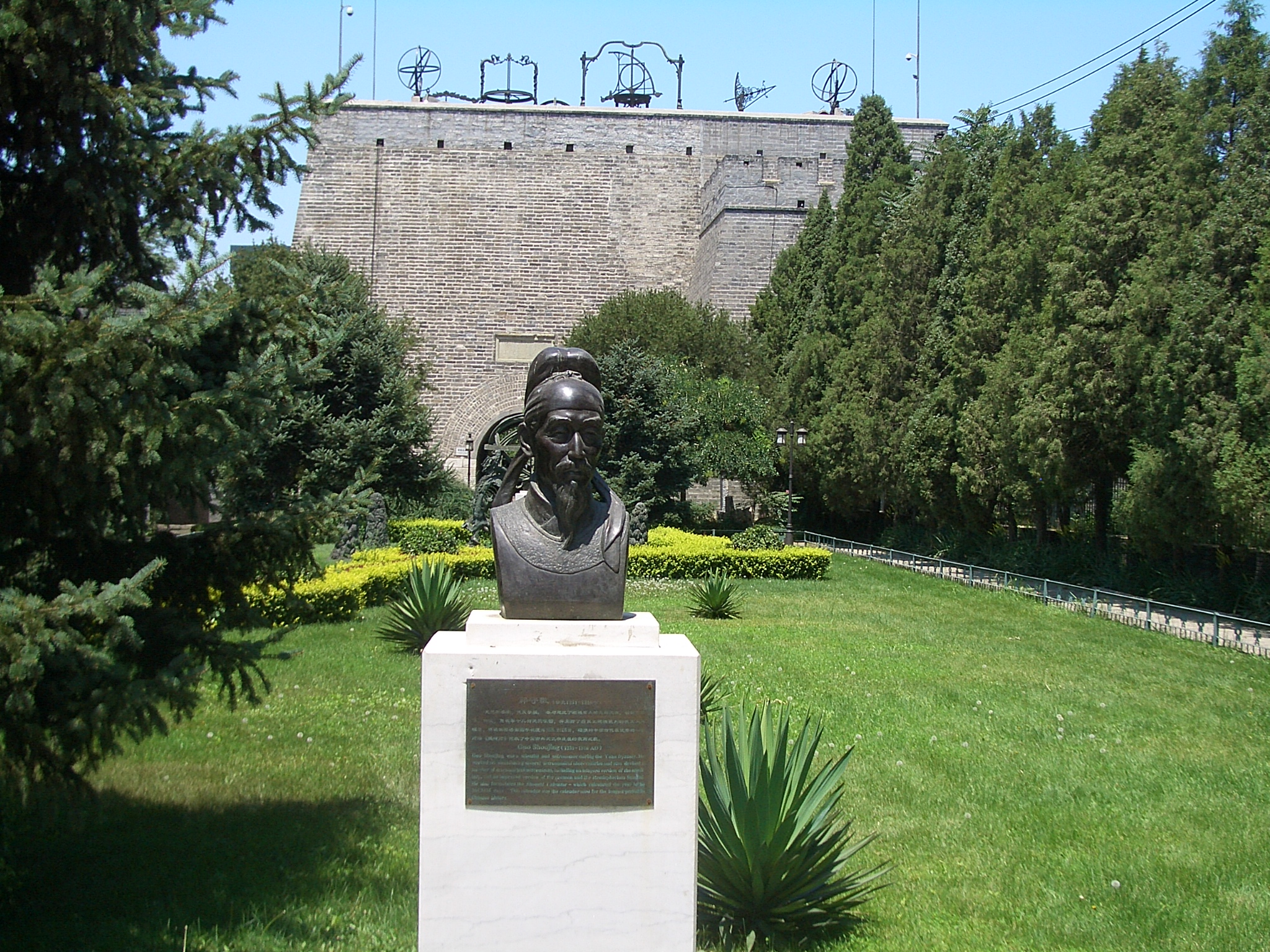
Beijing Ancient Observatory
Atop a 15-meter brick tower -- an extant fragment of the city wall that once encircled all of Beijing -- bronze instruments point at the sky. Armillary spheres, quadrants, celestial globes: they have been here in one form or another since 1442, when the observatory was completed during the Ming dynasty. What makes this place remarkable is not just its age, but the layers of civilization encoded in its metal. Chinese astronomers built it. Jesuit missionaries rebuilt its instruments. Foreign armies looted them. And the governments of France and Germany eventually sent them back.
The Son of Heaven's Stargazers
Chinese emperors were not casual about astronomy. As the "Son of Heaven," the emperor's legitimacy was intertwined with celestial phenomena -- eclipses, comets, and planetary movements carried political meaning, and accurate prediction was a matter of state. The observatory's predecessor dated to 1227, when the Jin dynasty transferred astronomical instruments from Kaifeng to Beijing. In 1279, Kublai Khan built a new observatory just north of the current site and appointed the brilliant polymath Guo Shoujing as its director. Guo designed instruments of remarkable precision for his era and calculated the length of a year to within 26 seconds of the modern value. When the Ming dynasty replaced the Mongol Yuan, the founding emperor moved these instruments to Nanjing. The Yongle Emperor later had them copied and sent back to Beijing, and in 1442 the present observatory was completed on the old city wall.
When a Jesuit Won an Astronomy Contest
In the mid-17th century, the observatory's history took an unexpected turn. Jesuit missionaries, who had traveled to China seeking converts, discovered that their European astronomical training gave them an advantage in the one arena where accuracy was a matter of imperial prestige. When the Jesuit Ferdinand Verbiest won a public astronomy contest -- correctly predicting celestial events that Chinese court astronomers could not -- the emperor awarded him complete charge of the observatory. In 1673, Verbiest supervised the construction of new instruments incorporating European astronomical advances. The heavy bronze armillary spheres and celestial globes that visitors see today are largely the product of this Jesuit intervention, a strange collaboration between Catholic missionaries and Confucian court culture, each using the other for purposes the other barely understood.
Looted, Then Returned
The observatory's instruments survived centuries of dynastic change only to be seized during one of Beijing's darkest chapters. In 1900, during the Boxer Rebellion, members of the Eight-Nation Alliance looted the bronze instruments, dividing them between French and German troops. The instruments traveled to Europe as war trophies. The story might have ended there, but as World War I drew to a close, diplomatic pressure and the terms of the postwar Versailles settlement compelled Germany to return its five instruments in 1921. France had actually returned its five instruments much earlier, in 1902. The homecoming was a rare instance of cultural restitution in an era that rarely practiced it. Some of the observatory's Ming-era instruments, however, never returned to Beijing -- they now reside at Purple Mountain Observatory in Nanjing.
Standing on the Wall
What makes the observatory physically distinctive is its platform: the top of a section of the Ming-dynasty city wall that somehow survived the wholesale demolition of Beijing's fortifications in the 1950s. While most of the wall was torn down to make way for the 2nd Ring Road, this fragment endured because it served a purpose -- holding the observatory aloft. The result is a peculiar time capsule: visitors climb a 15th-century wall to examine 17th-century instruments designed by European missionaries for a Chinese emperor, all within sight of modern skyscrapers and subway stations. The observatory grounds cover 10,000 square meters and now function as a museum affiliated with the Beijing Planetarium. An early seismograph based on the design of Zhang Heng, the 2nd-century polymath, was once housed here as well, connecting the site to an even deeper tradition of Chinese scientific observation.
From the Air
Located at 39.91°N, 116.43°E just south of Jianguomen in Dongcheng District. The observatory sits atop a visible section of preserved Ming-dynasty city wall near the Jianguomen interchange. Beijing railway station is nearby to the south. Best viewed at 2,000-3,000 feet AGL. Beijing Capital International Airport (ZBAA/PEK) is 12 nm to the northeast.