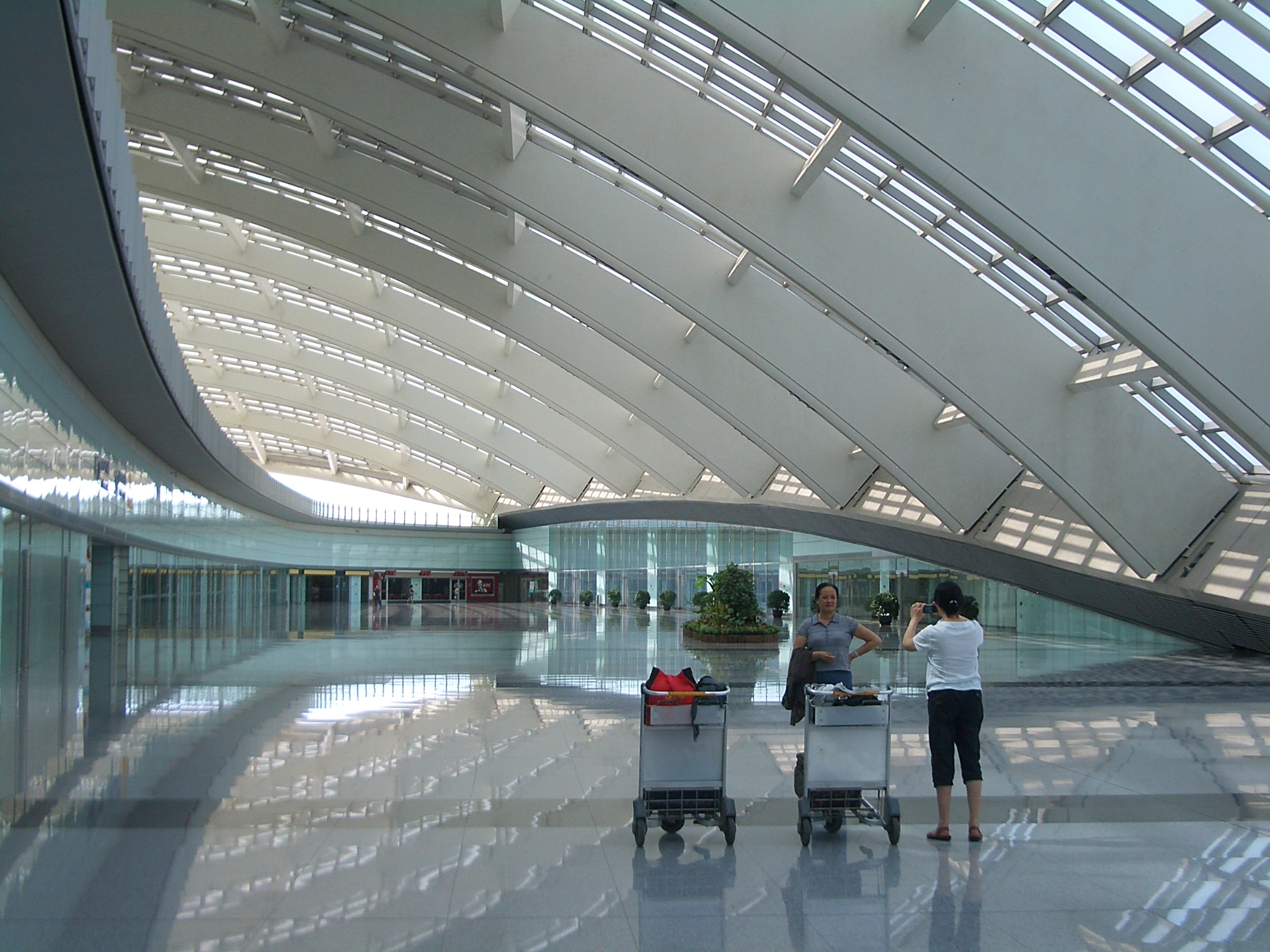
Beijing Capital International Airport
The IATA code says it all: PEK. Not BEI, not BJG, but PEK, a three-letter artifact of the city's old romanized name, Peking. Beijing Capital International Airport has been accumulating history in exactly this way since March 1, 1958, when it opened with a single terminal and one 2,500-meter runway. Today it sprawls across 3,657 acres with three terminals and three runways, processing over 100 million passengers at its pre-pandemic peak in 2018, a number that made it the second-busiest airport in the world.
Terminal 3 and the Olympics
Everything changed in 2008. With the Beijing Summer Olympics approaching, China embarked on one of the most ambitious airport expansions in aviation history. Terminal 3 opened in February 2008, and at the time of its inauguration, it was the largest man-made structure in the world by area covered, with 986,000 square meters of floor space built in a single construction phase. Designed by Foster + Partners alongside Netherlands Airport Consultants and Arup, the terminal's roof is red, the Chinese color of good luck, and its form suggests a dragon when viewed from above. The $3.5 billion project was partly funded by a 30-billion-yen loan from Japan and a 500-million-euro loan from the European Investment Bank, the EIB's largest-ever grant in Asia. Following the Olympics, Beijing Capital overtook Tokyo Haneda as the busiest airport in Asia.
A Dragon Full of Details
Terminal 3's interior fuses cutting-edge engineering with deliberate Chinese cultural references. The ceiling shifts from light orange at the center to deeper tones at the edges, a color gradient designed to help passengers intuitively sense their location within the building. Dozens of triangular skylights in the roof adjust light angles throughout the day. Interior decorations include a Menhai, a copper vat modeled on those used to store firefighting water in the Forbidden City, and carvings that echo the famous Nine-Dragon Wall. The T3E waiting area houses an indoor garden built in the style of imperial gardens like the Summer Palace. A 2-kilometer automated people mover connects the three sub-concourses in a journey of two to five minutes, while a luggage system capable of processing 19,200 pieces per hour can move a suitcase from check-in to the international gates in five minutes.
The Weight of Growth
By the 2010s, even this enormous facility was straining under the pressure of China's aviation boom. Passenger numbers climbed relentlessly: 73 million in 2010, 83 million in 2012, 94 million in 2016, breaking 100 million for the first time in 2018. The solution was not another expansion but an entirely new airport. Beijing Daxing International Airport, designed by Zaha Hadid Architects and shaped like a starfish, opened in 2019 to absorb traffic that Capital could no longer handle. The airlines split: Air China and Hainan Airlines stayed at Capital, while China Eastern, China Southern, and China United moved to Daxing. The result is a capital city served by two colossal airports, a reflection of the scale at which modern Chinese infrastructure operates.
Connections to the City
Getting from the airport to downtown Beijing was once an adventure in traffic. Now the Capital Airport Express, a dedicated rail link integrated into the Beijing Subway system, covers the 30 kilometers from Terminal 3 to Dongzhimen station in approximately 16 to 20 minutes. Opened on July 19, 2008, just in time for the Olympics, the line extended to Beixinqiao station in December 2021. Four expressway toll roads connect the airport to different parts of the city, and 18 bus routes reach points throughout Beijing and to neighboring cities including Tianjin and Tangshan. The original 1958 terminal still stands on the property, apparently serving VIPs and charter flights, a modest brick building dwarfed by the dragon-shaped terminal that arrived half a century later.
From the Air
Beijing Capital International Airport (ICAO: ZBAA, IATA: PEK) is located at 40.08N, 116.58E, approximately 32 km northeast of downtown Beijing. Three runways handle arrivals and departures. The airport is clearly visible on approach with Terminal 3's distinctive dragon-shaped roof a prominent landmark. Elevation 116 feet / 35 meters. Check NOTAMs for current runway configurations and traffic patterns.