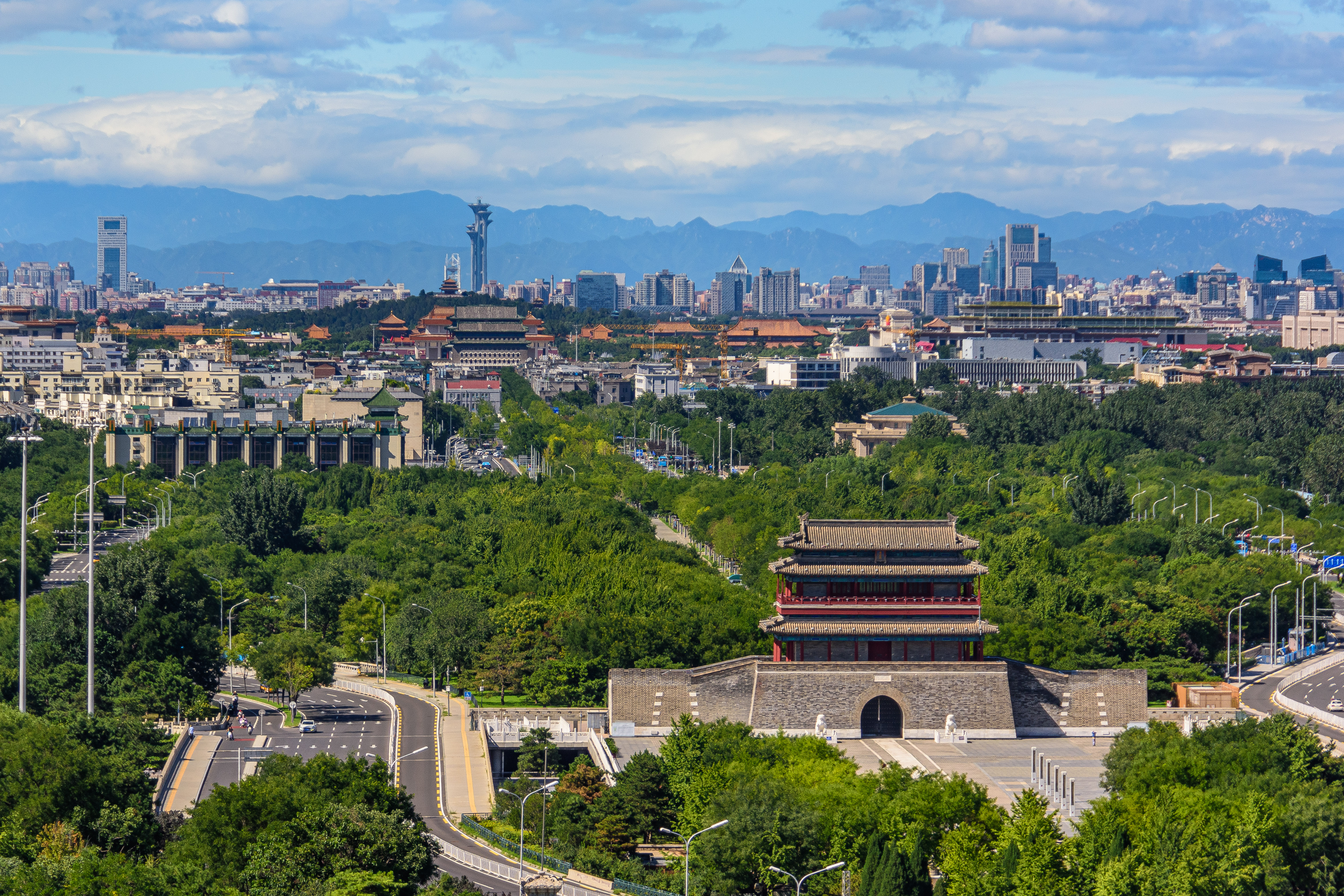
Beijing Central Axis
Draw a line due south from the Drum Tower in northern Beijing. Follow it through the Bell Tower, past Jingshan Hill, straight through the Forbidden City's Meridian Gate, across Tiananmen Square, through the Zhengyangmen Gate, and onward to the Yongdingmen Gate at the old city's southern edge. That line runs 7.8 kilometers. It is one of the most significant urban axes on Earth, a UNESCO World Heritage Site that organizes seven centuries of Chinese imperial architecture along a single, unbroken thread of symmetry.
An Axis Born of Empire
The Central Axis dates to the Yuan dynasty in the thirteenth century, when Kublai Khan's planners laid out Khanbaliq along strict cosmological principles. Chinese urban design tradition placed the emperor at the center of the world, and the north-south axis was the spine around which that world was organized. When the Ming dynasty rebuilt Beijing in the fifteenth century, the axis was preserved and elaborated. Every major ceremonial building, from the Forbidden City to the Temple of Heaven, was positioned in deliberate relationship to this line. The result is not merely an avenue but a spatial argument about order, hierarchy, and the emperor's cosmic role.
Reading the Line from North to South
Walking the axis is a journey through the layers of Beijing's identity. The Drum and Bell Towers at the northern terminus once regulated the city's daily rhythms, marking time for a population of hundreds of thousands. Jingshan Hill, an artificial mound created from the earth excavated to build the Forbidden City's moat, offers a view directly down the axis through the palace complex. The Forbidden City itself occupies the central stretch, its succession of gates and halls arranged with theatrical precision. South of the palace, Tiananmen Square opens into the vast public space that the People's Republic created by demolishing the old gate precinct. The Zhengyangmen Gate and its archery tower mark the boundary between the inner and outer city, and beyond them, the Temple of Heaven and the Altar of the God of Agriculture flank the axis to the east and west.
Symmetry as Philosophy
The axis is not merely geometric. It encodes a philosophy of governance. Buildings of equal importance are paired symmetrically on either side: the Altar of Land and Grain to the west, the Imperial Ancestral Temple to the east. The Temple of Heaven to the southeast, the Altar of the God of Agriculture to the southwest. This bilateral symmetry expressed the idea that the emperor balanced all forces, agricultural and spiritual, ancestral and territorial. Even the bridges crossing the Golden Water Stream in front of Tiananmen are arranged symmetrically, their number and placement dictated by court protocol. The axis transforms urban planning into cosmological statement.
A Living Heritage
In 2024, the Beijing Central Axis was inscribed on the UNESCO World Heritage List, recognizing what residents of the city have understood for centuries: this line is the organizational principle of one of the world's great capitals. Unlike the Axe historique in Paris or the comparable axis in Yogyakarta, Beijing's central line carries the accumulated weight of multiple dynasties, each building upon the alignments established by its predecessor. From the air, the axis is visible as a clear north-south corridor through the density of central Beijing, the Forbidden City's golden roofs marking its midpoint. On the ground, it is a walking tour through seven hundred years of architectural ambition.
From the Air
Located at 39.90°N, 116.39°E, running north-south through the heart of Beijing. The axis is clearly visible from altitude as a corridor of monumental architecture, with the golden-roofed Forbidden City at its center and Tiananmen Square immediately to the south. Nearest airport: Beijing Capital International (ZBAA), approximately 25 km northeast. The Drum Tower and Bell Tower at the northern end and the Temple of Heaven to the southeast are prominent landmarks.