Beijing City Fortifications
In August 1900, Russian and Japanese soldiers tried repeatedly to blow gaps in Beijing's city walls at Dongzhimen and Chaoyangmen. They packed nitrocellulose against the brick and rammed earth, but could not get close enough to light the fuse without being shot from above. The walls held for two full days of cannon bombardment before the Eight-Nation Alliance finally overran the defenses. Six decades later, in 1965, those same walls were torn down without a fight -- not by foreign armies, but by the Chinese Communist Party, to make way for the 2nd Ring Road and Line 2 of the Beijing Subway.
Four Cities, One Shape
Beijing's fortifications were not a single wall but a system of nested enclosures. At the center sat the Forbidden City, ringed by the Imperial City, which was enclosed by the Inner City, which was adjoined on its southern side by the Outer City. Together they formed a shape resembling the Chinese character for "convex" -- a smaller rectangle protruding from the bottom of a larger one -- with a total perimeter of approximately 60 kilometres. The Inner City walls, completed during the Ming dynasty between 1406 and 1445, were the backbone. Emperor Yongle, who moved the capital from Nanjing to Beijing in 1421, ordered the southern walls pushed 0.8 kilometres south to make room for the Imperial City complex. His successor, Emperor Ying, added an extra layer of bricks to the interior walls, built gate towers and watchtowers at nine major gates, constructed four corner guard towers, and replaced wooden moat bridges with stone. The Outer City walls were completed in 1553, originally intended to encircle the entire Inner City but abandoned partway through when Mongol invasions drained soldiers and funds to the northern frontier. Only the southern extension was finished.
Nine Gates, Eight Tangs, One Old Bell
Each of the Inner City's nine gates had its own identity and function. Chaoyangmen, the Food Gate, was closest to the Grand Canal, and carts of wheat and rice from southern China entered through it -- a wheat grain was engraved on its barbican archway. Fuchengmen, near the coal reserves at Mentougou, bore a plum blossom on its archway: the word for plum and the word for coal are homophones in Chinese, and when the plum trees nearby bloomed in spring, coal deliveries ceased. Xizhimen was the water gate, where carts of spring water from Mount Yuquan entered each morning for the imperial family. Deshengmen -- the Gate of Moral Triumph -- was where both the Ming and the Qing dynasties first entered the city after defeating their predecessors. Xuanwumen was the Death Gate, through which carts carried prisoners to execution at Caishikou. Only Chongwenmen had bells announcing the closure of gates at day's end; the other eight used a flat instrument producing a "tang" sound, giving rise to the saying: "Nine gates, eight tangs, one old bell."
The Walls Come Down
The dismantling began gradually after the Qing dynasty collapsed in 1911. Barbicans at five Inner City gates were removed to improve traffic flow. The circum-city railway required the demolition of sluice gate towers. New archways were punched through the walls at Hepingmen in 1924, and at Jianguomen and Fuxingmen in 1939. But the wholesale destruction came after 1949. During the Korean War, six new archways were cut to ease traffic density. In 1965, the remaining Inner City walls and most gate towers were demolished to build the 2nd Ring Road and subway Line 2. Xizhimen, the last gate to remain fully intact, fell in 1969. Workers dismantling it discovered that parts of the barbican gateway were 13th-century originals from the Yuan dynasty -- seven hundred years of continuous use, ended with a wrecking crew. When Chongwenmen came down during the Cultural Revolution, its timbers turned out to be the original Ming structure, built from phoebe puwennensis wood. Some of the recovered lumber was used to repair the Forbidden City and Tiananmen.
What Survived
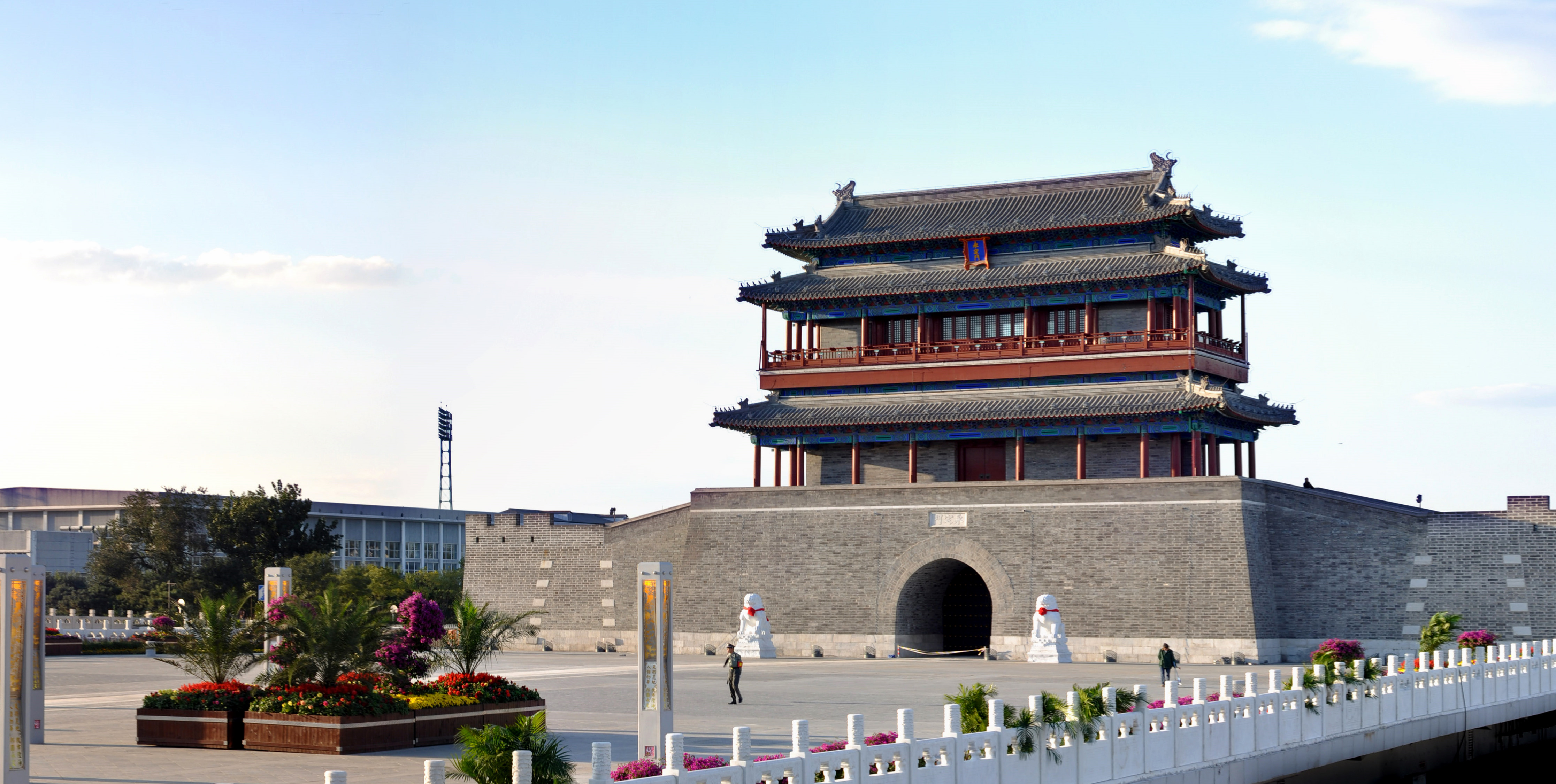
Of the most extensive defense system in Imperial China, fragments remain. The Forbidden City stands intact as the Palace Museum. The gate tower and watchtower at Zhengyangmen -- saved from demolition in 1965 on the personal orders of Premier Zhou Enlai -- still anchor the southern end of Tiananmen Square. The watchtower at Deshengmen survives, kept after a 1979 demolition proposal was overruled. The southeastern corner guard tower endures because the subway was rerouted to avoid disrupting rail service at the nearby Beijing railway station, accidentally preserving a section of the Inner City wall in the process. That wall section and the corner tower now form the Ming City Wall Relics Park. Yongdingmen, the central southern gate of the Outer City, was completely reconstructed in 2004, slightly north of its original position. These remnants are scattered across a modern city that erased most of the walls that defined it. But the shape persists. The 2nd Ring Road traces the exact footprint of the demolished Inner City walls. Beijing's past is literally the road it drives on.
From the Air
The fortifications once formed a convex-shaped perimeter of approximately 60 km around central Beijing. The 2nd Ring Road now traces the demolished Inner City walls. Surviving elements visible from altitude include: the Forbidden City (39.92N, 116.39E), Zhengyangmen gate tower at the south end of Tiananmen Square, the southeastern corner guard tower and Ming City Wall Relics Park near Beijing Railway Station, and the reconstructed Yongdingmen. The wall perimeter is best appreciated by following the 2nd Ring Road from altitude. Nearest airports are Beijing Capital (ZBAA) and Beijing Daxing (ZBAD).