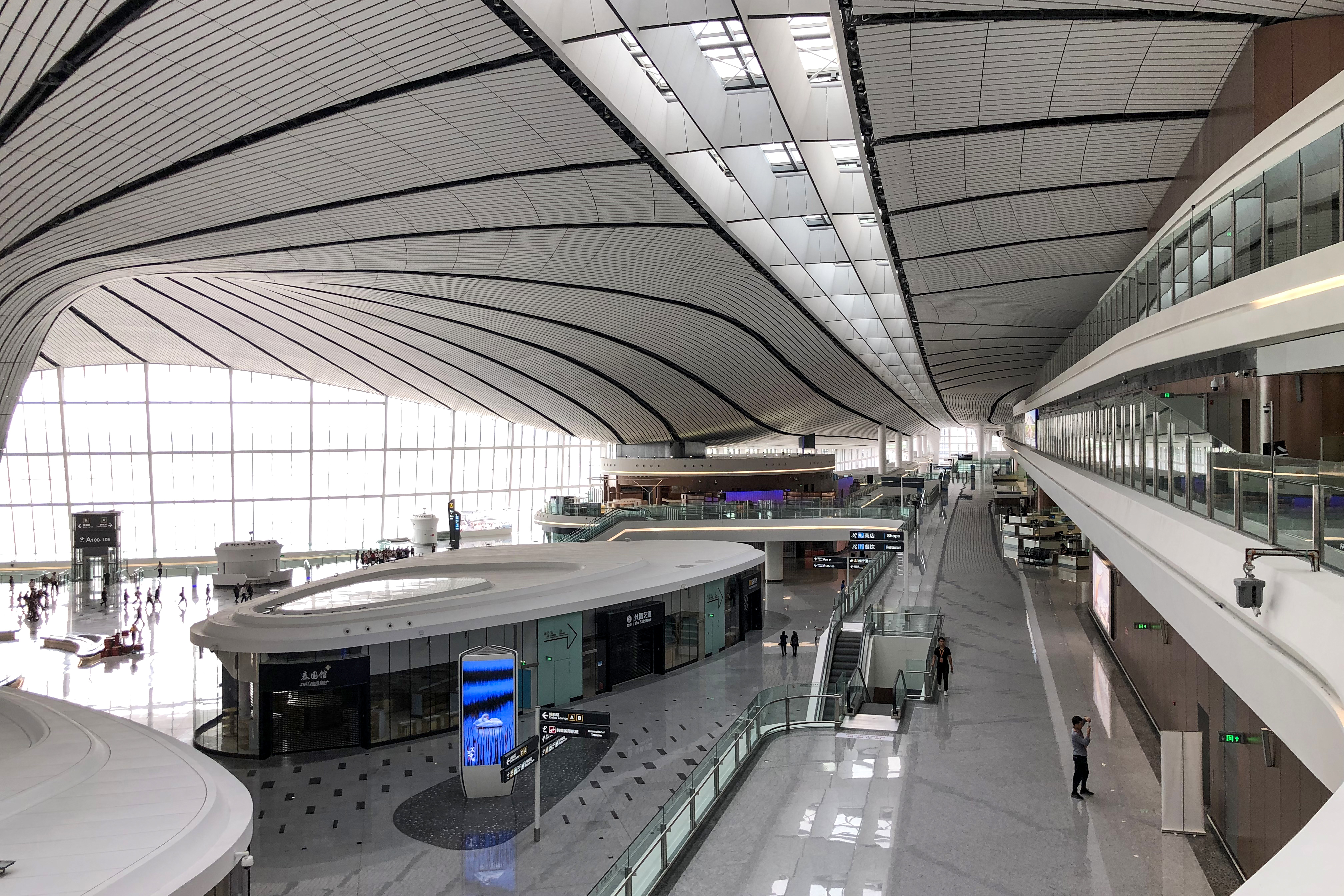
Beijing Daxing International Airport
On 25 September 2019, six days before the 70th anniversary of the founding of the People's Republic of China, President Xi Jinping opened an airport that had not existed five years earlier. Beijing Daxing International Airport sprawled across 47 square kilometres of land on the border of Beijing and Langfang, Hebei -- a facility so large it earned the nickname "the starfish." Its terminal building, at 700,000 square metres, was the world's largest single-building airport terminal. The project cost 80 billion yuan for the airport itself, with peripheral infrastructure pushing the total to 450 billion yuan. The first commercial flight, an Airbus A380 operated by China Southern Airlines, departed later that afternoon.
The Problem of Success
Beijing needed a new airport because its existing one was too popular. Beijing Capital International Airport handled 83 million passengers in 2013, making it the second busiest in the world. The capital's explosive growth had overwhelmed a facility that, despite three terminals and three runways, could not keep pace. A third airport for Beijing was proposed in 2008. Early reports suggested up to nine runways and a capacity of 120 to 200 million passengers per year -- numbers that, if fully realized, would have surpassed Hartsfield-Jackson Atlanta by a wide margin. The National Development and Reform Commission gave official approval on 22 December 2014 for an airport in the southern part of Daxing District, along the Beijing-Hebei border. The approved design called for seven runways: six civilian and one military.
Six Curved Spokes
The terminal building was designed by Zaha Hadid Architects and French planners ADPI, then executed by the Beijing Institute of Architectural Design. The concept: a central hub with six curved spokes radiating outward, creating a form that is organic from the air and efficient on the ground. The master plan was prepared by Netherlands Airport Consultants, integrating a ground transportation hub beneath the terminal that links high-speed rail, metro, expressways, and bus routes into a single intermodal node. Arup handled fire engineering. BuroHappold integrated structural solutions. Chief engineer Guo Yanchi oversaw the construction, which capped the concrete structure by March 2017 and completed flight inspection by early 2019. The airport covers 2,679 hectares with four civilian runways and one military runway. When Beijing Nanyuan Airport -- the oldest airport in China -- closed on the same day Daxing opened, an era ended and another began on the same calendar page.
Dividing the Sky
The opening of Daxing split Beijing's aviation world in two. The Civil Aviation Administration of China directed SkyTeam alliance airlines -- led by China Southern and China Eastern -- to relocate to Daxing, while Star Alliance carriers, anchored by Air China, remained at Capital. China Eastern and China Southern each received 40 percent of Daxing's landing slots, with the remaining 20 percent allocated to smaller carriers and international airlines. Oneworld members, drawn by codeshare partnerships with China Southern, began migrating as well -- British Airways and Malaysia Airlines moved their Beijing flights to Daxing. By October 2020, China Southern had transferred all its Beijing operations to the new airport. The COVID-19 pandemic delayed many planned international moves, but the fundamental restructuring held: two airports, two alliances, two gravitational centers for a city that had outgrown the capacity of any single hub.
Twenty-Eight Minutes
Daxing sits 46 kilometres south of Tiananmen Square, but the distance is measured in minutes, not kilometres. The Beijing-Xiong'an intercity railway, running at 250 kilometres per hour, connects Beijing West railway station to the airport in 28 minutes. The Daxing Airport Express metro line links to the city's subway network. Expressways converge from multiple directions. A planned intercity railway connector will eventually link Daxing to Langfang, the Beijing sub-administrative center in Tongzhou District, and Beijing Capital International Airport itself -- knitting the entire region into a single transit web. The airport was designed not just for Beijing but for the Jing-Jin-Ji megaregion encompassing Beijing, Tianjin, and Hebei. Standing in the terminal's soaring atrium, watching the six spokes radiate toward distant boarding gates, the scale of the ambition becomes physical. This is infrastructure built not for the country China is, but for the country it intends to become.
From the Air
Beijing Daxing International Airport (ICAO: ZBAD) at 39.51N, 116.41E, 46 km south of Tiananmen Square on the Beijing-Hebei border. Four civilian runways plus one military runway. The starfish-shaped terminal building is the world's largest single-structure airport terminal at 700,000 square metres. Hub for SkyTeam alliance. 65 km south of Beijing Capital International Airport (ZBAA). Visible from considerable distance due to its scale and distinctive radial design.