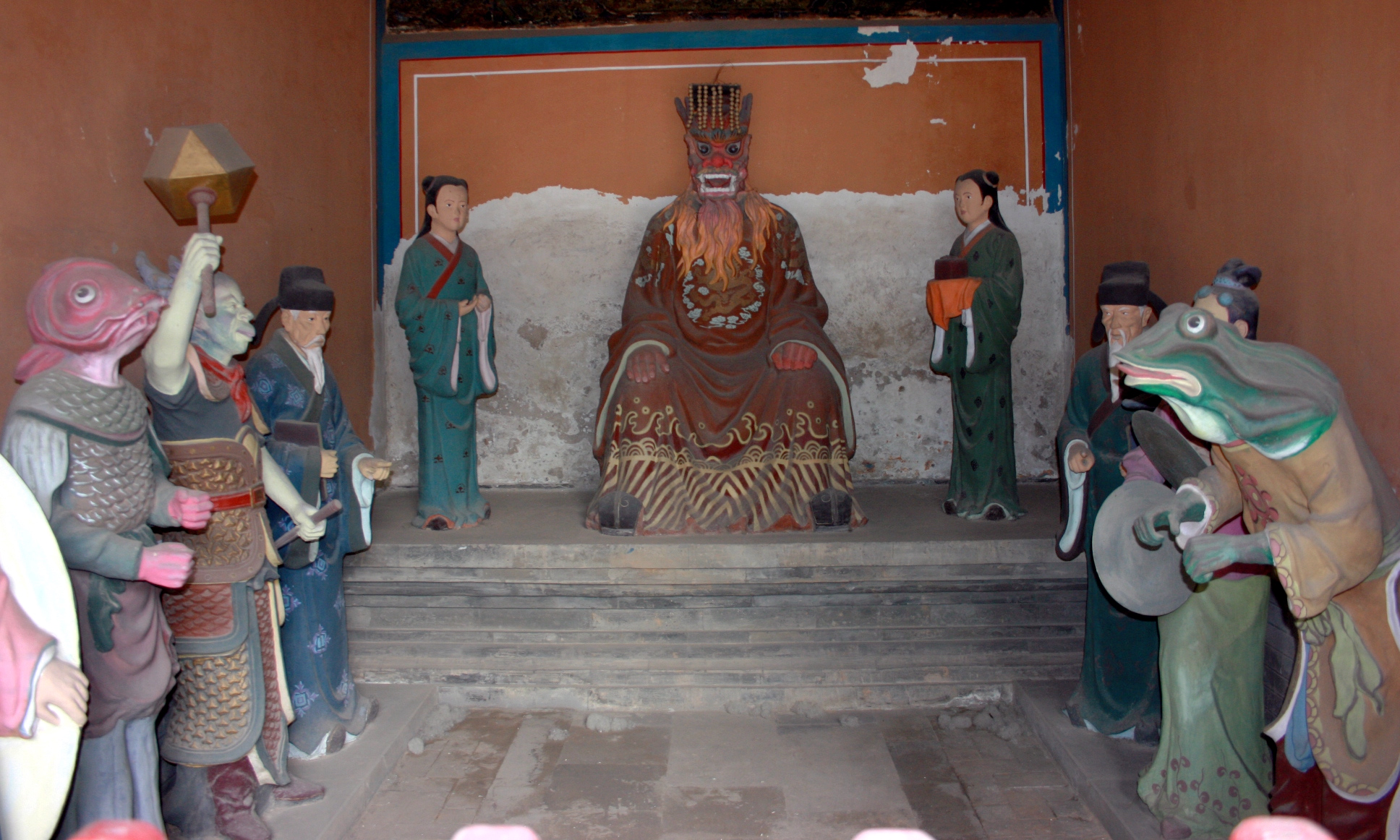
Beijing Dongyue Temple
Walk into the central courtyard of Beijing's Dongyue Temple and you encounter a vision of the afterlife arranged like a government bureaucracy. Surrounding the open space, a succession of small rooms each opens to the courtyard and displays an ensemble of plaster statues depicting one of the "seventy-six wings" of the Taoist pantheon -- departments of the celestial administration that govern everything from rainfall to the recording of good deeds. The Department of Rain Gods. The Department of Longevity. The Department of Wandering Ghosts. Each tableau is simultaneously devotional art and cosmic organizational chart, the divine order expressed not as a single throne room but as an office complex.
A Temple for the Holiest Mountain
The Dongyue Temple -- the Temple of the Eastern Peak -- is dedicated to the Great Deity of Mount Tai, the easternmost and most sacred of China's Five Sacred Mountains. Mount Tai has been a pilgrimage site for thousands of years, a place where emperors performed the Feng and Shan sacrifices to communicate with heaven. Building a temple to Mount Tai's deity in Beijing made spiritual geography portable -- worshippers could honor the Eastern Peak without making the journey to Shandong Province. Founded in 1319 during the Yuan dynasty, the temple is the largest of the Zhengyi school of Taoism in Beijing. Zhang Liusun, a Yuan official and descendant of the legendary Taoist patriarch Zhang Daoling, raised the money and acquired the land. He died in 1321, and his disciple Wu Quanjie completed the main halls and gate by 1322.
Seven Centuries of Renovation
The temple accumulated layers over the centuries like geological strata. The Ming dynasty's Zhengtong Emperor repaired and renamed it in 1447. During the Qing, it was rebuilt twice -- once in 1698 under the Kangxi Emperor, again in 1761 under the Qianlong Emperor -- and expanded significantly. At its peak, the complex covered 4.7 hectares and contained 376 rooms. Stone tablets accumulated in the courtyards, roughly 140 dating from the Yuan, Ming, Qing, and early Republican periods. Among the survivors is a Yuan-dynasty tablet bearing calligraphy by Zhao Mengfu, one of the most celebrated calligraphers in Chinese history. Its inscription recounts the life of the temple's founder in 2,786 characters, the sole remaining piece of what was originally a set of four.
Gutted and Reborn
The Cultural Revolution nearly finished what seven centuries of turmoil could not. In the late 1960s, the temple was stripped bare -- statues destroyed, contents hauled away, the interior entirely gutted. The buildings were repurposed as a school, government offices, and housing for hundreds of people. The Public Security Bureau occupied part of the site until the 1990s; after the PSB left, the vacated portion was redeveloped into commercial real estate. In 1996, the State Council declared the temple a national treasure, and a full restoration was completed in 2002 at a cost of 5.8 million yuan. Of the original statues, only five survive -- donated from another Beijing temple, the Sanguanmiao, which had ceased to function as a religious site.
What the Stone Tablets Remember
Today three courtyards and their buildings remain, occupying only part of the original site. An archway with three gates, covered in green and yellow glazed tiles, still belongs to the complex but has been physically separated from it by a public road cut through the grounds. About 90 of the original 140 stone tablets survive, and the three main halls -- Yude Hall, Daizongbao Hall, and Yuhuang Hall -- have been restored. Yude Hall displays statues carved from Jinsi Nanmu wood depicting the gods of heaven, earth, and water. The temple also houses the Beijing Folk Customs Museum, which documents the traditional festivals, rituals, and daily practices that once defined life in the capital. Sitting 500 meters east of Chaoyangmen subway station on Chaowai Dajie, the temple exists in quiet tension with the modern commercial street surrounding it -- ancient stone tablets and plaster deities surrounded by glass towers and shopping centers.
From the Air
Located at 39.92°N, 116.44°E on Chaowai Dajie in Chaoyang District, east-central Beijing. The temple compound is modest in footprint compared to surrounding modern buildings. Best viewed at 2,000-3,000 feet AGL. Beijing Capital International Airport (ZBAA/PEK) is 11 nm to the northeast.