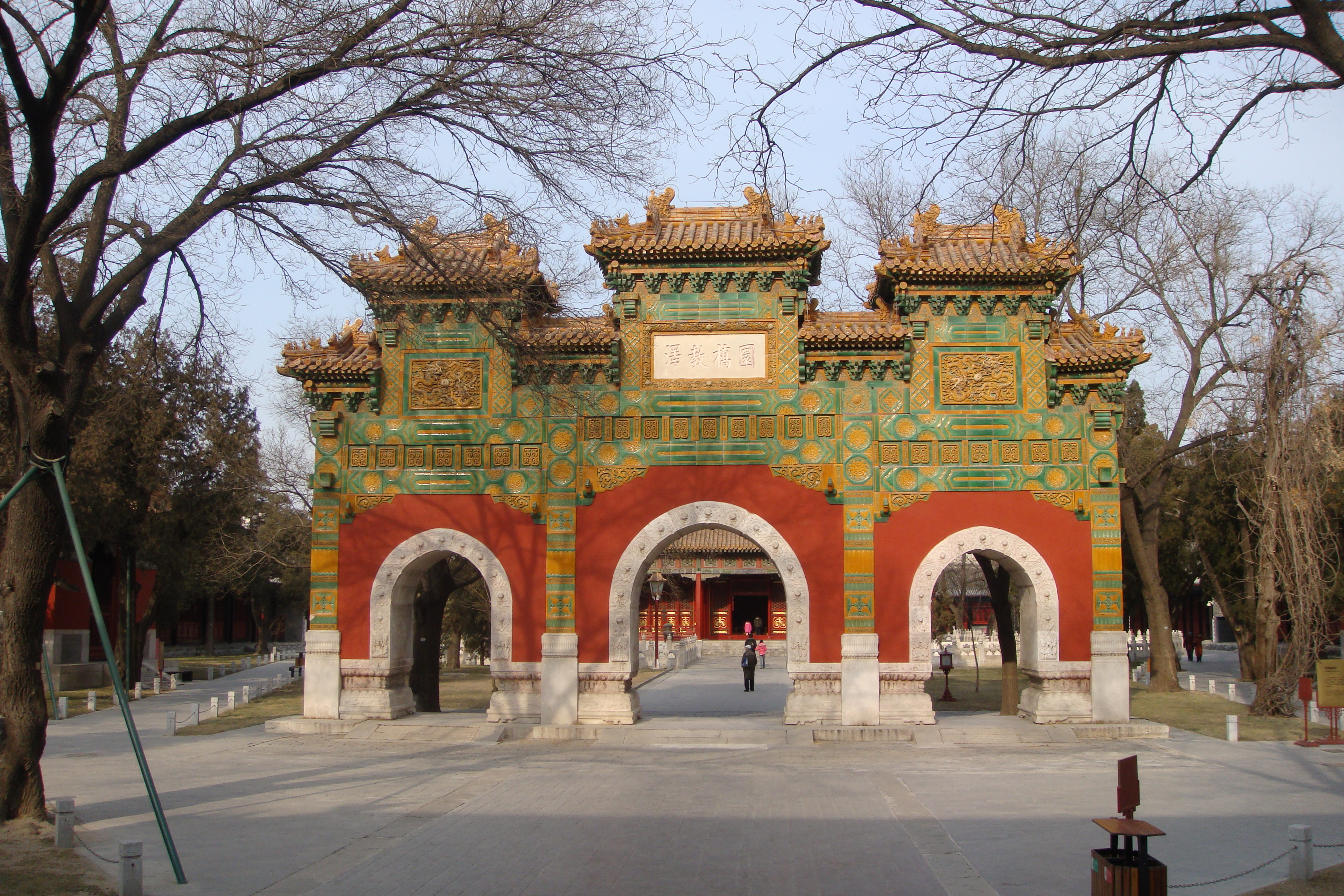
Beijing Guozijian
There is a building in Beijing where emperors went to school -- or rather, where they went to teach. At the Beijing Guozijian, the Imperial Academy, the Son of Heaven would periodically appear before hundreds or thousands of students to read and expound upon the Confucian classics. It was simultaneously an act of scholarship and of state theater, the ruler demonstrating that he understood the moral foundations on which his authority rested. First built in 1306 during the Yuan dynasty and reconstructed on a grand scale during the Ming, the Guozijian served as China's national university through three dynasties until it was shut down in 1905 -- its educational functions absorbed by what is now Peking University.
Where the Emperor Lectured
The guozijian system had roots stretching back to the Jin dynasty, when similar institutions were established to educate imperial princes. Over centuries, the system expanded to become the pinnacle of China's traditional educational hierarchy, a place where the empire's most promising scholars studied the Confucian classics in preparation for the imperial examinations that governed access to government service. Students, called Jiansheng, came from across the empire. The administrative hierarchy was precise: a Chief, a Dean of Studies, and a Proctor oversaw operations. But the institution's most dramatic moments came when the emperor himself arrived to lecture. These were carefully staged events, designed to demonstrate that the ruler was not merely a wielder of military power but a scholar-king steeped in the moral philosophy that legitimized his rule.
Between Temple and Academy
The Guozijian's location was no accident. Chinese tradition dictated that the temple should stand on the "left" and the school on the "right," and accordingly the academy sits adjacent to the Beijing Confucius Temple, the second largest in all of China. The Yonghegong, Beijing's largest Tibetan Buddhist temple, lies just to the east, creating a remarkable concentration of spiritual and intellectual architecture along Guozijian Street. The whole complex faces south, as cosmic orientation demanded, covering more than 10,000 square meters. Along its central axis stand the Jixian Gate, the Taixue Gate, the distinctive Glazed Archway -- one of the few structures in Beijing permitted to use imperial yellow and green glazed tiles -- the Biyong hall, and the Yiluntang, flanked symmetrically by six halls on either side.
The Biyong at the Center
At the heart of the complex stands the Biyong Palace, a square building surrounded on all sides by a circular moat, its design embodying the ancient Chinese cosmological principle that heaven is round and earth is square. This was the ceremonial hall where the emperor delivered his lectures on the classics. The building's form was meant to suggest that the sovereign's wisdom, like water, flowed in all directions from the center of the world. The palace's interior contains an imperial throne from which the lectures were delivered, and the surrounding halls once housed the traditional instruments of Chinese education -- texts, brushes, and the apparatus of a scholarship system that endured for centuries with remarkably little fundamental change.
The End of the Old Learning
The Guozijian's closure in 1905 came during the convulsions of the late Qing dynasty, as reformers pushed to modernize China's institutions. During the Hundred Days' Reform, the academy's educational and administrative functions were transferred to the Imperial University, which would eventually become Peking University -- one of China's most prestigious institutions and, in a direct sense, the Guozijian's descendant. The academy buildings survived because they were preserved as a museum, declared a nationally protected historical and cultural site. Today visitors walk through the same gates that scholars once entered with the ambition of passing the imperial examinations and securing government appointments. The Confucian texts that formed the core curriculum are no longer the path to power, but the buildings that housed their study remain -- a physical record of a meritocratic ideal, however imperfect in practice, that shaped Chinese governance for over a thousand years.
From the Air
Located at 39.95°N, 116.41°E on Guozijian Street in Dongcheng District, central Beijing. The complex sits between the Beijing Confucius Temple and the Yonghegong Lama Temple, both visible from the air. Best viewed at 2,000-3,000 feet AGL. Beijing Capital International Airport (ZBAA/PEK) is 13 nm to the northeast.