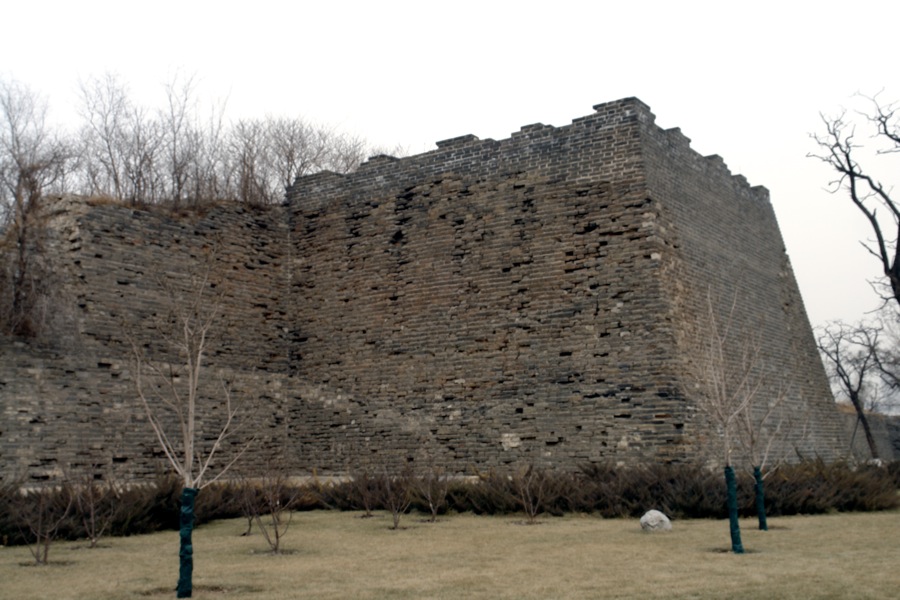
Beijing Ming City Wall Ruins Park
Most of Beijing's Ming dynasty city walls are gone, demolished during the twentieth century to make way for the ring roads that now trace their former path. But at the southeast corner of the old inner city, a 1.5-kilometer section survives, its rammed-earth core lined with bricks that are partly original and partly donated by Beijing residents who kept Ming-era bricks in their homes for generations. The Beijing Ming City Wall Ruins Park preserves this fragment and the massive Southeast Corner Tower, a fortification built between 1436 and 1439 that bears the literal scars of foreign invasion.
Six Centuries of Standing
Beijing's inner city wall was constructed in 1419 during the Ming dynasty, enclosing the capital with fortifications that stood over 550 years. The wall was not a simple barrier. At its foundation, it measured 19.8 meters thick; at the top, 16 meters. Brick lined the exterior, and rammed earth filled the interior, a construction method that gave the wall both mass and resilience. The Southeast Corner Tower, built from 1436 to 1439 at the junction of the southern and eastern walls, was a major defensive position. Eleven bastions punctuated the southern wall, two more guarded the shorter eastern section. The tower's sheer bulk, its multiple stories of arrow loops and defensive platforms, reflected a dynasty that took the possibility of siege seriously.
Invaders Leave Their Mark
In 1900, the Boxer Rebellion brought foreign armies to Beijing's gates. The Eight-Nation Alliance attacked and captured the Southeast Corner Tower, and soldiers from the invading forces carved graffiti into the interior walls, marks that survive today as a preserved historical record inside the tower. The restoration that followed in 1983 turned the tower into a tourist site and museum, with exhibits documenting the history of the city's Ming-era fortifications. For over two decades, the Red Gate Gallery operated inside the tower as a non-profit contemporary art space before relocating to the 798 Art Zone. The juxtaposition was striking: Boxer-era graffiti and twenty-first-century installation art coexisting within the same 550-year-old walls.
Building the Park from Memory
The park around the wall ruins opened in September 2003, after a construction process that balanced preservation with urban renewal. Homes that had grown up against the wall over the centuries were demolished, though large trees from their courtyards were saved. The most remarkable element of the restoration was the brick drive: to maintain historical integrity, authorities solicited donations of original Ming-era bricks from city residents. One-fifth of the two million bricks used in the restoration, roughly 400,000, are genuine Ming-dynasty material. The park also includes a restored signal house from the Beijing-Fengtian Railway, built in 1901, adding a layer of early-twentieth-century transportation history to the site.
Neighborhood Commons
The park covers 15.5 hectares, with 3.3 hectares of fortifications and 12.2 hectares of green space. During restoration, some 400 trees, 6,000 bushes, and 100,000 flowering plants were planted. In 2009, about 600 old trees on the grounds were adopted by social organizations that pledged to fund their care. The park sits about three kilometers southeast of Tiananmen Square in Dongcheng District, just inside the Second Ring Road. The Beijing Ancient Observatory, built atop another section of the eastern city wall at Jianguomen, is a short walk north. Residents from surrounding neighborhoods use the green space for morning exercises and dog walking, an everyday domesticity playing out at the foot of walls that once defined the boundary between the imperial capital and everything beyond it.
From the Air
Located at 39.90°N, 116.43°E in southeastern central Beijing, just inside the Second Ring Road in Dongcheng District. The park appears as a linear green space running east-west, with the distinctive Southeast Corner Tower at the junction. Nearest airport: Beijing Capital International (ZBAA), approximately 22 km northeast. Beijing Railway Station sits immediately north of the park.