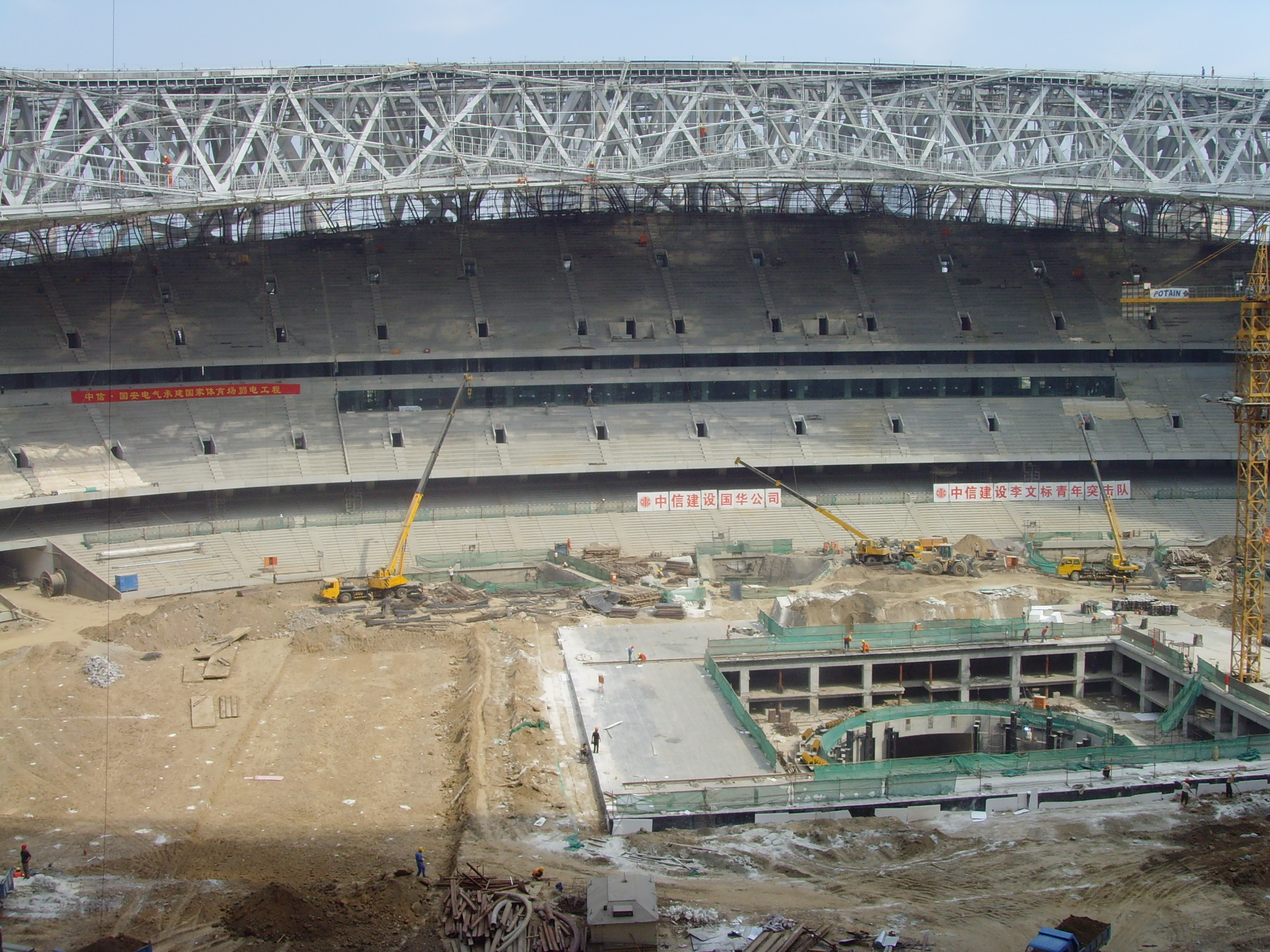
Beijing National Stadium
The architects studied Chinese ceramics. That was the starting point -- not sports engineering or crowd flow or sightline optimization, but the textures and patterns of ancient pottery. When the Swiss firm Herzog and de Meuron sat down with Chinese architect Li Xinggang in Basel in 2003 to design Beijing's Olympic stadium, they wanted something that had never been built before. What emerged was a structure of interlocking steel beams that appear random but are nearly symmetrical, hiding their structural supports within the tangle. The nickname came from the architects themselves, though they later insisted "there should be many ways of perceiving a building." The rest of the world settled on one: the Bird's Nest.
Building the Nest
The stadium's genesis was a bidding process launched in 2001, before Beijing had even been awarded the 2008 Summer Olympics. Thirteen final submissions competed under demanding requirements: the design had to work for post-Olympic use, include a retractable roof, and keep maintenance costs low. Li Xinggang recalled placing his model at the exhibition hall, seeing the rival entries, and thinking, "We will win this." He was right. But the winning design evolved significantly. The retractable roof -- originally a practical requirement -- was eventually removed from the plans, but not before its supports had inspired the building's most recognizable feature: the lattice of exposed steel beams wrapping the entire structure. All 121,000 tons of steel were manufactured in China. At peak construction, 17,000 workers labored on the site. Ground was broken on December 24, 2003, and the stadium officially opened on June 28, 2008.
The Artist Who Walked Away
Leading Chinese artist Ai Weiwei served as artistic consultant on the project, contributing to the stadium's conception as a work of art rather than merely a sports venue. But Ai's relationship with the Bird's Nest -- and with the Olympics it hosted -- became complicated. Before the 2008 Games opened, Ai publicly distanced himself from the event, criticizing what he saw as the Chinese government's use of the Olympics as political propaganda. He refused to attend the opening ceremony. The stadium he had helped conceive became, for Ai, a symbol of the contradictions he spent his career exposing: beauty in service of power, architecture as spectacle, a building designed for people but controlled by the state.
Two Olympics, One Stadium
The Bird's Nest achieved a distinction no other stadium can claim when it hosted the opening and closing ceremonies of the 2022 Winter Olympics, making it the only venue to have served as the ceremonial heart of both Summer and Winter Games. The 2008 ceremony, remembered for 2,008 synchronized drummers and a massive scroll painting, contrasted sharply with the 2022 version -- smaller in scale, shaped by pandemic restrictions, but powered by technology unavailable fourteen years earlier, including a 10,552-square-meter LED floor that turned the stadium into an immersive digital canvas. Between the two Olympics, the stadium served as a tourist attraction, drawing 20,000 to 30,000 visitors daily at 50 yuan admission. It hosted the 2015 World Championships in Athletics, the 2017 League of Legends World Championship Finals, Italian Super Cup matches, and concerts, though it struggled to attract the regular sporting events its designers had envisioned.
Engineering Beneath the Surface
The stadium's innovations extended beyond its famous exterior. The eastern and western stands were built higher than the northern and southern ones to improve sightlines -- a subtle asymmetry invisible from outside. A 24-hour rainwater collection system purifies and recirculates water throughout the complex. Pipes beneath the playing surface gather geothermal heat in winter and disperse it in summer, reducing energy costs. The stadium covers 204,000 square meters and originally held 91,000 spectators with temporary seating, reduced to 80,000 for permanent use. The US$428 million price tag made it one of the most expensive stadiums ever built, but the structure proved durable enough to serve two very different Olympic events fourteen years apart.
Between Monument and White Elephant
The Bird's Nest was intended as a Monument of New China, and in some respects it has succeeded. The building is an architectural icon, instantly recognizable worldwide, its image on countless postcards and guidebooks. But its post-Olympic life has been uneasy. The Beijing Guo'an football club considered moving there but declined, unwilling to fill even a fraction of 80,000 seats for matches drawing 10,000 fans. By 2013, visitors noted the stadium appeared rusty and neglected. Maintenance costs run approximately $9 million per year. Plans for an anchoring shopping and entertainment complex have been discussed since 2009 but have moved slowly. The Bird's Nest remains profitable -- tourism alone generates substantial revenue -- but the gap between the building's ambitions and its daily reality reflects a tension common to Olympic architecture: structures built for singular moments struggling to find purpose in ordinary time.
From the Air
Located at 39.99°N, 116.39°E at the Olympic Green in Chaoyang District, northern Beijing. The stadium's distinctive lattice-steel exterior is unmistakable from the air, surrounded by other Olympic venues including the Water Cube and the Ice Ribbon. Best viewed at 2,000-5,000 feet AGL. Beijing Capital International Airport (ZBAA/PEK) is 13 nm to the northeast.