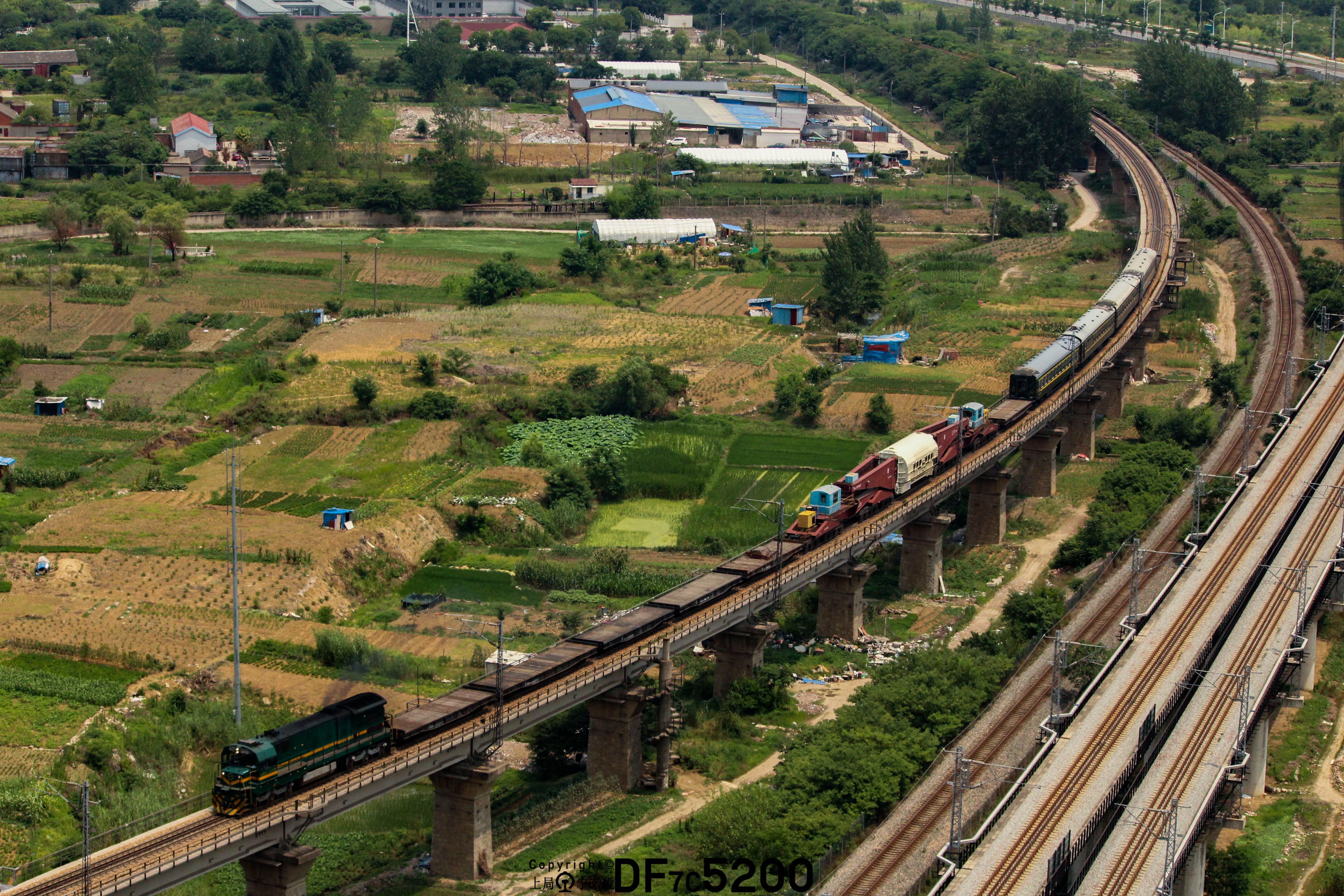
Beijing-Shanghai High-Speed Railway
In 1933, traveling by train from Beijing to Shanghai took forty-four hours. Passengers had to disembark at Pukou, drag their luggage onto a ferry named Kuaijie, cross the Yangtze River, and board a different train on the other side. Today, a CRH380 bullet train covers the same 1,318 kilometers in four hours and eighteen minutes, gliding across the Danyang-Kunshan Grand Bridge, the longest bridge on Earth, at 350 kilometers per hour. The Beijing-Shanghai high-speed railway is not just a feat of engineering. It is the story of a century-long compression of distance between China's two most important cities.
A Century of Shrinking Time
Beijing and Shanghai were not connected by rail until 1912, when the Jinpu railway linked Tianjin to Pukou. Early travelers endured a river crossing by ferry that added hours to the journey. A train ferry introduced in 1933 let passengers stay aboard, and the Nanjing Yangtze River Bridge, completed in 1968, finally made the crossing continuous. Each decade brought incremental improvements: diesel locomotives in the 1970s, electrification in 2006, and CRH bullet trains in 2007. The journey shrank from forty-four hours to thirty-six, then twenty-one, then twelve, then under ten. But the conventional line had reached its limits. A quarter of China's population lived along this corridor, and the old railway was buckling under the weight of demand.
Building at an Impossible Scale
Construction began on April 18, 2008, employing more than 130,000 workers at its peak. The numbers are staggering: the project consumed twice as much concrete as the Three Gorges Dam and 120 times the steel used in the Beijing National Stadium. Engineers laid 1,268 kilometers of ballastless track, built 244 bridges and 22 tunnels, and installed 321 seismic sensors, 167 windspeed monitors, and 50 rainfall gauges along the route. The most daunting challenge came in the Yangtze Delta, where the soft, marshy soil required innovative foundation techniques to support trains traveling at extreme speeds. During testing, a CRH380AL trainset reached 486.1 kilometers per hour on the Zaozhuang-to-Bengbu section, and a modified CRH380BL hit 487.3 shortly after.
The Race Against Airlines
When tickets went on sale at nine in the morning on June 24, 2011, they sold out within an hour. Airlines responded by slashing Beijing-Shanghai fares by up to 65 percent. Economy air tickets dropped 52 percent almost overnight. But the competition cut both ways: in the railway's second week of operation, three malfunctions in four days sent passengers scrambling back to airports. By August, 54 CRH380BL trains had been recalled for equipment problems. Airline prices rebounded as confidence in the new service wavered. The Ministry of Railways apologized, acknowledging that only 85.6 percent of trains had arrived on time in the first two weeks. It was a humbling start for a line designed to be the world's best.
The Most Profitable Track on Earth
The rocky opening gave way to sustained success. By 2013, the line had carried 100 million passengers. By 2017, daily ridership exceeded 500,000, and on September 21 of that year, operating speeds were restored to 350 kilometers per hour with the introduction of the China Standardized EMU. In 2019, the railway transported over 210 million passengers, more than the entire French TGV or German Intercity Express networks, and posted a net profit of 11.9 billion yuan, roughly 1.86 billion US dollars. In 2020, the operating company became the first high-speed rail operator in China to go public on the Shanghai Stock Exchange. The total investment of 217.6 billion yuan had produced the most profitable railway line in the world.
From the Air
The railway runs 1,318 kilometers from Beijing South station (39.87N, 116.38E) to Shanghai Hongqiao station (31.19N, 121.32E), passing through Tianjin, Jinan, and Nanjing. The article's coordinates (35.53N, 118.80E) place it near the midpoint in Shandong Province. The Danyang-Kunshan Grand Bridge, the world's longest bridge, is visible on the Shanghai-Nanjing section. Nearest airports along the route include ZBAA (Beijing Capital), ZSSS (Shanghai Hongqiao), ZSJN (Jinan Yaoqiang), and ZSNJ (Nanjing Lukou). The elevated track is visible from 10,000 feet as a continuous line cutting through the landscape.