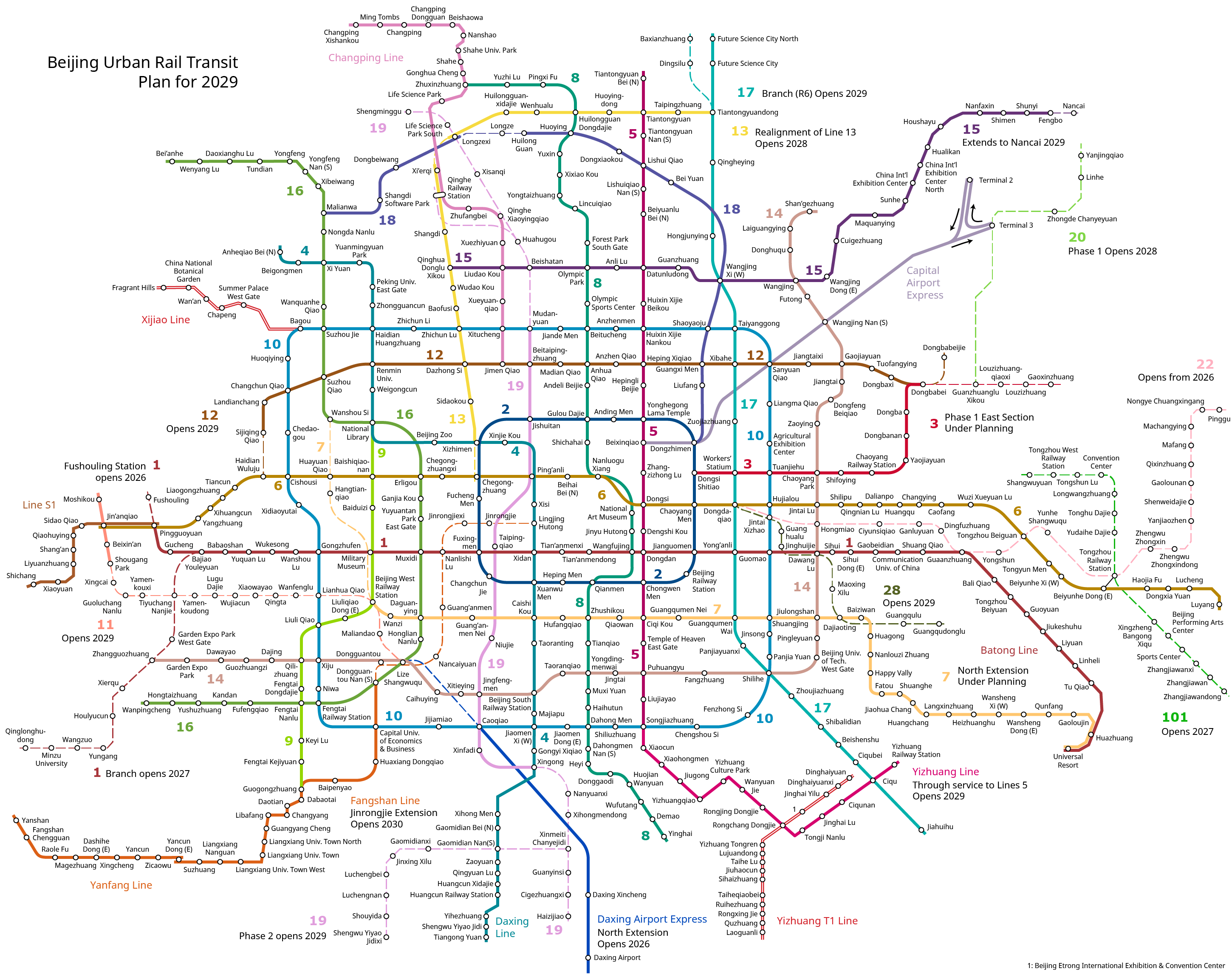
Beijing Subway
In 1969, at the height of Cold War tensions, Beijing opened a subway line that civilians were not allowed to ride. Built primarily for military evacuation and restricted to government and military personnel for over a decade, Line 1 ran beneath Chang'an Avenue in near secrecy. Today, the system it spawned carries more than ten million passengers on an average weekday across more than 800 kilometers of track. No urban rail network on Earth has grown faster.
Born Underground, Kept Secret
China's first subway was as much a Cold War bunker project as a transit system. Construction began in 1965 with technical assistance from the Soviet Union, though that partnership frayed as Sino-Soviet relations deteriorated. The initial 23-kilometer line opened on October 1, 1969, running from Beijing Railway Station westward beneath the capital's most politically significant boulevard. For its first twelve years, the subway required a letter of introduction to ride. It was not until 1981 that ordinary citizens could buy a ticket and board a train. By then, Line 1 had been operating for over a decade in a city of millions who had never set foot inside it.
The Olympic Surge
Beijing's selection to host the 2008 Summer Olympics transformed the subway from a modest two-line system into something approaching a modern metro. Between 2002 and 2008, the network expanded rapidly, adding Lines 5, 10, and the Airport Express, among others. The city committed to having eight lines operational in time for the opening ceremony. Construction crews worked in overlapping shifts, and entire neighborhoods were disrupted by the tunneling. When the Games began in August 2008, Beijing's subway had tripled in length compared to just six years earlier. The expansion did not stop when the athletes went home. If anything, the Olympics proved what was possible, and the pace accelerated.
A City Reshaped by Rail
By the mid-2020s, the Beijing Subway comprised more than 27 lines and over 490 stations, making it one of the longest metro systems in the world. The network's reach has fundamentally altered how the city functions. Neighborhoods that were once considered remote became commuter suburbs almost overnight when a new station opened. Property values along announced lines surged before construction even began. The loop of Line 10, completed in 2013 at 57 kilometers, encircles the city's core the way the old ring roads do at street level. Line 6, stretching 55 kilometers east to west, provides a second spine beneath the city parallel to Line 1. The sheer density of stations in central Beijing means that few residents live more than a short walk from a platform.
Moving Ten Million a Day
The numbers are staggering. On peak days, the system has carried over twelve million trips in a single twenty-four-hour period. Annual ridership regularly exceeds three billion. During morning rush hour, trains on the busiest lines run at intervals of under two minutes, and platform screen doors -- installed across the system -- open and close with mechanical precision. The flat fare that once made the system one of the cheapest in the world has given way to distance-based pricing, but a cross-city ride still costs a fraction of what a taxi would charge. For a metropolis of over twenty million people spread across a vast plain, the subway is not a convenience. It is the circulatory system.
From the Air
The Beijing Subway network spans the city beneath you, roughly 39.9°N, 116.4°E. The system is invisible from the air, but its effects are visible in the dense urban development radiating along its corridors. Nearest major airport is Beijing Capital International (ZBAA/PEK), connected to the network by the Airport Express line. Beijing Daxing International (ZBAD/PKX) is served by the Daxing Airport Express.